New technology captures eating habits in real time to advance nutrition research
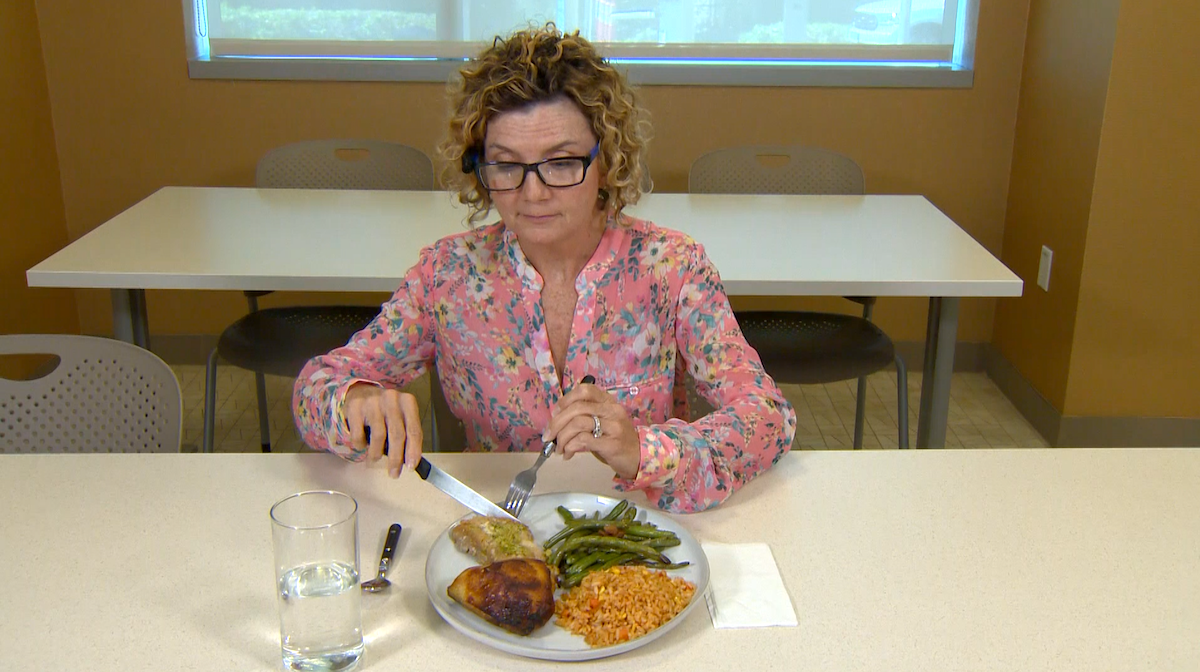
A SENSE study participant prepares to eat a meal while wearing an AIM-2 camera sensor on her eyeglasses. The camera records the meal being eaten while she chews.(Photo provided)
Written by: Tim Brouk, tbrouk@purdue.edu
New nutrition AI tools developed by Purdue University researchers could improve how scientists measure diet by capturing eating behaviors in real time instead of relying solely on participants’ recollections. The system combines a smartphone app, the mobile Food Record (mFR) and a wearable camera sensor (AIM-2) mounted on eyeglasses to document meals with minimal effort from participants.
Heather Eicher-Miller, professor of nutrition science, partnered with Fengqing Maggie Zhu, associate professor of electrical and computer engineering, to use these mobile and wearable technologies combined with advanced AI algorithms to conduct the SENSE (Sensor-based Estimation of Nutrition and Surrounding Environment) study. Participants take pictures of their meals before and after eating while the AIM-2 sensor automatically captures images during the meal.

Heather Eicher-Miller
“Traditional methods for monitoring food intake — including food diaries and 24-hour recalls — are inherently retrospective,” Zhu said. “They impose substantial cognitive burdens, leading to fatigue, noncompliance and systematic underreporting. More critically, retrospective tools provide limited support for in-the-moment dietary decision-making. They typically summarize eating behavior after the relevant episode has passed, limiting their ability to support timely, context-sensitive intervention.”
Eicher-Miller continued, “Generally, there’s going to be underreporting of calories. People misreport on the amounts and types of foods, sometimes overreporting the amount and sometimes underreporting, but the way it usually shakes out is that underreporting of calories is the biggest problem, probably by about 5% to 15%, but it could be more than that.”
The researchers have tested the app with 200 adults ages 18 and older. Most are Purdue students and members of the Greater Lafayette community.
The research team disclosed SENSE to the Purdue Innovates Office of Technology Commercialization. OTC has received two patents and applied for a third to protect the intellectual property. This work is funded by grants from the National Institutes of Health and National Science Foundation.
Food environments and interventions


Eicher-Miller noted behavioral aspects to the SENSE work. She is interested in the influence that the environment has on meals and snacks. For example, how and what does the participant eat at a restaurant compared to at home? And if they are eating at home, how does the participant eat with the family or friends versus alone and in front of a television? If the participant ate healthier one day than on others, what circumstances contributed to those healthier choices and where were they when they chose healthier options?
During meals, SENSE also asks participants whether they would consider healthier substitutions or smaller portions, allowing researchers to study when people are most receptive to dietary guidance. The participant’s response helps the researchers start to map out how willing they would be to change their diet to follow nutritional guidance.
“Maybe people are more open to making healthier choices at a snack rather than a meal or when they’re eating in a particular location, maybe they’re more willing to change when they’re at home as opposed to being in a fast-food restaurant,” Eicher-Miller said.
Making SENSE
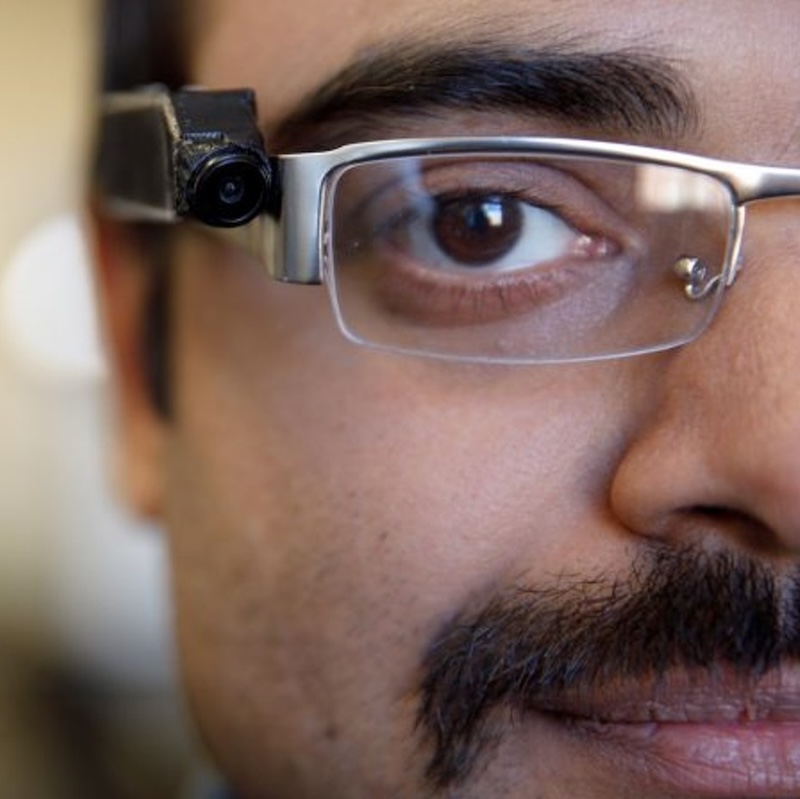
A SENSE participant shows his AIM-2 camera sensor, which is ready to record him eating a meal.(Photo provided)
The SENSE team has grown since the project was launched in 2022 and participant recruitment began in 2025. The team is joined by the lab of Edward Sazonov, an engineer from the University of Alabama who developed the AIM-2 sensor and J. Graham Thomas, a behavioral scientist from Brown University.
The AIM-2 sensor is activated by the participant’s chewing. The sensor then turns on the camera component to capture what is going on during eating episodes. The camera records images within the participant’s field of vision as they chew.
The participants still fill out traditional, 30–45-minute dietary assessments at the end of each day. Those assessments are cross-referenced with the images captured by the tiny camera sensor on their glasses. The participants also use a smartphone app to take images of their food before they eat it and afterward. The wearable sensor grabs everything in-between.
The mFR is part of the Technology Assisted Dietary Assessment (TADA) system, developed by the Video and Image Processing Laboratory at the Purdue School of Electrical and Computer Engineering. It features an image-based mobile Food Record application with image analysis tools that draw on computer vision and machine learning techniques to identify and quantify food intakes from meal images. Extensive developmental research of the TADA system has been achieved using controlled feeding and community-dwelling studies.
“The app prioritizes verifiable algorithms that undergo rigorous peer review; curated, diverse native training datasets; and clear, calculated variance bounds for nutritional outputs supported by nutrition researchers,” Zhu said.
Current and future studies
If the SENSE pilot study can accurately capture both what people eat and the circumstances surrounding those choices, researchers hope it could eventually help develop more personalized nutrition guidance and interventions.
Eicher-Miller and her team are currently sifting through data collected from the participants’ eating occasions. They are first looking at the overall diet quality and how it compares to the dietary patterns outlined in the Dietary Guidelines for Americans. Participants that match the guidelines get a score of 100. None of the participants so far have gotten close to that, Eicher-Miller reported.
“Most people are getting a score somewhere between 40 and 60,” she said. “U.S. diets are not really amazing. But we can score each person’s diet quality and then we can determine their receptivity (from interventions), or how willing they would be to change their diet during that day. So, we have a way of finding out if their diet quality might have some relationship to how receptive they are to making a change to their diet.
“We hope that our work on learning more about the context of eating, in particular the circumstances when people may be more open or receptive to dietary interventions, will help us to make more effective interventions that are tailored to individuals and that help them to improve their diets.”
Discover more from News | College of Health and Human Sciences
Subscribe to get the latest posts sent to your email.