Purdue Faculty in Residence uses public health background to help Boilermakers thrive in residential life
Written By: Rebecca Hoffa, rhoffa@purdue.edu
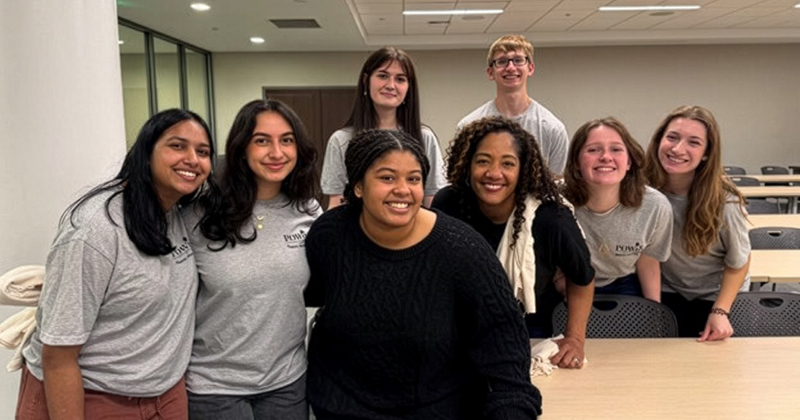
Kayce Solari Williams always wanted to be a resident assistant (RA) when she was an undergraduate student at Texas A&M University but graduating early prevented her from pursuing that dream. Now a clinical associate professor in the Purdue University Department of Public Health, Solari Williams is living out a version of her dream of providing support for residential life as the university’s Amelia Earhart Faculty in Residence.
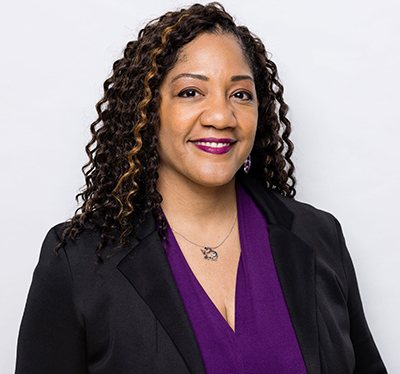
For Solari Williams, who is entering her second year as Faculty in Residence living alongside the students in Meredith South Residence Hall, the Faculty in Residence program is all about community-building, learning and balancing academic success with personal well-being. During her first year in the position, she focused on both spontaneous moments of connection through office hours, informal conversations and gatherings in common spaces as well as large-scale programming in the residence halls.
“Seeing what the students experience, it helps me foster those kinds of environments for them to feel engaged and connected to campus,” Solari Williams said. “It’s also a little bit ingrained in how I’m trained to understand and work in communities. That’s how you impact a community is to really, truly understand it. What better way to understand it than live in it?”
Solari Williams has gained a reputation in the residence halls for her creative programming, which uses techniques from her Promoting Optimal Wellness in Research (POWiR) Lab in the College of Health and Human Sciences to emphasize total wellness, movement and memory-making.
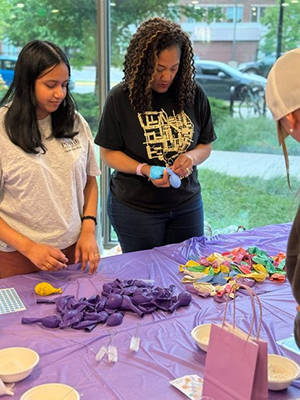
students at the Day of Care event. (Photo
provided)
One of Solari Williams’ most successful events has been the Day of Care (DoC), which has drawn more than 150 students each of the three times she’s implemented it. The event pulls together a variety of stations centered on self-care, including smoothie-making; stretching and movement activities; coloring stations; and DIY stress balls, body scrubs and slime. After the event’s success, Solari Williams has been able to translate the DoC to other professional organizations in the public health side of her role and will be translating it to the Indianapolis location as well in the fall.
“Making giant leaps — that’s our Purdue ‘thing,’” Solari Williams said. “But in order to take a leap, you have to take the steps to start on one foot and end on another. So, when we’re talking about developing you as a professional, we also need to look at who you are as a person. You can’t forget the person side because that person is along for the ride on the professional side. You can’t construct anything, operate on anything, teach anything, innovate or create anything if you’re working on fumes. It is reminding the students to take care of themselves because you’re nothing to someone else if can’t be something to yourself first.”
While programming, office hours and each opportunity to connect with students throughout the residence hall has been meaningful, Solari Williams noted one moment has really driven home the impact of her role.
She recalled one student having just received the news that her parents couldn’t afford to bring her home for the summer, and she appeared to be struggling emotionally at the front desk. The student, who has autism spectrum disorder, had previously taught Solari Williams a calming technique that enabled Solari Williams to help the student ground herself in the moment and let the two of them talk about making a plan. One week later, Solari Williams saw the student in much better spirits after getting everything in order.
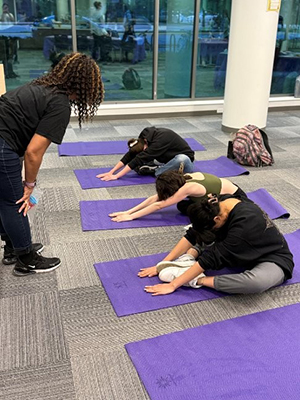
during the Day of Care event. (Photo
provided)
“That moment right there — I would have never planned for that to be an impact that I made with any of the well-being stuff I’ve done,” Solari Williams said. “You don’t anticipate that stuff. I am a trained behavioral analyst, but no book, degree or license can compare to seeing those real-time moments happen. I’ve seen her around this summer, just thriving. I’ve had some really, really cool moments, but that’s one I’m not going to forget.”
For the 2026-27 academic year, Solari Williams is looking forward to doing all of the things time didn’t allow her to accomplish in her first year. This includes taking students in the residence hall — which she will be testing with leadership and the resident assistants — to some of Purdue’s sporting events, such as volleyball and softball, to emphasize the fun side of college living alongside the academic rigor Purdue is known for.
“I’ve been trying to find those moments where students are connected,” Solari Williams said. “I just think about what that adds to their remembering of their time at Purdue and what that adds to the story they may tell.”
After being part of the program, Solari Williams has seen its value, and she said she hopes it can expand to include even more faculty perspectives in the future.
“I’m one person, and I can tell you the things that I’ve been a part of, seen happen and had shared about my being in this space and what it means has been really amazing,” Solari Williams said. “Part of the college experience is learning how to live as a productive, respectful member of society. What better way to help in learning that than to see a professional model of what that looks like in real time, in a safe space?”
Discover more from News | College of Health and Human Sciences
Subscribe to get the latest posts sent to your email.