Purdue Public Health and Pharmacy combine for study on urban free clinic vaccination needs, perceptions
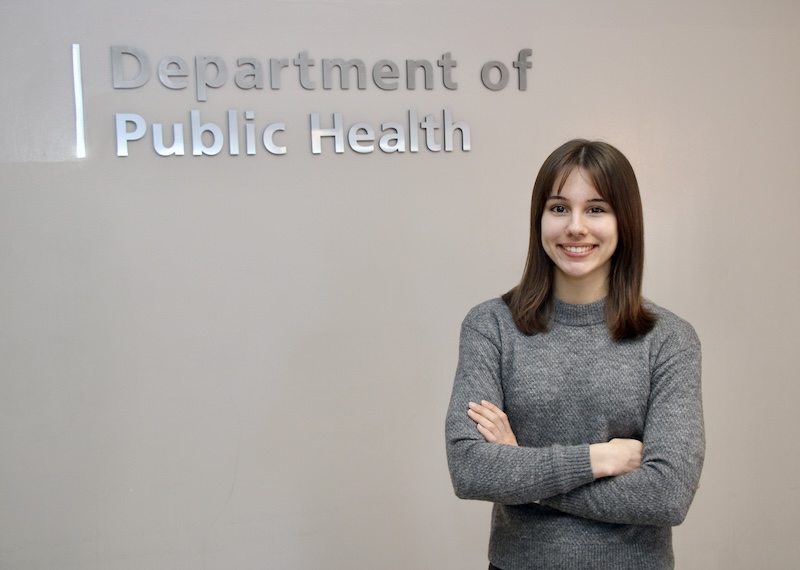
With designs on medical school, Purdue University public health sophomore Hannah Hampson teamed up with researchers from the Purdue College of Pharmacy to study vaccination needs for an urban free clinic in Indianapolis. She and her team found most patients want vaccines — especially for the flu, shingles and pneumococcal disease.(Tim Brouk)
Written by: Tim Brouk, tbrouk@purdue.edu
When the availability and opinions of vaccines for adults at a large city’s free clinic were questioned, Hannah Hampson injected herself into finding out why.
The sophomore studying in the Purdue University Department of Public Health joined researchers from the College of Pharmacy for a snapshot study, “Adult Immunization Needs and Perceptions Among Patients at a Free Medical Clinic in Indianapolis,” to see if there was a need for immunizations among clinic patients. They also polled patients’ opinions on the vaccines and what kind of barriers, if any, they experienced when trying to get immunized from the flu, shingles, pneumococcal disease and other infections. They also questioned if the free clinic was needed in that part of the city. Spoiler alert: It was.
Conducted from May to August 2025, study participants arrived for care at Gennesaret Free Clinic located inside a St. Vincent de Paul food pantry just north of downtown Indianapolis. Hampson interviewed 18 of the participants and collected their data, often through an interpreter. Most were older adults.
“The study looked at need, so looking at what people’s past vaccine history was to isolate what vaccinations they might be eligible for because the clinic was considering bringing vaccines to that site,” Hampson said. “So, we were seeing if there was a need, and if so, which vaccines would be most helpful to have?”
Most of Hampson’s participants were without health insurance, which emphasized the importance of a well-stocked free clinic in Indianapolis and cities like it. She reported some vaccine hesitancy, mainly centered around side effects — real or perceived. The undergraduate researcher also learned that cost, lack of transportation and knowledge about the vaccines themselves were significant hindrances for her study participants.
The results of the study showed free clinics are vital to an urban community, and their patients want to be immunized.
“When we looked at perceptions of vaccines and how people thought about immunizations, it was surprising that overall, people’s perceptions were quite positive, and they wanted these vaccines,” Hampson recalled. “But they had experienced a lot of barriers to actually getting them, or they just didn’t have the knowledge that certain vaccinations were needed, but they did want to seek out that care in the future.”
This research is a part of Purdue’s presidential One Health initiative that involves research at the intersection of human, animal and plant health and well-being.
Pre-med experience
Hampson said her post-Purdue goal is medical school, and the free clinic pharmaceutical research project would be a beneficial experience toward a medical career. In addition to practicing clinical medicine, she also wants to conduct research on addressing health disparities within infectious disease.
“I thought it was a really great experience to get to see firsthand how a pharmacist handles certain conversations and does their work,” Hampson explained. “It also provided an opportunity in the analysis of this research to take multiple lenses on it to look at the healthcare-specific side as well as the social determinants of health for public health.
“As an undergraduate student in public health, there’s sort of a certain perspective you get on a lot of health issues, looking at the community lens and how to affect population change. And I hadn’t really been exposed to pharmacy before. So, it did take me some time to sort of learn the terminology and their process flow and all of that.”
The student’s public health knowledge was also expanded during the research project.
“It’s really interesting that the clinic is actually located inside of a food pantry,” Hampson said, “which is a really great public health method of being able to get people access to multiple resources that they might need at once.”
Pharmacy colleagues
Interning at the Center for Health Excellence, Quality and Innovation (CHEQI), Hampson was given the opportunity to work alongside researchers affiliated with CHEQI. Hampson worked with Ashley Meredith, clinical professor of pharmacy practice, and two Purdue Pharmacy staff members, Adriana Gardner and Kalesia Smith. Meredith was impressed with the young public health researcher and her goal of medical school.
“She was organized. She was on top of things and then constantly volunteering to do more. And this project was a perfect example of that,” Meredith said. “It was not a requirement of her internship. It just was an interest, and she felt she could support it and had the time and capacity to do so. And so, ‘Absolutely. Let’s keep you engaged.’
“I think it gives her a great perspective on sort of looking at how to identify deeper needs within a health care setting. The clinic does a great job with the resources that it has, but maybe it doesn’t fully explore all the risk factors or all the potential preventive measures because they’re more focused on the ‘What do I need to do right now?’ So, I think it will help Hannah have a great perspective on thinking more holistically and comprehensively around what patient care and providing patient care means. I also think from a research side, it gives her a great experience as far as what it’s like to recruit human beings for research and the challenges that may come along with that.”
While the researchers only interviewed patients at one clinic, Meredith believes the findings from the facility on 30th Street in Indianapolis is representative of what other free clinics experience and — more importantly — their patients.
“We found that there is a large need and a desire to get vaccines within the patients that were interviewed,” Meredith said. “Unfortunately, it is pretty cost prohibitive for the clinic to be able to provide the full gamut of vaccines that folks would benefit from. But I think what I have seen is that a more intentional conversation around it and linking to other resources within Indianapolis that can help people get the vaccines that they need.”
Discover more from News | College of Health and Human Sciences
Subscribe to get the latest posts sent to your email.