Purdue Health Sciences researchers investigate harmful airborne dust in swine farrowing rooms
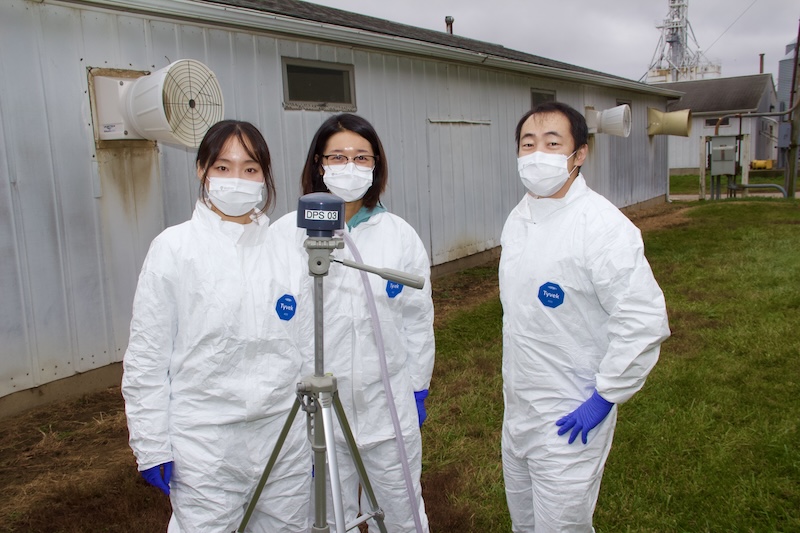
Subin Han, from left, Nara Shin, both PhD students in Purdue University School of Health Sciences; Jae Hong Park, associate professor of health sciences, and their air sampler stand outside of a Purdue swine farrowing room, ready to gather more data from the air around sows and their piglets.(Tim Brouk)
Written by: Tim Brouk, tbrouk@purdue.edu
A Purdue University One Health study will seek healthier conditions for sows and their tiny piglets right after birth.
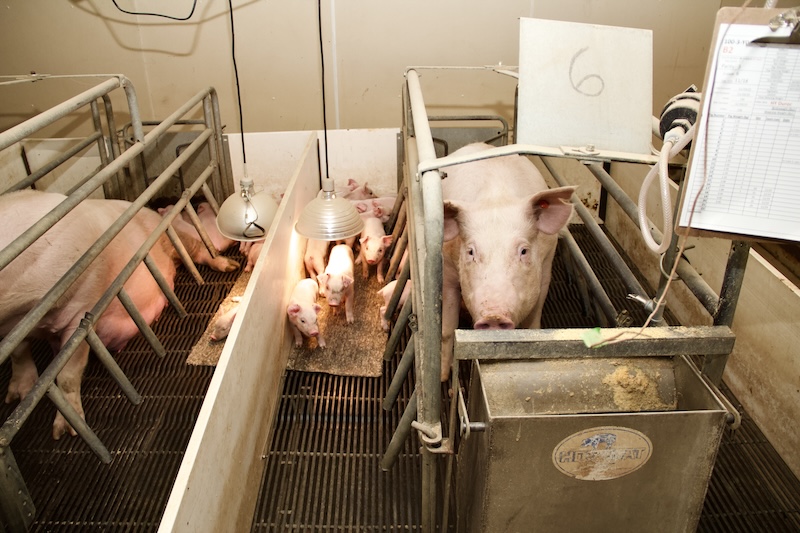
The research project led by Ji-Qin Ni, professor of agriculture and biological engineering, and Brian Richert, associate professor of animal sciences in the Purdue College of Agriculture, tapped the Purdue School of Health Sciences’ Aerosol Research Lab to investigate the dust composition floating in the air of farrowing rooms. Located in hog farms, these rooms house pregnant sows weighing in at about 500 pounds as they give birth and nurse their piglets for the first three weeks of life before the young animals are moved to nursery facilities for weaning.
Jae Hong Park, associate professor of health sciences and principal investigator in the Aerosol Research Lab, and his PhD student Subin Han have supported the project by characterizing particulate matter (PM), including the bioaerosols in the farrowing rooms, and contributing to the development of a PM monitoring station.
Bioaerosols are airborne biological dust that includes bacteria. Bacterial genera commonly reported in hog barn environments include listeria, pseudomonas and bacillus, which originate from manure, feed, soil and resuspended barn dust. While many species within these genera are environmental or opportunistic, they can pose respiratory or systemic health risks to pigs, particularly neonatal piglets with underdeveloped immune systems. Han emphasized that although typical environmental concentrations are not considered hazardous to humans, they remain important for animal health in farrowing environments.
“I expect that there is more risk during the birthing process, and the piglets’ immune systems are weak,” Han said. “The mothers also produce a lot of manure at that time. So, the (farrowing room) is very good for microorganisms to thrive, and bioaerosols can be generated at that time.”
With 4.4 million hogs in Indiana alone and contributing about $17 billion to Indiana’s economy, according to the Indiana State Department of Agriculture, it’s important to keep sows and their wriggly, squealing offspring safe from airborne pathogens by investigating what exactly the pigs are breathing in before implementing safety measures and mitigating equipment.
The study is funded by the Foundation for Food and Agriculture Research and is a part of Purdue’s presidential One Health initiative that focuses on research at the intersection of human, animal and plant health.
Back to the Swine Unit
Park and Han have conducted repeated field visits to the Purdue Animal Sciences Research and Education Center Swine Unit. The Swine Unit allows students to study and work with the animals under real production conditions. It’s also an ideal venue for Park and Han to evaluate air sampling methods in the farrowing rooms.
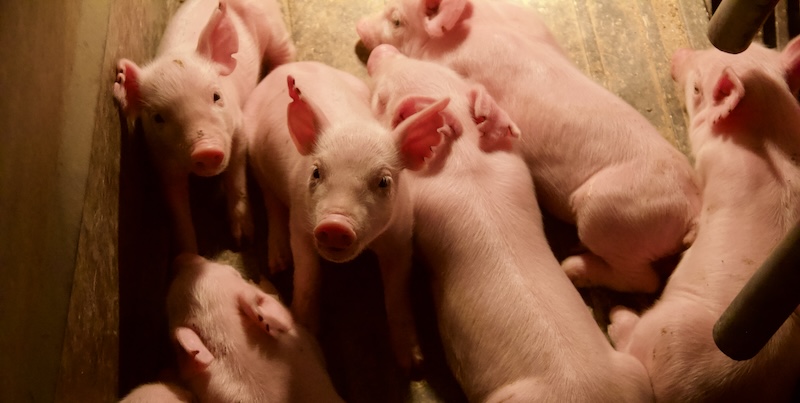
A recent visit found more than 100 pigs in one of the facility’s several farrowing rooms. In this space, 11 sows nursed about 10 piglets each. While mom would get a drink of water or sleep, the piglets would run around in their pens and nap under heat lamps.
“I was very excited when I first visited this site,” Park said. “This is a great location to obtain samples and test our developed instruments. It is unique and convenient for researchers, provides real-world conditions, and gives us a better chance to refine our methods for both accuracy and applicability in farm environments.”
Characterizing swine PM and developing a real-time monitoring system
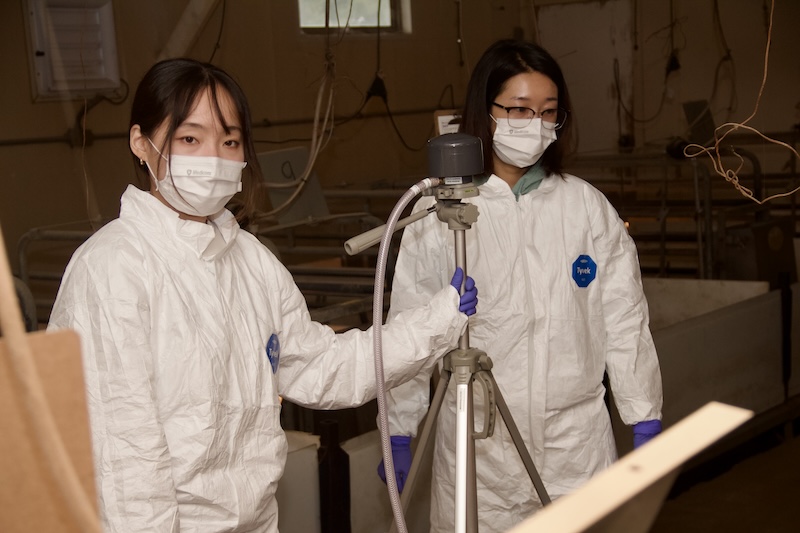
Park and Subin have used a deployable particulate sampler in the room to collect PM on a filter for a 24-hour sampling session so enough is obtained for analysis. After weighing the collected PM, its mass concentration is calculated. To measure bioaerosol size distribution, they have used a viable Andersen cascade impactor, which separates particles by size and captures them directly onto agar plates. After incubation, bacterial colonies grow when viable microorganisms are present. Understanding bioaerosol size is essential for exposure assessment, since smaller particles are more likely to be inhaled deeply into the lungs and pose greater health risks. Subsequent DNA or RNA analyses can identify bacterial species.
Park and Han’s sampling and analytical approaches provide a clearer picture of airborne exposures in farrowing rooms and help guide the development of evidence-based strategies to improve air quality and protect the health of workers, sows and their vulnerable newborn piglets. Most importantly, their work helps collaborators develop a PM monitoring system for the project.
“Currently, the team has tested several PM sensor elements and built prototypes,” Park said. “Dr. Ji-Qin Ni is selecting the sensor elements, and he has identified several promising components that are being integrated with other circuit parts.”
Sensor testing is currently ongoing at a custom-built testing station in Ni’s laboratory. To support this work, Park developed a custom dust aerosolizer that reproduces PM conditions representative of swine barns. This device enables controlled evaluation of sensor performance under realistic livestock conditions.
Ni said Park’s work is essential in establishing the reliable methods to monitor PM in swine barns, which will eventually support healthier breathing conditions for pigs and people.
“The objectives of this research project are to characterize the PM at swine producing facilities and to develop a PM measurement system to quantify PM concentrations in and out of swine barns objectively and reliably,” Ni continued. “The end goal of this research beyond this project is to mitigate PM pollution for sustainable swine production and environmental protection.”
One Health in action: Training the next generation of researchers
In the future, this collaboration between the College of Agriculture and the College of Health and Human Sciences can benefit human health, Han and Park believe.
“By combining engineering, environmental science and occupational health, their work not only advances scientific understanding but also provides practical tools to protect livestock, support farm workers and safeguard surrounding communities,” Park explained. “Together, this research has the potential to improve both animal and human health in real-world farm environments.”
Building on the characterization of swine PM, Han is pursuing the next step. She is developing an air sampler designed to detect viruses in swine barn environments. This technology can identify viruses that pose risks to both animals and humans, including swine influenza, and can be further adapted for poultry and other livestock systems.
Park believes this collaboration project not only advances One Health but also provides valuable learning opportunities for students.
“I have expertise in designing new devices and also air sampling, which I have shared with Subin. She has trained as an industrial hygienist for more than three years and now applies that knowledge to agricultural PM. This project gives her a broader perspective and larger vision. She can explore new applications, develop innovative solutions, and make a greater impact. The experience is helping her grow as a multipurpose researcher,” he said.
Discover more from News | College of Health and Human Sciences
Subscribe to get the latest posts sent to your email.