Undergraduate research, service shape Psychological Sciences junior’s Boilermaker journey
Written By: Rebecca Hoffa, rhoffa@purdue.edu
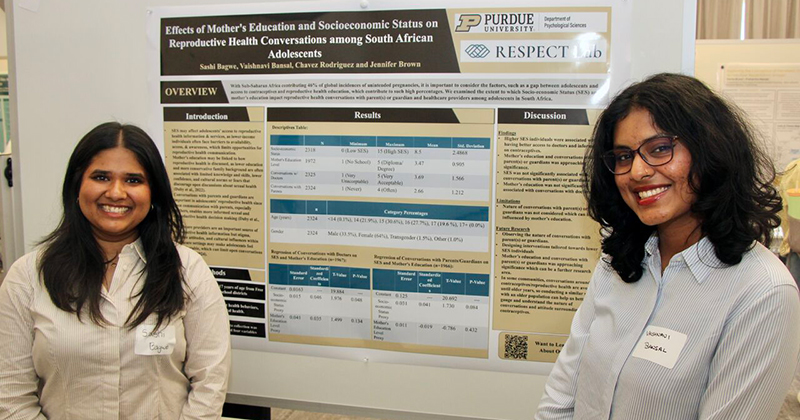
For Vaishnavi Bansal, a junior in the Purdue University Department of Psychological Sciences, a casual conversation with a friend and a chance encounter at a career fair shaped the trajectory of her Purdue College of Health and Human Sciences experience, allowing her to become heavily involved in undergraduate research and opening up the opportunity to be a part of the Purdue Student Security Patrol with the Purdue University Police Department (PUPD).
“(Because of those experiences), I think I feel more confident in my abilities and taking on more challenges,” Bansal said. “The way the courses are designed, they’ve pushed me to work harder and to have a different attitude toward my academics and the opportunities on campus. I never thought I would be a student patroller and do safe walks. I think I’ve grown a lot — that’s given me more confidence, more leadership skills and better time management skills.”
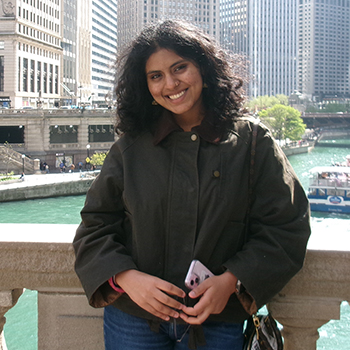
Bansal, who is originally from India, was drawn to research even as a high school student, interested in deepening her knowledge of human thoughts, behaviors and emotions.
“I have always been very fascinated by how people think and how emotions come to be, especially because everything’s so biological, but we still feel all of these things that are so emotional,” Bansal said. “I chose Purdue because there’s a lot of research here on campus. There are a lot of research opportunities, and I like the community here.”
Because of her interest in research, Bansal is currently working in three Psychological Sciences research labs as an undergraduate research assistant: professor Jennifer Brown’s RESPECT Lab, professor Susan South’s Relationships and Mental Health Lab, and professor Dan Foti’s PACER Lab. In total, Bansal has worked in five research labs, having also completed experiences in Department of Human Development and Family Science assistant professor Laura Elenbaas’ Social Development Lab as well as Psychological Sciences professor Thomas Redick’s Purdue Applied Cognition Lab.
For Bansal, the experience in Elenbaas’ Social Development Lab has remained particularly influential as her first-ever research experience. One of Bansal’s friends had worked in the lab and casually mentioned the opportunity to her.
“I’d never done research before that, so it gave me so much space to explore, to see what I’m comfortable with,” Bansal said. “The grad students in the lab and Dr. Elenbaas were so helpful. That’s where I got the most push professionally, just getting to know if research is for me or not. Working with children is a little tougher because of how the studies are designed, so I think once you get experience collecting data with kids, you are able to take on tougher data collections because you’re like, ‘OK, I did it once; I can do it again.’”
As part of her research experience, Bansal has presented her work and received an award, which she said has been one of her proudest accomplishments thus far at Purdue.
“Last fall, during the Purdue Undergraduate Research Symposium, I did a research talk on a project I did with Dr. Elenbaas’ lab, and I received a highest distinction award — that was a big achievement for me,” Bansal said.
One of Bansal’s other standout experiences at Purdue has been becoming a student patroller assisting PUPD in keeping campus safe. Bansal currently serves as a team lead for Purdue’s Safe Walk Program, which helps escort students, faculty and staff who request the service to their destination safely.
“It’s a really fun program to be in,” Bansal said. “I get to do so many things I never thought I would, like patrolling campus or providing security detail or bag checks. I slowly worked my way up to more administrative work, so now I’m in charge of recruitment and hiring.”
Bansal noted coming to the United States for college has opened up a lot of new experiences, but it has also been a significant adjustment in navigating the newness of college life while also learning the customs of an entirely different country.
“It doesn’t seem drastic at first because we’ve always been exposed to what American college life might be through movies, but I think it slowly catches up to you,” Bansal said. “The culture shock starts to hit you that people do things differently over here. It’s been a really pleasant change, though. I’ve gotten a lot of opportunities to do things that I would not have gotten in my program back home.”
Bansal, who hopes to pursue a PhD in clinical psychology after graduating, said the support from faculty has been particularly valuable in shaping her path toward success.
“Almost all of my professors, especially the instructors in my labs, have been so impactful,” Bansal said. “Everyone has such amazing advice to give. Especially as a junior, because I’m getting closer to the time when I need to apply for grad school, I find myself talking to them more and asking questions.”