Purdue Nutrition Science researcher explores Mexican and Central American ‘diet of the cornfield’ as a healthy alternative in the U.S.
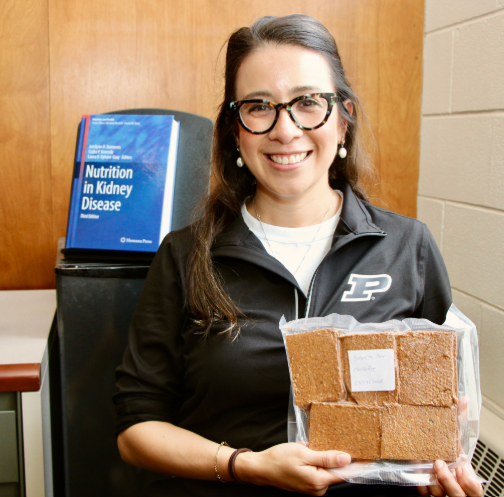
Annabel Biruete, assistant professor in the Purdue University Department of Nutrition Science, holds a package of milpa crackers shipped from Mexico. The crackers are being used in a study as a substitute to chips, bread and American crackers. The researcher expects to see participants’ score better on a post-study metabolic panel in glucose levels, blood lipids and kidney function.(Tim Brouk)
Written by: Tim Brouk, tbrouk@purdue.edu
A traditional way of growing and eating food in Mexico and Central America could offer clues for healthier diets in the United States.
Annabel Biruete, assistant professor in the Purdue University Department of Nutrition Science, grew up in Mexico around communities that practiced “dieta de la milpa” or “diet of the cornfield.” This centuries-long agricultural custom consists of planting corn; beans; gourds, such as pumpkins and squash; and chili peppers. The “diet of the cornfield” is naturally regenerative and loaded with health benefits — corn for carbohydrates and energy, beans for protein, gourds for fiber, and peppers for vitamin C and other micronutrients.
“In the same plot of land, they can grow corn with beans, which is synergistic because they help each other grow and transfer nutrients,” Biruete said. “Pumpkins and squashes provide shade to the soil and maintain humidity. And then the chilies protect against pests. So, it’s a synergistic agriculture system that is also sustainable.”
Biruete and her lab are conducting pilot research with 12 Hispanic adult participants ages 18-65 eating crackers made from milpa ingredients — corn flour, bean flour, pumpkin seeds and more — as a part of their daily diets for two weeks. All study participants have a body mass index of more than 25, which is deemed “overweight.” The study is part of Biruete’s broader research into cardiovascular-kidney-metabolic (CKM) syndrome, a cluster of conditions that includes obesity, diabetes, kidney disease and cardiovascular disease.
The work is funded by a Purdue AgSEED grant.
After an initial metabolic screening, participants will consume 50 grams of the milpa cracker a day. The crackers can substitute for foods such as bread or tortilla chips. For example, instead of eating guacamole with a tortilla chip, the participant can use the milpa cracker. After two weeks, participants will undergo the same metabolic screening. A full metabolic panel will be conducted to look for changes in glucose levels, blood lipids and kidney function. Biruete hopes to see signals for improved metabolic and gut microbiome health because each cracker contains 5 grams of fiber along with other valuable vitamins and nutrients.
“The milpa crackers have plant-based protein and dietary fiber, which can be beneficial for overall health and cardiovascular health in particular,” she said.
The milpa crackers were produced in Mexico before being shipped to Biruete. The crunchy brown crackers come in three flavors — spicy chipotle, sweet vanilla and a nutty savory flavor. Biruete’s lab previously did taste tests with different participants. The Mexican milpa cracker manufacturer, food scientist and nutritionist Luis Mojica at Centro de Investigación y Asistencia en Tecnología y Diseño del Estado de Jalisco (CIATEJ), has a patent in place for the product.
Biruete admitted the crackers are dry to extend shelf stability, so marketing the milpa cracker as something different and healthier to spread peanut butter on or to scoop hummus with could make them more appealing to American consumers.
“The sweeter one, they can just mix it with their smoothie,” she said. “I think it has a lot of possibilities. We will give some options to participants, but really, however they want to take it, if they just want to take the cracker as a snack, that’s also completely fine.”
Biruete believes the milpa cracker can be part of a healthy diet and can help with addressing CKM syndrome. It can also show how a healthy diet from Mexico and Central America could help its neighbors to the north. After all, she isn’t studying a food system she discovered in a textbook. She grew up around it.
“Sometimes, unfortunately, we think Mexican food may not be the best for us, but really, when you look into all of the nutrients that could be provided in a traditional Mexican diet or Central American diet, it is very healthy,” Biruete said. “It is not so different from a Mediterranean diet, actually. The milpa dietary pattern provides the nutrients necessary for growth and development and to help maintain health through all stages of the life cycle.
“I would love to see (these crackers) as an alternative in the grocery stores. When you go to a grocery store, the crackers are usually a salty profile. It’s usually a cheesy profile. You now have corn chips with chia seeds and things like that, but this is an alternative for a graham cracker or Saltine. I don’t think there’s anything really in the market like that looks very similar to this. So, I think it could be definitely something that would be amazing to have.”
Biruete’s milpa work is one of four Purdue College of Health and Human Sciences research projects funded by AgSEED grants in 2025 and 2026. Here are the others:
- “Next-Gen Milks: How Emerging Processing and Production Techniques Shape Flavor and Metabolism” — Led by Cordelia Running, associate professor of nutrition science, this study looks at how milk is an important source of nutrition, but lactose intolerance, milk-protein sensitivity and blood glucose responses can make it difficult for some people to consume. The project will examine commercially available milk varieties to better understand their potential health benefits and consumer appeal. Read more.
- “A Matter of Balance” — Steve Amireault, associate professor in the Department of Health and Kinesiology, developed an eight-session fall prevention program for midlife and older adults ages 55 and up through the Extension network across Indiana in both four-week and eight-week periods. This project’s objective is to evaluate how the program’s length and timing (spring/summer versus fall/winter) impact its effectiveness. Read more.
- “Investigation of the Relationship Between Social Media Use and TDAP/Influence Vaccine Uptake Among Pregnant Women in Indiana” —This study, led by School of Nursing assistant professor Soojung Jo, aims to identify how the use and trust in various information sources, particularly social media, relate to vaccine uptake among pregnant women in rural Indiana — a population with notably low vaccination rates. Read more.
Discover more from News | College of Health and Human Sciences
Subscribe to get the latest posts sent to your email.