Purdue Miller Child Development Lab School celebrates 100 years of growth, teaching and research in early childhood education
Written By: Rebecca Hoffa, rhoffa@purdue.edu
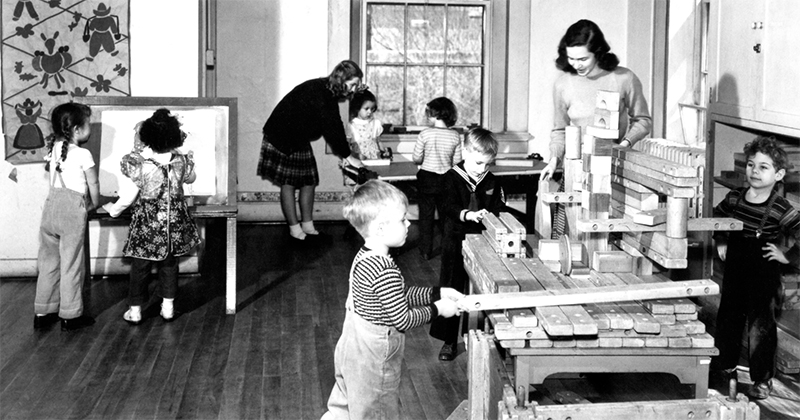
A toddler swirls paint across a page. A preschooler examines a leaf found on the playground. An infant shakes a tambourine for the first time. Nearby, an undergraduate student leads a lesson while researchers study how the children learn and grow.
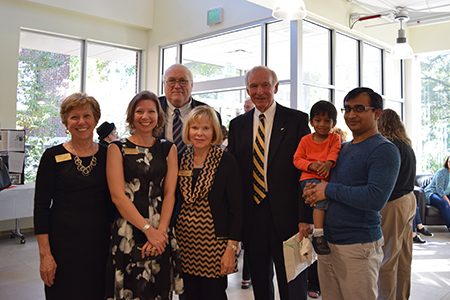
Schlesinger-Devlin, former HDFS head Doran French, Maxine
Miller, Ben Miller, and a MCDLS parent and child take a photo at the
lab school’s 90th anniversary celebration in 2016. (Photo provided by
the MCDLS)
For the last century, these moments, both ordinary and extraordinary, have unfolded in Purdue University’s Ben and Maxine Miller Child Development Laboratory School where children, families, students and researchers come together to shape the highest quality early childhood education. Now, as it celebrates its 100-year anniversary, the lab school, which is housed in the Department of Human Development and Family Science, is taking a moment to appreciate its past and build its momentum toward the future.
“I think reaching 100 years is definitely a testimonial to the history, the work, the intentionality and the value of the lab school,” said Elizabeth Schlesinger-Devlin, director of the Miller Child Development Lab School. “The university has been so supportive over the years, and the department has been historically anchored to the vision, philosophy and value of the program, so sustaining it for 100 years is a really big milestone and something to lift up.”
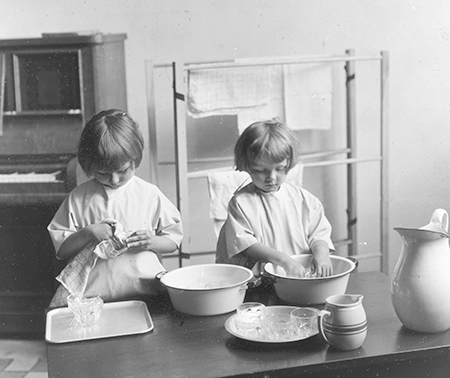
days of the MCDLS. (Photo provided by the MCDLS)
The lab school started as the Purdue Nursery School in 1926 and was an initiative of Mary Matthews, dean of the School of Home Economics at the time. The Purdue Nursery School became the first university-based preschool in Indiana with 16 children enrolled during the first year under the direction of Laura Partch. It was located near what is now Stone Hall.
After experiencing a period of growth from the early 1930s through the 1950s, the Purdue Child Care Program was officially established in the 1980s and was housed in the Burtsfield Elementary School Building in West Lafayette, off campus. It later moved back onto Purdue’s campus, eventually joining the newly renovated Fowler Memorial House in 1994 with larger classrooms and a new playground.
While the location, name and size of the program have changed over time, the mission remains steady: to help young children and families learn and grow across the center’s commitments to early childhood education, undergraduate education and research.
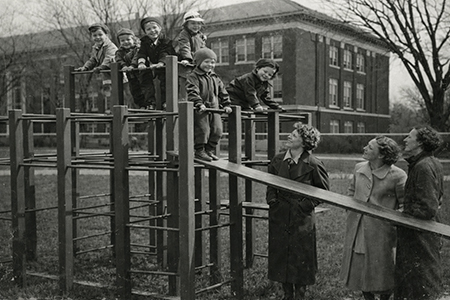
(Photo provided by the MCDLS)
“There’s this core of the work that’s really important, not solely in the children who have their growth and development here and the families that learn and grow with them, but in the undergrad population and the research aspect of it — those things historically, too, haven’t changed,” Schlesinger-Devlin said.
In 2011, upon the completion of Hanley Hall, the school was renamed to what it is today, the Ben and Maxine Miller Child Development Laboratory School, after longtime supporters Ben and Maxine Miller. The school’s essential work in shaping generations of young minds was a driver behind the Millers’ support throughout the years.
“Maxine was the second to the youngest in a family of 12 and as a result had dozens of cousins, nephews and nieces. She could experience firsthand the importance of early childhood development,” Ben Miller said. “Maxine’s degree in home economics further stimulated her feeling for a strong early childhood training. To watch the development of children, we think it’s quite important. Today’s children are tomorrow’s leaders, and whatever we can do to help them at an early age learn life’s challenges and how to handle life will determine the type of leaders they are when they become adults. We were interested in that kind of project, something where we could help with the future.”
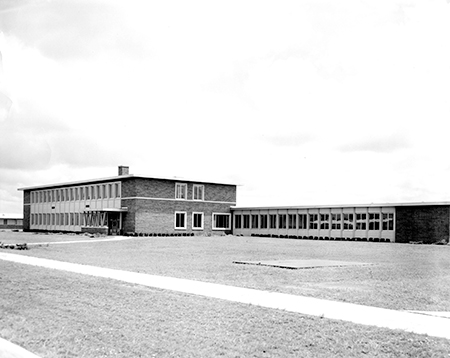
Building was completed and was the home to two child
development labs. (Photo provided by the MCDLS)
The Millers noted they’ve seen the impact not only in the stories of others but also in their great-granddaughter, who attends the Miller Child Development Lab School.
“Watching how our own great-granddaughter has developed in the program has been really amazing,” Maxine Miller said.
The school has also played an essential role in the development and testing of the Early Learning Matters (ELM) curriculum, an accessible and adaptable curriculum focused on children ages birth-5, which was developed by Purdue University for the Department of War Child Development Program. The Department of War comes to campus roughly three times each year to see the curriculum in action in the lab school.
“The Early Learning Matters curriculum has been really influential in our program, and we have sustained research throughout — research with STEM, health and human sciences, intervention studies and special education,” Schlesinger-Devlin said. “Our partnership is such an ongoing dialogue and an ongoing evolution because we learn more from research. We also learn more about teachers. The more we implement curriculum, the more we understand what families need, what teachers need, what children need. That’s an evolution piece that’s been important.”
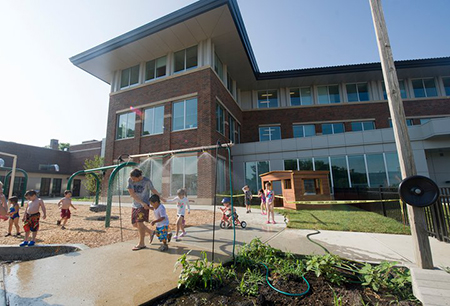
provided by the MCDLS)
The school will be reuniting former students, families, alumni, faculty, staff and friends for an open house event to recognize the lab school’s 100-year anniversary from 6-8 p.m. Nov. 6 in Fowler Memorial House and Hanley Hall. Schlesinger-Devlin said she hopes attendees will leave with a sense of connection, community and nostalgia.
“Purdue and the lab school lent themselves to foundational pieces of growth and realization, and that’s exciting to me because that impact continues on to today,” Schlesinger-Devlin said. “I think those are the aspects that looking over the last 100 years have really been meaningful — over and over again, it’s the culture and relationships. We get to see children and families come back, and even after such a period of time, the relationships still play an important part in their lives.”
As the school looks beyond this milestone into their future, Schlesinger-Devlin looks forward to seeing how the school will continue to grow into the next century.
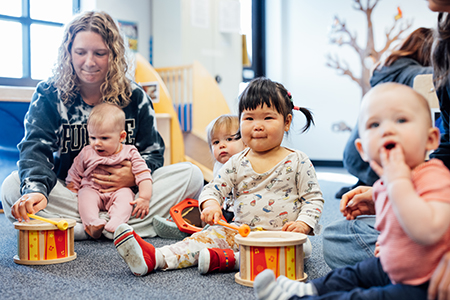
“My vision is continuing to build that deep relationship with research and the ELM curriculum, continuing to influence dynamics of families and children’s development and care, blending those together, and continuing to teach,” Schlesinger-Devlin said. “We’re constantly teaching children, but we’re also constantly teaching our undergrad population and constantly working and teaching with research.”
Interested in learning more about the history of the lab school? Order the school’s 100th anniversary book. All proceeds go to the Miller Child Development Lab School playground fund.
Discover more from News | College of Health and Human Sciences
Subscribe to get the latest posts sent to your email.