Purdue psychological sciences graduate student research supports shift from PCOS to PMOS
Written By: Rebecca Hoffa, rhoffa@purdue.edu
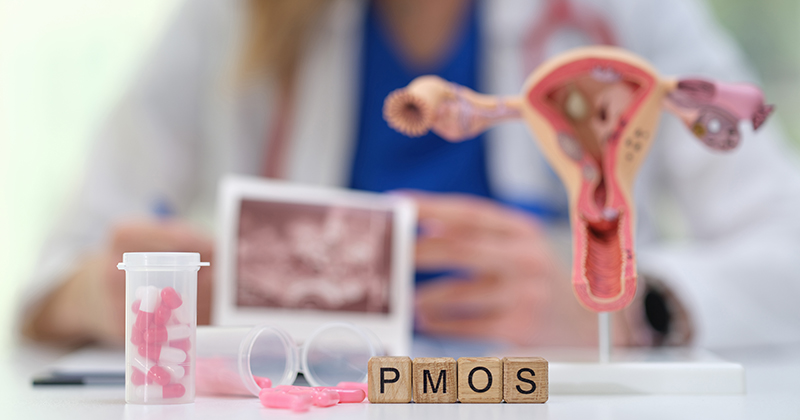
When polycystic ovary syndrome (PCOS) was renamed to polyendocrine metabolic ovarian syndrome (PMOS) in May 2026, understanding of the syndrome seemingly took a step forward overnight. However, the condition, which is a hormonal disorder affecting women and is the leading cause of infertility worldwide, according to the World Health Organization, has often gone understudied. Direct causes of the condition remain unknown.
Claire Miller, a graduate student in the Purdue University Department of Psychological Sciences (PSY), recently published her master’s thesis centered around PMOS with findings that support its renaming through modeling dehydroepiandrosterone (DHEA) as a precursor for the syndrome. In this study, which was published in Physiology & Behavior, Miller’s model produced excess testosterone and irregular menstrual cycles but not the polycystic ovaries that are the original namesake of the disorder.
“My research lines up really well with the recent transition from PCOS to PMOS because under the Rotterdam criteria used to diagnose it, you have to have two of the three symptom groups,” Miller said. “So, you can have acyclicity — your periods or ovulation are irregular or missing entirely; elevated testosterone levels, which can be confirmed via a blood test and through certain things like heavy acne, greasy skin or extra hair in typical male patterns; and of course, polycystic ovaries, which is what the condition used to be named for. The problem (with the former name) is, if you can have two of the three, you don’t always need to have polycystic ovaries.
“It feels very empowering to see that shift happen right as I was getting my results out — it is great timing. I believe the average wait time to diagnosis is somewhere around 34 months, which is extensive, from the time someone sees a doctor for issues they are experiencing, so when you actually have a diagnosis named after its core component, that is a big thing.”
For Miller, who is part of the Kinzig Lab, directed by Kim Kinzig, PSY department head and professor, the project came as a natural place to start in the lab and evolved into something she was able to make her own.
“Claire joined the lab in 2024 and jumped into the project started by an undergraduate in our group, Linnaea Krupke,” Kinzig said. “She expanded the project and carried it through for her master’s degree and to publication in Physiology & Behavior. Her dedication to the project never wavered, even as she mastered new techniques on the fly, and it was that combination of persistence and quick learning that pushed the work to publication. Watching her grow from a brand-new graduate student into independently carrying and growing the research is one of the most rewarding parts of working with graduate students.”
Past research of PMOS has used androgen-based hormone models to study the condition; however, Miller’s goal in her work was to gain a larger picture understanding of the metabolic conditions happening in these women in addition to the hormonal changes.
“The thing was, that is not what’s happening in women with PMOS — those women are not getting straight injections of testosterone, and it’s unclear if the raise in testosterone is the key,” Miller said. “We know testosterone levels are elevated, but is that what’s causing everything else, or is that just another symptom of some source we haven’t found yet? When you just focus on testosterone as the source, you’re missing a key part of the puzzle and making assumptions that we don’t know to be true.”
One component of Miller’s research was also looking at neuroinflammation in her PMOS models by examining microglia, or neuroinflammatory immune cells in the brain. Because studies have shown women with PMOS have changes in gray matter in their brain that’s associated with cognitive and memory abilities, Miller said she was interested in how the brain connects to the other abnormalities associated with the condition.
“We actually found very few differences between neuroinflammation in any of these groups, which was so interesting,” Miller said. “That raises the question: Was microglia not the right measurement? I would love to parse that out using different neuroinflammatory markers. Really, what would be so interesting is trying to create a brain-down effect — so, altering the brain to get the PMOS-like symptoms in the body rather than altering the body and hoping it changes the brain because we don’t know where PMOS originates.”
As her first primary research paper as the lead author, Miller said her PMOS research and seeing it through to the end is one of her proudest accomplishments thus far as a graduate student in the College of Health and Human Sciences.
“I think the timing of this publication with the recent renaming of the syndrome is truly the best thing that could have happened for this particular research because now you can emphasize that it’s not just the ovaries, and the ovaries aren’t the only important part in female reproductive health,” Miller said.
Discover more from News | College of Health and Human Sciences
Subscribe to get the latest posts sent to your email.