Purdue hospitality expert: American barbecues foster savory flavors, community
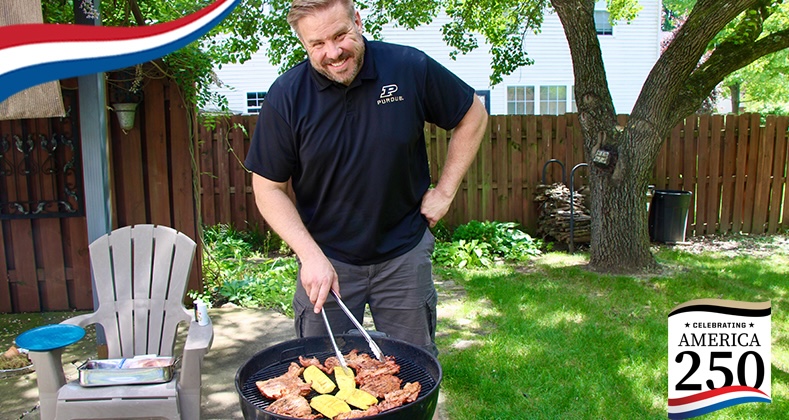
Shawn Bucher, clinical assistant professor in the Purdue University White Lodging-J.W. Marriott, Jr. School of Hospitality and Tourism Management, said taking your time and concentrating on what you can do best are ways to make your July 4 barbecue a bigger and better blast.(Tim Brouk)
Written by: Tim Brouk, tbrouk@purdue.edu
This article is one in a series of America250 stories showcasing Boilermakers contributing to some of America’s most popular pastimes.
Shawn Bucher’s barbecue mantra of “low and slow is the way to go” is poetry to the ears of grilled-meat fanatics.
The savory verse means pork, beef or chicken that is cooked at a lower temperature for longer than usual and left to rest for an hour or more makes for the best flavors. This method has served Bucher well throughout his delicious career as a certified executive chef, an official Kansas City-style barbecue judge, and a clinical assistant professor in the Purdue University White Lodging-J.W. Marriott, Jr. School of Hospitality and Tourism Management.
“When I’m grilling or barbecuing at home, my preference is to go slow, take more time, be more mindful and really enjoy the process versus trying to check a box and just get it done,” Bucher explained.
Bucher noted one of the best aspects of a good barbecue is that culinary school is not required to put on a memorable ’cue. Most cooks who enter barbecue competitions are amateurs who take up smoking and grilling meats as a hobby. This means almost anyone can fire up the grill to the delight of family, friends and neighbors.
“Part of what I think draws Americans to barbecues so much is that barbecues are some of the times where we really come together as a family, community or nation,” Bucher said. “The Fourth of July for example is one of those few times where we’re really coming together and looking past political differences and ideologies and whatnot. I think barbecue is kind of symbolic in some ways of that.”
Bringing the heat
The age-old gas versus charcoal or wood-burning grill question was quickly answered by Bucher: Gas grills are best for cooking for large groups where consistency is coveted, but for smaller gatherings, charcoal or woodburning barbecue is preferred due to better flavors. It’s also preferred for his “low and slow” principle.
Bucher often cooks with a mix of charcoal and wood — usually a fruit wood (i.e., cherry or apple) and hickory. After some initial charring, he often covers the meat and lets the low heat, charcoal and wood do their work.
“I want the flavors to really come together,” Bucher said. “I want that hardwood, that charcoal smoke to really seep up in there. I want the fat to render and melt on the meat and drip down, hitting that smoke point, and pop back up.”
Lost in the sauces
For many, barbecue sauce is vital to most cookouts, and sauces also help differentiate American regions of barbecue styles. For example, Memphis-style is light on the sauce and often benefits from a dry rub while Kansas City-style usually features sweeter, tomato-based sauces. Texas-style is all about post oak or mesquite wood smoked meat. Carolina-style is known for vinegar sauces and Alabama barbecues often feature a white mayo-based sauce.
Bucher personally prefers Kansas City-style sauces, and his favorite lately has been the popular Sweet Baby Ray’s brand. While Bucher prefers to make his own sauce — adding uncommon ingredients like fresh fruit jams as flavor differentiators — he feels that store bought is fine but warned against going lower cost on sauces.
“I really feel like the craft in some of those generic, lower-end ones, like the ingredients that they use and the way they prepare it, you just get an inferior product,” Bucher explained. “I think if you’re going to do the sauce, spend the money on the good sauce.”
On sides
Bucher said he prefers traditional sides — potato salad, macaroni and cheese, baked beans, sliced watermelon — but enhanced. He mentioned a Caribbean coleslaw as a recent crowd-pleaser.
“I actually add fresh mango and pineapple to it,” Bucher said. “A traditional coleslaw is going to be mayo and honey, essentially. For mine, I do a cream of coconut mixer then I throw some fresh lime juice and zest into it too. It makes for something familiar, but unique.
Bucher hinted that adding regional ingredients such as roasted green chilis to your average macaroni and cheese or candied bacon to your green beans can give the sides a welcomed kick too. Also, there doesn’t have to be an army of side dishes at your next barbecue. Concentrate on the two or three you do the best and add more once you feel comfortable.
“It’s a lot easier to add than subtract, so really focus the few you do best, and try to see your cooking as an evolution,” Bucher said. “As with anything else, you’re learning and you’re growing through the process.”
Rest in flavor
Resting or letting cooked meat sit undisturbed before slicing is vital to the barbecue, according to Bucher. Resting allows the internal temperature of the meat to equalize, which redistributes juices and prevents the liquid from spilling onto your cutting board while keeping the meat tender and flavorful. He recommends a rest period of about 45-60 minutes before first cut. The meat should be covered with foil or butcher paper with space for ventilation.
With the “low and slow” anthem in mind, that steak, chicken or pork cooked to perfection will highlight your event while keeping that American cookout tradition of community and food alive.
“With barbecue,” Bucher concluded, “it’s more about the process than anything else, because the love and care in the process is really what makes it in the end.”
Discover more from News | College of Health and Human Sciences
Subscribe to get the latest posts sent to your email.