First-year Purdue HHS students explore rare disease symptom solutions at Harvard HackRare competition
Written By: Rebecca Hoffa, rhoffa@purdue.edu
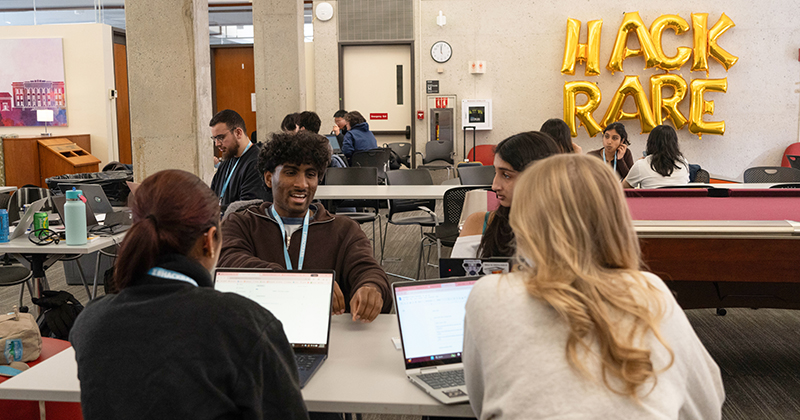
Kezia Samuel and EmmiLee Whittington work with their group for the HackRare competition.(Photo provided by Harvard Undergraduate Rare Diseases)
Growing up with a brother with Angelman syndrome, EmmiLee Whittington, a Purdue University School of Health Sciences first-year student double-majoring in medical laboratory sciences and biomedical health sciences, sees rare diseases personally. When she learned of the opportunity in Caduceus Club to participate in the Harvard University HackRare competition, a hackathon focused on rare diseases, she knew it was something she wanted to pursue.
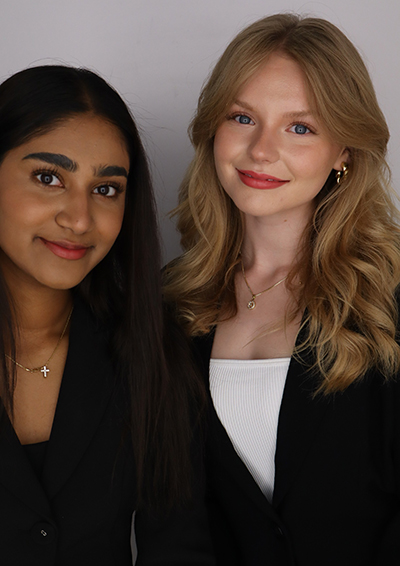
Kezia Samuel (left) and EmmiLee Whittington (right)
Alongside fellow Purdue biomedical health sciences first-year student Kezia Samuel and Purdue Department of Computer Science sophomore Ramya Prasanna, the team partnered with a student from University of California, Irvine and traveled to Boston to put their skills into practice and explore solutions to rare diseases. The team ultimately created PWSense, a symptom monitoring system for Prader-Willi syndrome.
“I felt very prepared for the competition because when you start learning a lot about Angelman syndrome, you learn inversely about Prader-Willi.” Whittington said. “I felt very good about working with my team on that disease. We spent the whole 24 hours working on this project and networking and working one-on-one with the tutors from Harvard. It was just a wonderful experience.”
Individuals with Prader-Willi syndrome often experience symptoms such as insatiable hunger and behavioral disabilities, so the team’s PWSense solution is a minimally invasive implant focused on detecting triggers to help caregivers mitigate outbursts before they occur.
“As the person says trigger words, the implant would be able to listen to the individual and pick up on keywords,” Whittington said. “The code is able to detect when they’re starting to say trigger words more and starting to get more anxious. With that, it would ping directly to the website or the caregiver’s phone and let them know there might be an outburst coming so they can prepare for or manage these symptoms.”
Samuel and Whittington were the brains behind the science of the disorder and which symptoms to target while Prasanna and Raghav Sriram, her UC Irvine counterpart, worked on the code. Although the team didn’t win the competition, Samuel noted they walked away with valuable experience she’ll continue to carry with her for her next three years in the College of Health and Human Sciences and beyond.
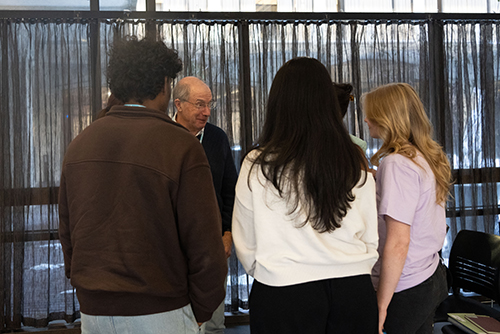
Samuel and Whittington and their group talk with a Harvard University professor with expertise in Prader-Willi syndrome(Photo provided by Harvard Undergraduate Rare Diseases)
“I’m impressed by what we made because it was a team of four of us,” Samuel said. “I was very proud of what we built and still am, even if we didn’t win. I didn’t even know Prader-Willi Syndrome existed before I went to this competition. Just seeing how many different rare diseases there are — because obviously everyone was talking about different things — it was a really good learning opportunity.”
The ability to connect with other students as well as faculty, medical professionals, caregivers of individuals with rare diseases and more was particularly notable for both Whittington and Samuel in their pursuit toward medical school.
“I met so many different people from so many different universities,” Whittington said. “I thought it was so cool to meet people from Yale, Brown and Harvard. Afterward, I was able to talk with the panelists a little bit more, and it was very personal to me too. I also never really realized how much these kinds of events bring people together from so many different backgrounds. I talked to a bunch of people I would never have gotten the opportunity to talk with, especially in a science-related atmosphere like this.”
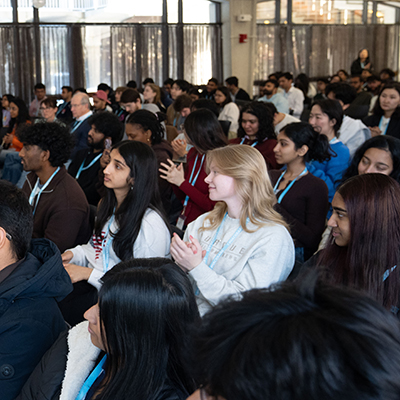
Samuel and Whittington sit in the crowd, listening to speakers talk about their experiences with rare diseases.(Photo provided by Harvard Undergraduate Rare Diseases)
Samuel also noted having new knowledge of rare diseases and understanding of approaches toward them will provide an important foundation for her classes leading up to medical school.
“I think when I take classes in the future that focus on diseases, I can apply the knowledge that I learned at Harvard and be able to recognize things and form patterns in my head,” Samuel said. “I think that will be really useful in medical school eventually.”
For Whittington, the experience also served as inspiration for the future, showing how she and her peers can create lasting change in human health and well-being.
“We were working together to create something that would be useful in a medical field that doctors or researchers could use in the future,” Whittington said. “It’s laying a foundation that other people could use our project to go further on. I think seeing that my work could make a difference was a huge light switch for me. It just clicked when I was there. I definitely think this is helping me stay motivated and showed me how my work could be something similar to this and change how well someone is living with a rare disease.”
Discover more from News | College of Health and Human Sciences
Subscribe to get the latest posts sent to your email.