Same care, different setting: Purdue Nursing alumna serves those who serve

Abby Badinghaus, right, salutes a U.S. Air Force officer during her training completion ceremony.(Photo provided)
Written by: Tim Brouk, tbrouk@purdue.edu
While the setting is different, the Purdue University School of Nursing quality of care and expertise is the same.
Abby (Reneau) Badinghaus (BS ’25) commissioned in the Air Force after graduating and is stationed in Mississippi. The young nurse is in the medical-surgical unit.
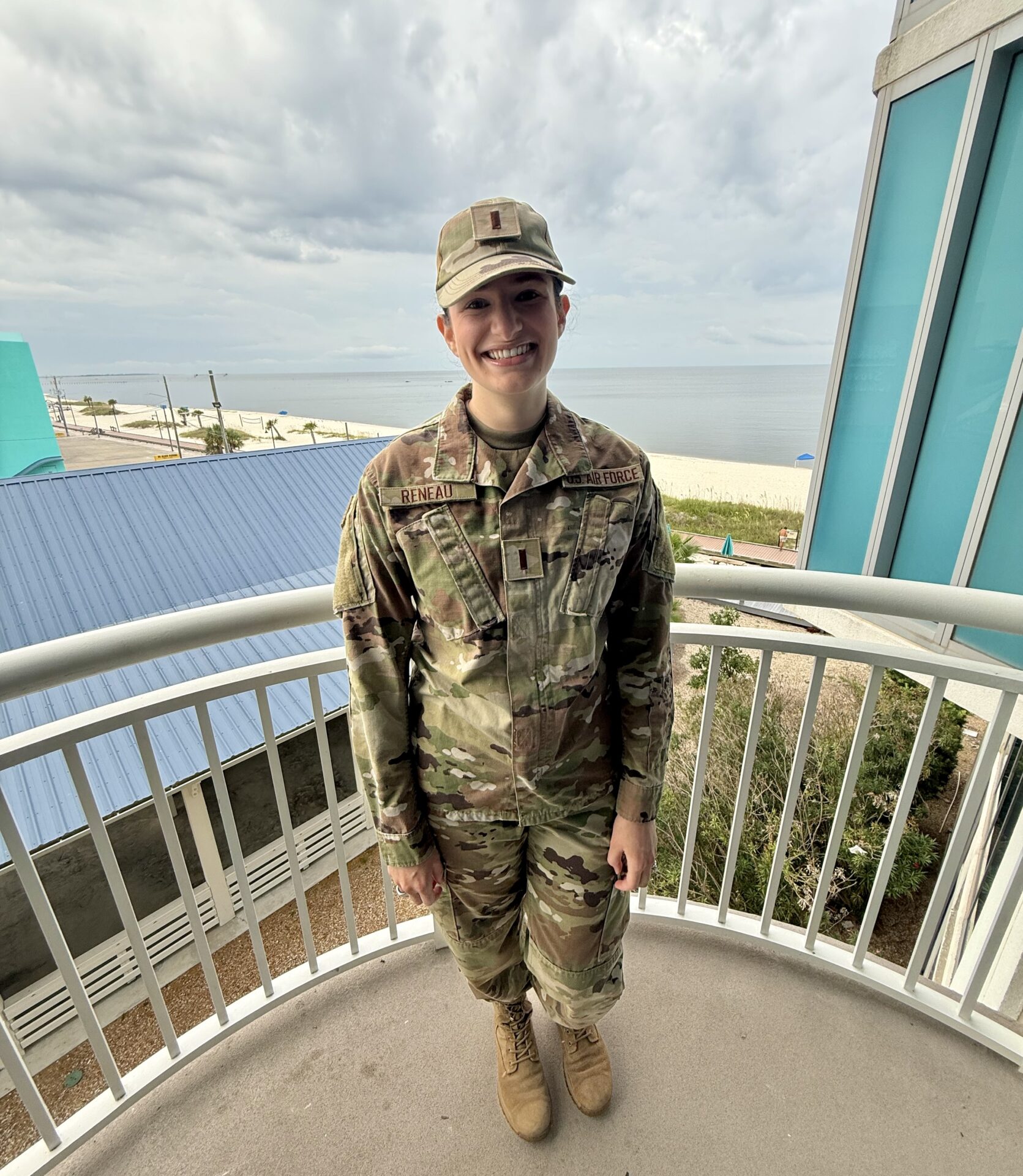
Badinghaus said being a nurse in the military gives her unique opportunities such as “travel opportunities for trainings, humanitarian aid during pandemics or natural disasters, deployments, and civilian hospital training agreements.”(Photo provided)
While many of her former classmates are in civilian jobs, providing care on an Air Force base has more similarities than differences.
“We work 12-hour shifts, care for patients and advocate for best practice,” Badinghaus explained. “Some differences, however, are our patient population; we only see retirees, veterans, and active-duty members and their families. All my coworkers are also active-duty members.”
Badinghaus’ husband, Matthew Badinghaus, also graduated from Purdue Nursing in 2025. However, he works as a civilian nurse in nearby Pascagoula, Mississippi.
In time for Armed Forces Day, Abby Badinghaus discussed what it’s like providing health care in the military, how her Purdue training has helped her provide expert care and what it’s like being married to another nurse.
What are some unique aspects of a military nursing job?
Some unique opportunities the military gives nurses include travel opportunities for trainings, humanitarian aid during pandemics or natural disasters, deployments, and civilian hospital training agreements.
Our nurse-to-patient ratio is also smaller compared to our civilian counterparts. On average, I get anywhere between one to three patients a day. I feel like this ratio really allows me to give quality care. Another big change compared to civilian facilities are our medics and techs. They have a far wider scope of practice than civilian techs. I learned from them as a new grad. They can do so many skills I assumed only nurses could do. Finally, another difference is we always have Air Force duties on top of our nursing duties, so we’re always doing a little extra.
I would say the most important aspects of the job include giving quality care, working as part of a team and following policies. I was trained at a larger army hospital, and they were very by-the-book. We chart absolutely everything. If it’s not documented, it didn’t happen. We have to be thorough in everything we do, and our patient ratios allow us to give that kind of care. We also always work as a team. If one nurse is busy, another can usually step in to help.
What is your favorite part of the job so far?
My favorite part of the job is getting to connect with my patients and really talk with them. We see all age groups and situations. I’ve cared for patients from 6 years old to 99.
What is it like providing care for veterans?
I treat veterans almost every day. We get a lot of patients from the Department of Veterans Affairs. I can’t speak exactly on how the VA handles their care since it’s different from the active-duty side. But our veteran population is a special population, and unfortunately many of them carry emotional baggage we can’t even comprehend today. PTSD (post-traumatic stress disorder) is real. I think being present for them and taking the time to listen, even just an extra five minutes in their room, can make all the difference.
What parts of your Purdue Nursing education have helped you most so far?
I feel like the Purdue School of Nursing taught me excellent assessment skills and knowledge behind everything I do. I came out of school not only knowing how to do an assessment well but interpret and understand abnormal findings. I also knew how to think about the medications I give and why I do what I do. Every action has a consequence, and Purdue taught me how to prevent bad outcomes and be the best advocate for my patients.
What’s it like to be married to another nurse?
We definitely lean on each other all the time. He tends to have more hectic days than I do, and we vent to each other all the time. It’s nice to have someone who understands exactly what I go through, and it’s nice balancing our schedules with much needed rest and vacations.
Will you stay in the military for the rest of your nursing career?
I’m not sure if I will stay in the Air Force after my contract or not. I think it’s too early in my career to make that kind of decision. I value God and my family more than anything else. I’m taking it one day at a time.
Discover more from News | College of Health and Human Sciences
Subscribe to get the latest posts sent to your email.