Purdue speech, language, and hearing sciences student leads Purdue Equestrian Team in national championship defense
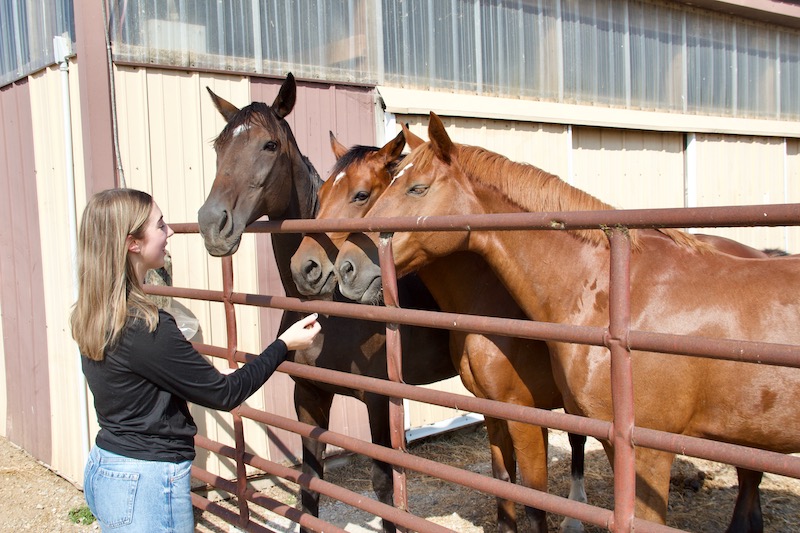
Haylie Johnson feeds Purdue Equestrian Team horses some treats at Camp Tecumseh, the team’s practice arena. A junior studying in the Department of Speech, Language, and Hearing Sciences was named co-captain of the equestrian team, which is defending its 2024 Intercollegiate Horse Shows Association championship this fall.(Tim Brouk)
Written by: Tim Brouk, tbrouk@purdue.edu
Please excuse Haylie Johnson for being on her high horse for a bit, both literally and figuratively.
The Purdue University Department of Speech, Language, and Hearing Sciences junior was part of the 2024 national championship-winning Purdue Equestrian Team. The Purdue squad was one of only a few club teams to make it to nationals. These student-athletes and their horses defied the odds by overcoming Indiana opponents before trampling more favored schools in regional and zone competitions. Johnson and her undefeated underdog team then went on to defeat 15 other programs in the Intercollegiate Horse Shows Association (IHSA) national meet in Tryon, North Carolina. The student from Brownsburg, Indiana, reported the Boilermaker riders won the top prize by one point.
“It was a three-day competition, and so it kind of builds up with suspense and anticipation,” recalled Johnson, a co-captain of the 2025 Purdue Equestrian Team, during a recent visit to the Camp Tecumseh Equestrian Center just north of West Lafayette where her team practices. “It was very biting-our-nails to the end. It felt so surreal winning. It took a long time for it to set in.”
When she’s not in the saddle, Johnson is earning her degree in speech, language, and hearing sciences, with the ultimate goal of becoming an elementary school speech-language pathologist.
But before then Johnson will lead her fellow Boilermaker riders to victory this fall one small trot and one giant gallop at a time. The team began its season Sept. 20 versus Indiana University and will participate in a tournament at Goucher College in Baltimore, Maryland.
How do these competitive IHSA equestrian shows usually go?
The way our competitions work is we’ll show against a handful of other schools in Indiana. And then all the different schools bring a few horses of theirs to these shows. And you’ll draw a name of a horse out of a hat. It could be from any of the schools we compete against. And then you go find that horse, hop on and head right into the ring to compete.
What made you want to get into the sport?
I started horse-riding when I was 7 years old. My grandma actually got me started. She got me a set of 12 riding lessons. And because I was like a classic little girl, “I want a horse! I want a horse!,” my parents thought, “She’ll realize it’s hard and won’t want to do it anymore,” but here I am 13 years later. Then I rode on a similar style team when I was in middle school and high school, where you compete on a (randomly) drawn horse, and that’s kind of what got me interested in riding in college.
I have always been a very competitive person even if it’s playing a card game with my family. My family’s a pretty competitive family. So, I think that’s always kind of been rooted down in me. And then I know Coach (Kathryn) Kraft is very competitive as well. She’s very encouraging. And I think that it’s really cool to ride for a Big Ten school, even though we aren’t a varsity team. It’s very encouraging and inspiring to wear a Purdue shirt and represent this school.
How does it feel being co-captain for a team defending its national title?
It’s great. I really like stepping into a leadership role. We always say you get out of this team what you put into it, and I put a lot of time into it. Some of my best friends are on this team. I and my other co-captain, Abby Cole, we help get everybody on and prepared to show; we do a lot of the hands-on stuff at the barn or meetings and all the onboarding done for new members.
What kind of horses do you practice with?
We have 13 team horses. We’re very fortunate to have a very wide range of horses — all different types of horses from many different backgrounds. They feel very different when you ride them, which really helps us with success because when you go to a show, you never know what kind of horse you could draw.
What’s your secret in working so well with horses?
I think a lot of the trainers I have had in the past are very big on treating the horses with respect, and everything they do is communication. I think it’s very big to stop and realize that what they’re trying to tell you is something real. It’s not just them being bad to be bad. I have owned a horse since I was 13 years old, and he has a very big personality and sometimes needs to be reminded that people are not horses. He can’t push us around like we’re horses. So, I think a big thing is just understanding horse communication. How do horses communicate with each other to show respect and how can I simulate that when I’m working with a horse?
Discover more from News | College of Health and Human Sciences
Subscribe to get the latest posts sent to your email.