Purdue HTM graduate student reveals sensory marketing is more than meets the eye through award-winning research paper
Written By: Rebecca Hoffa, rhoffa@purdue.edu
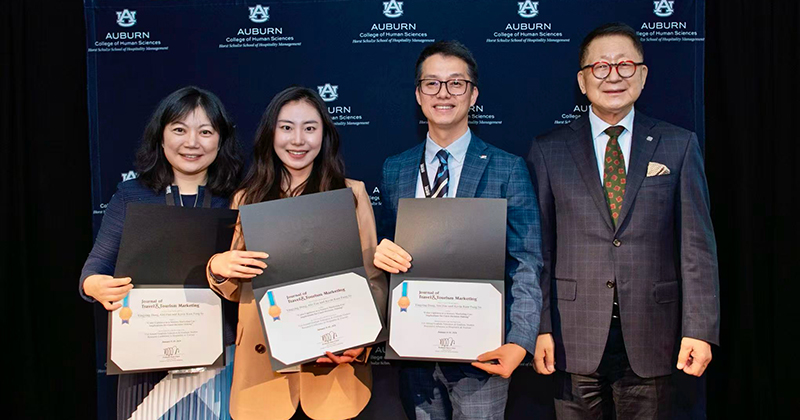
Yingying Dong (second from left) receives and award with HTM faculty members Aileen Fan (left) and Kevin So (second from right).(Photo provided)
Your favorite song plays as you’re shopping for clothes. The scent of bergamot draws you into a candle store. The bright colors and captivating photos motivate clicks throughout an online store. While we like to think of our shopping habits as our own, sensory cues guide our decision-making as consumers, often without even realizing it.

Yingying Dong(Photo provided)
Yingying Dong, a PhD student in the Purdue University White Lodging-J.W. Marriott, Jr. School of Hospitality and Tourism Management, is interested in understanding how companies can best leverage sensory marketing to influence consumer behavior.
Dong is particularly interested in these tactics within hotel and lodging websites to set up consumer expectations for their stay. She explored this in a recent paper that received one of four Best Paper Awards at the 31st Annual Graduate Education and Graduate Student Research Conference in Hospitality and Tourism. Dong investigated how bedding color, whether light or dark, can influence consumers’ perceptions of a hotel before they stay. She found that darker bedding, which is a more sustainable option than white options that require bleaching, often is associated with a stronger brand image for consumers.
“The perceptions consumers experience at the brand level can lead to a higher perceived comfort at the experience level, which in turn increases consumers’ willingness to pay,” Dong said. “These findings actually suggest that even subtle visual elements, such as color, can serve as signals that shape how people form expectations in the online booking context. Also, very importantly, these findings highlight that consumers rely on these sensory cues to infer qualities, even when they cannot directly experience it yet. So, something as simple as color and these subtle visual cues can really shape how a service may look and also how the service may be interpreted and valued before the consumer even experiences it.”
For Dong, sensory marketing is more than simply a way to appeal to consumers. It often affects the way people experience the world and can present differently across cultures.
“We definitely rely on the sensory information we acquire every day without even realizing it,” Dong said. “Actually, over time, these sensory inputs really shape how we understand and interpret the world. That actually makes sense for marketing because it taps into something very natural but also at the same time is deeply embedded in our daily lives. The way we interpret the sensory information is also socially and culturally shaped, because the same color probably can be interpreted and represent different meanings in different cultures. So, I think that definitely adds another layer of complexity to sensory marketing.”
Dong, who grew up in a tourism-heavy wine region in China, has always been interested in experience design and the marketing behind it.
“When I grew up, I was surrounded by a tourism environment,” Dong said. “I’ve always been so attracted to this kind of leisure, enjoyment and experience. I think that is why I want to explore more how to design and cultivate better experiences in this industry.”
For Dong, one of the most interesting findings in her work has been the limit consumers reach with sensory information. While sensory information is often helpful in bringing emotional responses and processing information, consumers who experience too many sensory cues at once in their experience may experience sensory overload and have a worse experience as a result. Finding the balance is essential to creating the best possible experience.
“Rather than simply adding more sensory elements to make an online environment more immersive, it is very important to carefully design how these cues work together,” Dong said. “This actually suggests that effective sensory design is not just about accumulation to simulate the real shopping experiences but also about coordination, balance and harmony.”
While receiving the Best Paper Award is a motivator to continue her work, Dong noted it’s also a reflection of her experience at Purdue and in the College of Health and Human Sciences.
“I think it is definitely super meaningful to me, not only because I feel like my work is recognized, but also I think this award reflected the support I have received during my time at Purdue,” Dong said. “I think I’ve been super fortunate to be able to learn and grow in such a supportive environment. And this achievement made me feel like I was able to represent Purdue in a positive way.”
Discover more from News | College of Health and Human Sciences
Subscribe to get the latest posts sent to your email.