Purdue SPEAK OUT! group strives to keep Parkinson’s patients loud and proud

Lydia Kruse, right and clinical assistant professor, sits with a Parkinson’s disease patient during a recent SPEAK OUT! session. The program facilitated by the Purdue University Department of Speech, Language, and Hearing Sciences welcomes real Parkinson’s patients to work with Kruse’s speech-language pathology graduate students one-on-one but in a group setting.(Tim Brouk)
Written by: Tim Brouk, tbrouk@purdue.edu
One of the devastating effects of Parkinson’s disease (PD) on a patient is the weakening of their voice. According to the Michael J. Fox Foundation for Parkinson’s Research, they may “speak quietly and in one tone; they don’t convey much emotion. Sometimes speech sounds breathy or hoarse. People with Parkinson’s might slur words, mumble or trail off at the end of a sentence.”
A solution to improve voice strength is to work with speech-language pathologists (SLPs) or those studying to become SLPs in the Purdue University Department of Speech, Language, and Hearing Sciences. Clinical assistant professor Lydia Kruse and her speech-language pathology graduate students have welcomed several Parkinson’s patients every week for SPEAK OUT! group sessions at Lyles-Porter Hall on the Purdue West Lafayette campus. The program is part of the national Parkinson Voice Project.
Kruse, her students and their “Noisy Boilers” meet for an hour to go through vocal exercises and discussion assignments. The participants sit face-to-face with their assigned SLP graduate student. They are encouraged to “throw their voice” over the shoulder of the student.
“The whole thing is based on the principle of using intent,” Kruse said. “We’re trying to tap into that pyramidal system so that we’re doing something that’s not automatic because what’s automatic to them is really weak. So, we have to do things intentionally and tap into this volitional system so they can get their voice strong and clear.”
SPEAK OUT! meets in eight-week sessions from late spring through fall. Each meeting is led by a student, who picks a theme and leads the vocal exercises designed for people who need their respiratory and vocal muscles worked more than people without PD.
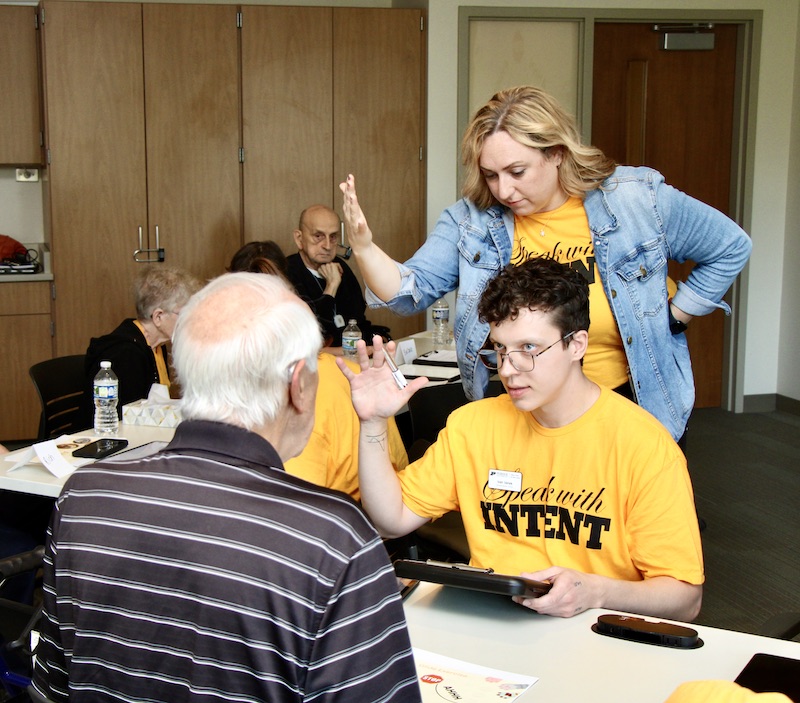
Purdue speech-language pathology student Ivan Vanek, middle, leads Lafayette Parkinson’s patient Steve Ulrich through a vocal exercise while Kruse supervises during a recent SPEAK OUT! session(Tim Brouk)
A recent session saw graduate student Lauren Browning leading a group of eight men and women with varying degrees of Parkinson’s. It was the highest number of SPEAK OUT! participants yet. She chose a pet theme, which allowed them to talk about dogs and cats from their childhood and/or pets they currently have. While Kruse and her students recorded their words on an iPad and measured for strength and volume, participants enthusiastically spoke, whether prompted by their SLP or simply chiming in after another participant’s speech. While some participants were urged to repeat their words louder and clearer, the camaraderie and smiles were still there.
“The overall purpose of doing the group versus individual sessions is that you’re working in a social environment,” Kruse explained. “You’re working on conversation, the enjoyment of being heard and understood by others, and having a good time.”
‘Make some noise if you’re with me’
A SPEAK OUT! meeting usually starts with warmup exercises. This recent meeting had the participants saying the phrase “may me my moe moo” together. Then there was a counting exercise from three to 60 by threes with strategic stops in the sequence and the challenging “ah exercise,” which had the Noisy Boilers use their pitch control up and then down while saying “ah.” They had to glide up and then glide down to get the right high and low pitches correct. And they did.
“We should start a choir,” quipped Sue Eiler of West Lafayette, who has had Parkinson’s for eight years.
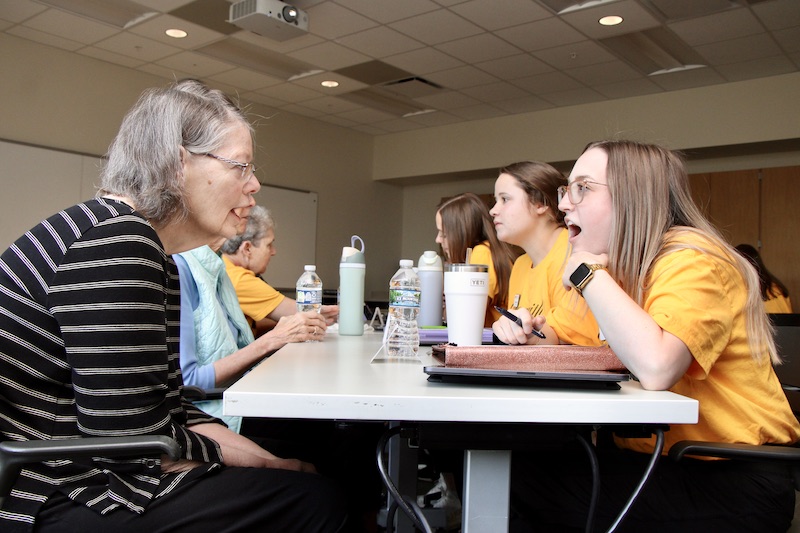
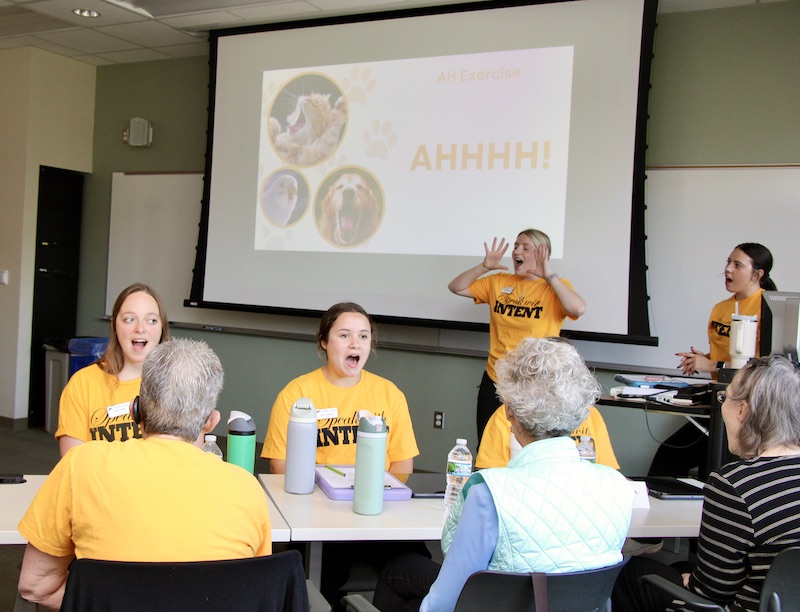

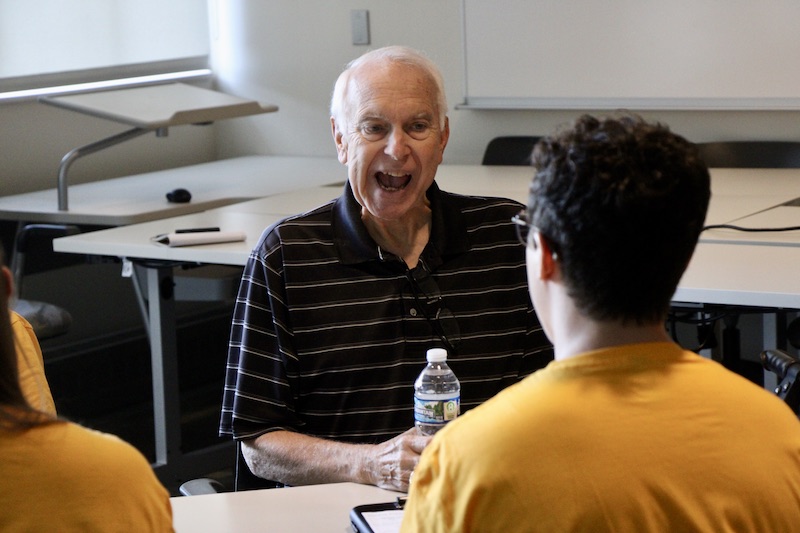
This session also had cognitive exercises to test their brain and voice strength at the same time. Prompts included “Name five dog breeds” and “Four tricks you may teach a dog.” After listing, the exercises ramped up to “Conversation with intent.” The participants talked about a cat that played fetch and how their family had a series of nine dachshunds throughout his life. While the stories were cute and brought laughter, the main goals were met — the participants were speaking conversationally with volume and, yes, intent. They also worked on their cognition by being prompted by discussion questions.
“In the beginning (of a session), it’s pretty low cognitive load and then the conversation (exercise) is a lot higher cognitive load,” Browning said. “It’s a lot easier to remember to use intent when saying ‘mee my moo’ versus when you’re trying to think of your favorite pet or whatever. While trying to use intent, it becomes a lot harder.”
Each client has specific goals when they enter the room. A common goal is for the client to reach their maximum potential in volume and voice strength, as determined by Kruse and her students.
‘Parkinson’s doesn’t take a break’
Eiler said she has been going to SPEAK OUT! since the summer. She enrolled in the program when she realized the weakness of her voice was causing her social isolation.
“For me, who’s always been a person who enjoyed being with people a great deal, I find it hard work now to say what I want to say, to focus on not only what you’re thinking, but remember what you’re thinking,” Eiler said. “It really slows down your desire to be as involved as you’ve been.”
During this session she noted some women from the other side of the room were speaking louder since those summer sessions.
“That was actually encouraging to me because right now I feel like I’m on a downslide with the strength of my voice and energy,” Eiler said. “And so, to hear them doing as well, if not better than they were, is a good sign.”
Steve Ulrich of Lafayette is another SPEAK OUT! regular. He refuses to kowtow to his PD diagnosis. He joined the program to keep his voice strong for his part-time job supervising student teachers. He started to notice his voice weaken during long evaluations with the young educators. After this meeting, Ulrich said gliding his pitch up and down was the most challenging exercise of the day, but he’s been pleased with the process so far.
“I’ve seen a lot of change since the first meeting,” Ulrich said. “The voice quality is still a problem. We’re working on that.”
Sessions will continue in the fall before taking a winter break. Kruse said SPEAK OUT! participants must practice speaking with intent to stay in the communication game. PD is a devastating disease, and some may eventually succumb to having a weak voice, but keeping a strong voice years after diagnosis is possible.
“Parkinson’s doesn’t take a break, and neither do we,” Kruse said to the participants.
If you or someone you know could benefit from SPEAK OUT!, email Kruse.
Discover more from News | College of Health and Human Sciences
Subscribe to get the latest posts sent to your email.