More than Machu Picchu: Purdue tourism researcher inspires sustainable rural Peruvian tourism, potential study abroad opportunity
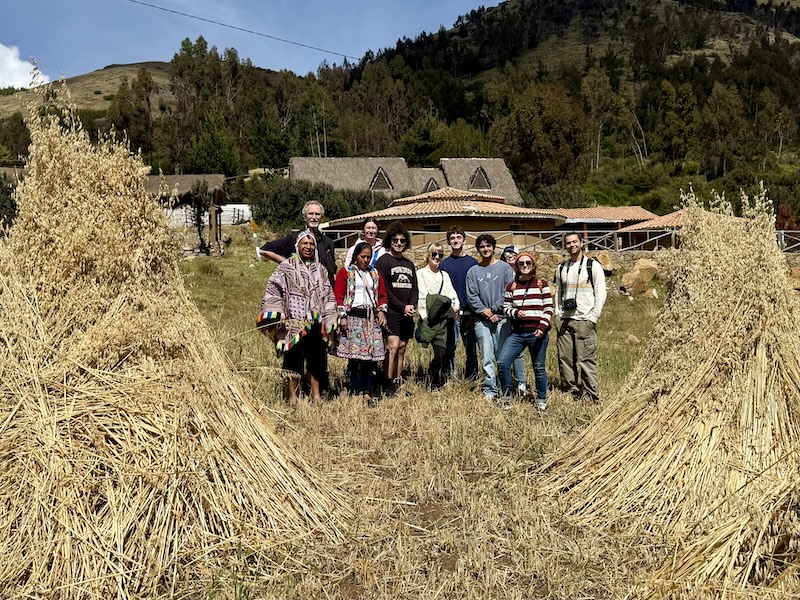
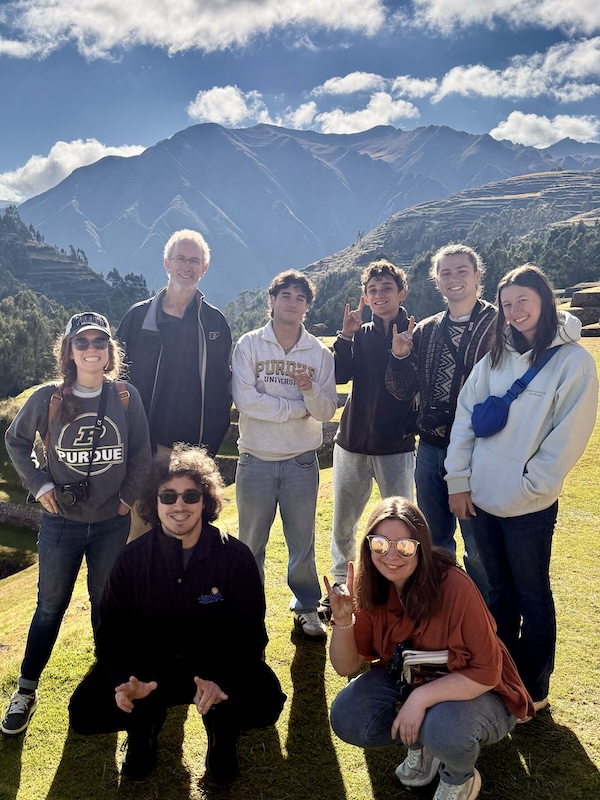
Jonothan Day, far left second row and associate professor in the Purdue University White Lodging-J.W. Marriott, Jr. School of Hospitality and Tourism Management (HTM), and students met with Colca Valley villagers in Peru to research how sustainable and regenerative tourism practices could draw international visitors. (Photo provided)
Purdue University researchers are helping rural communities in Peru develop sustainable tourism that preserves indigenous culture while creating new economic opportunities — work that could eventually become a recurring international study abroad experience for Purdue College of Health and Human Sciences students.
Jonathon Day, associate professor in the Purdue University White Lodging-J.W. Marriott, Jr. School of Hospitality and Tourism Management (HTM); Sarah Renkert, assistant professor of practice in the Purdue Department of Anthropology; and six Purdue undergraduates met with Peruvian village leaders in the Colca Valley to explore how rural tourism can impact communities while practicing sustainability — tourists leave the site as they found it — and regenerative practices as well.
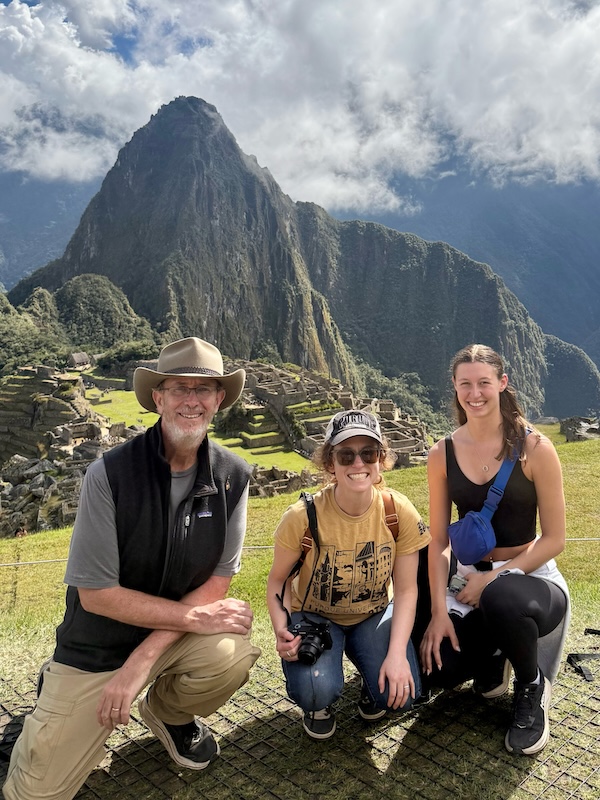
Day, Sarah Renkert, assistant professor of practice in the Purdue Department of Anthropology, and HTM sophomore Taylor Cawood experience Machu Picchu, the top tourist attraction in Peru.(Photo provided)
“It’s tourism that actually contributes positively to a destination,” Day explained. “Regenerative (tourism) is about, ‘What are my actions that can help make this destination better than it was and enhance it and build it up?’ And so, the students were able to see some of the real challenges that tourism has in doing that sort of stuff.”
The recent trip was a culmination of three years’ work with Peruvian villagers and tourism leaders. After completing research and engagement activities conducted as part of Purdue’s ongoing Nexus Institute collaboration with the National University of San Agustín (UNSA), Day and Renkert led a study abroad to showcase practical insights in sustainable and regenerative tourism.
The team spent May 18-June 6 immersing themselves in the Colca Valley culture while also visiting urban areas in Lima and Arequipa, which is home to longtime Purdue research partner UNSA. Day and Renkert began writing their findings for the upcoming “Exploring Peru: A Fieldschool in Sustainable Tourism and Ethnography” research article to be submitted for publication. The students received credits for the HTM 37000 (Sustainable and Responsible Travel) course as well an anthropology course.
Beyond Machu Picchu
Peru attracts millions of visitors each year, most drawn to iconic destinations such as Machu Picchu. But Day’s research looks at a different question: How can rural communities in Peru also benefit from tourism without sacrificing their culture or environment?
Day and his team spent significant time in three Colca Valley villages near a smaller tourist spot where Andean condors are known to soar. For years, tourists have watched the large birds soar at Cruz del Condor (The Cross of the Condor) but then the tourists usually leave. Nearby villages could attract these tourists for an unforgettable and authentic experience attached to the giant birdwatching.
The team spent significant time in the villages of Yanque, Madrigal, and Sibayo, which are rooted in such indigenous culture.
“Sibayo is like a picture book from what you imagine an old Incan village or an Andean village to be like,” Day said. “They’ve maintained the heritage architecture. You go in the square and see the thatched roofs and everything like that.”
Building tourism with local communities
If Peruvian village leaders want to increase their tourism business, Day said they must first think of who they want to attract. The best-case tourist is respectful of their hosts (sustainability) and lifts the community by spending money on authentic goods made by the villagers and not from a factory (regenerative).
“People who will come in and are interested in spending some time to learn about the textiles and the things that the local artisans will do, who appreciate the culture, who appreciate the landscape, these are the folks who encourage those behaviors as opposed to the folks who just sort of come in and are somewhat extractive,” Day said.
The ultimate Peruvian rural tourism immersion experience is called “casa vivencial” where tourists stay with villagers and experience life in the pueblo. But plopping international tourists into a Peruvian village takes some work in advance.
“We spent a lot of time talking to the villagers about what they consider to be the unique and special assets of their community and the parts that they don’t want to see changed,” Day recalled. “Protecting these assets will requires planning and takes commitment of time and energy.”
But Day sees promise in the villages of Colca Valley becoming more open to those nearby condor-watching tourists or even those who skip the birds to experience real, rural Peruvian culture and life.
“These communities are proud of their unique heritage and natural resources. Encouraging them to dig deep and invest in their futures through sustainable and regenerative practices helps reinforce their commitment to a better future. It is challenging to implement these changes while building their businesses,” Day said. “But it’s the same challenges that destinations all over the world are facing.
Day hopes to revisit the villages in the future — as a researcher or a tourist.
“We’d love to continue our relationship with the people in the communities that we’ve grown to love down there,” he said.
Learning in the field
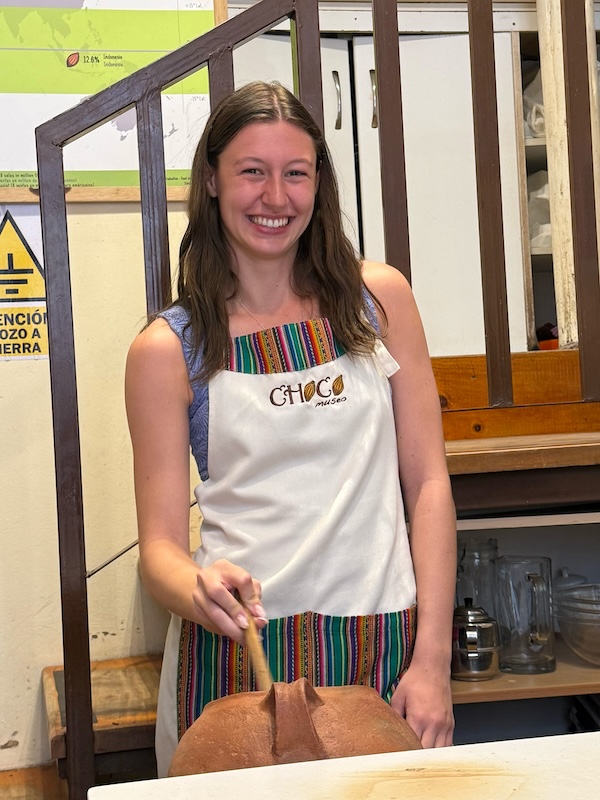
Cawood stirs up some Peruvian chocolate in a Colca Valley village.(Photo provided)
The project wasn’t only research. The study abroad course following the research project gave Purdue students an opportunity to evaluate tourism practices firsthand alongside local leaders.
Taylor Cawood, a sophomore studying hospitality and tourism management, stated the trip was eye-opening as she was able to see tourism management that she learned about in class be conducted in front of her on a different continent. Such work is a career option for the student.
“While I was in Peru, I got to evaluate why they chose certain tour guides and how our big tours, such as the one to Machu Picchu, was different than our local (village) tour guides,” Cawood recalled. “I also put together lists of things I did like and things I didn’t like about how the trip was planned and what could have made it better based on who the audience was.”
Cawood said she most appreciated the different experiences throughout her three weeks. The balance between the urban and bustling nature of Lima and Machu Picchu and the rustic, rural settings of the Colca Valley villages have enhanced her knowledge and passion for tourism management and travel.
“There’s no learning in the classroom that can replicate being in an area and talking to the people around you that live there every day. The experiences are once in a lifetime,” Cawood added. “I got a whole new outlook on tourism and the career paths that can be taken to fulfill my love of travel.”
Discover more from News | College of Health and Human Sciences
Subscribe to get the latest posts sent to your email.