Purdue Nutrition Science research examines metabolic health effects of red meat during grilling season
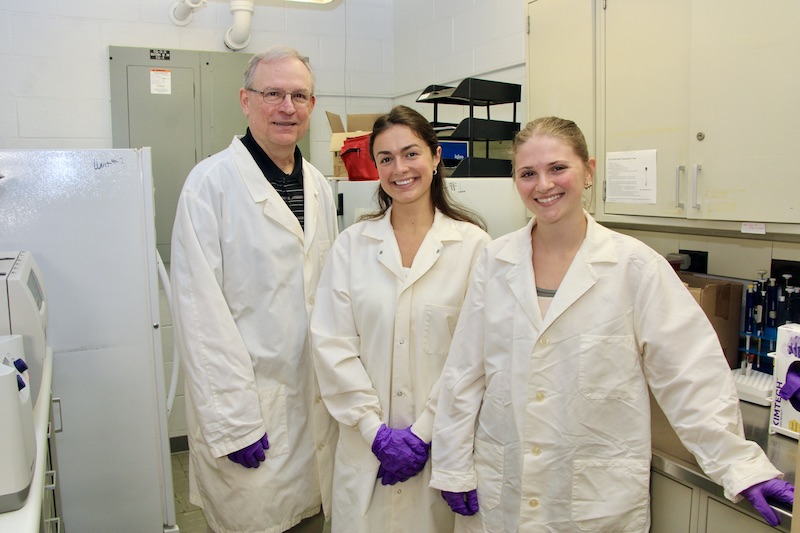
Professor of nutrition science Wayne Campbell and his former graduate students Jaqueline Schmok (middle) and Emily Glover pose for a picture in Campbell’s lab.(Tim Brouk)
Written by: Tim Brouk, tbrouk@purdue.edu
The sights, smells, sounds and, of course, tastes of those summer sizzles wafting from the barbecue grill are centerpieces to most outdoor summer gatherings in the United States.
Beef burgers and steaks will be on most of those grills, according to a report by the savory scientists at Beef Research. Within the study, the National Cattleman’s Beef Association found beef sales between Memorial Day and Labor Day almost doubled that of chicken and almost quadrupled pork in 2024. About 70,000 tons of beef were sold during the week of July 4, 2024.
But isn’t red meat bad for you? According to the National Institutes of Health (NIH), diets that are high in red meat consumption often lead to increased risks of Type 2 diabetes, cardiovascular disease and cancer. However, the NIH also stated organic, grass-fed beef in moderation can safely occupy a balanced diet. This was also confirmed in Professor Wayne Campbell’s lab in the Purdue University Department of Nutrition Science.
Written but in the editing process, “U.S.-Style Healthy Dietary Patterns with Moderate Amounts of Lean Red Meat and Plant-Based Protein Foods Promote Cardiovascular Health: A Randomized Control Trial” had about 30 participants consume healthy meals with varying kinds and amounts of protein in them over a five-week span. The protein was represented by unprocessed lean red meat — steak or ground beef — as well as plant-based protein — nuts (almonds, walnuts and pistachios), seeds and tofu.
Each participant consumed one, five or nine 3-ounce servings of lean red meat per week. The amounts of nuts, seeds and soy products (combined) consumed by each participant was eight, five or two servings per week. The absolute amounts of nuts, seeds and soy products consumed were based on their energy contents, not ounces of the food. In some meals, the ratios of red meat and plant-based protein were 50/50. Other meals had more red meat than plant-based and other meals had more plant-based protein than lean red meat.
“People’s health improved — blood pressures, lipids, glucose,” said Campbell, who co-authored the study with former graduate student Jacqueline Schmok (HHS’25).
Campbell stated that participants’ lipid profiles — namely their low-density lipoprotein (LDL) or “bad” cholesterol — were most interesting. The group that had equal plant-based protein and beef and the group with more plant-based protein than beef saw their LDL levels go down. The group that ate more beef than plant-based protein saw their LDL levels remain steady, showing that lean red meat can still be on your plate at the cookout as part of healthy dietary pattern.
“Is there a magical ratio? No, but it seems as though getting more nuts, seeds and soy products into your diet and choosing moderate amounts of lean red meat when you eat red meat is health-promoting,” Campbell concluded.
Pandemic roots
The roots of the red meat study came during the COVID-19 pandemic. With the mainstream success of consumers using online carryout and pick-up options for their meals and groceries, Campbell worked with Greater Lafayette Pay Less grocery stores to provide convenient meal kits for study participants to pick up at their leisure. They then portioned and prepared the meals at home.
The participants were then brought into Campbell’s clinical lab for blood draws and measurements of body weight, height, blood pressure and a survey on the experience.
Funding
This study was funded by the Foundation for Meat and Poultry Research and Education, one of the many partners that have fueled most of Campbell’s 60 research studies during his tenure in the Purdue College of Health and Human Sciences.
Other funding sources have come from the U.S. Department of Agriculture, National Institutes of Health, Hatch grants from the Purdue School of Agriculture, and agricultural commodity organizations such as the National Cattlemen’s Beef Association, the National Pork Board and the National Dairy Council.
“They are very interested and very supportive of research to make sure that we know what the influences are on human health,” Campbell explained. “We do applied human nutrition research where we’re looking for when people would eat things, how does that influence their bodies metabolically, cognitively and functionally? Those interests align very nicely with the agricultural commodity organizations.”
Another such organization is the Mushroom Council, which funded another recent project in Campbell’s lab.
Mediterranean brains
Research out of Campbell’s lab studies the effects of Mediterranean diets with or without servings of mushrooms and vitamin D-enriched mushrooms on indexes of brain health, such as anxiety, depression, mood, cognitive function and well-being. Published in Foods Journal, “Effects of Consuming White Button and Oyster Mushrooms within a Healthy Mediterranean-Style Dietary Pattern on Changes in Subjective Indexes of Brain Health or Cognitive Function in Healthy Middle-Aged and Older Adults,” studies the brain health of 60 participants after eight weeks of eating meals aligning with a healthy Mediterranean-style dietary pattern with one of the groups also consuming one serving per day (84 grams) of oyster mushrooms three days a week and white button mushrooms four days a week along with the Mediterranean diet. The fungi were either steamed, microwaved, sauteed or raw in meals that also featured servings of vegetables, fruit, whole grains, beans, nuts and seeds often found in Mediterranean cuisine.
“To our knowledge, this is the first study ever to completely control people’s diets while testing mushrooms,” said Campbell, who co-authored the work in his lab with former graduate student Emily Glover (HHS’25) and undergraduate Nok In Chan (HHS’25) as well as Purdue Department of Psychological Sciences professor Dan Foti, PhD candidate Roslyn Harold and former PhD candidate Cassi Uffelman (HHS’23).
Glover added, “It was also the first to use whole dietary mushrooms. All the other studies previously used it as a supplement or as a dried powder. So, it wasn’t in its natural state.”
The researchers found both the mushroom group and the control group benefitted from the Mediterranean diet meals with better short-term memory performance.
Glover is also part of a unique spinoff mushroom study that looks at how the vitamin D in mushrooms affects human brain health. Currently in the final stages of editing, “Effects of Consuming Mushrooms Produced to Contain Vitamin D2 on Self-Reported Indexes of Brain Health and Performance-Based Cognition in Middle-Aged and Older Adults,” studied the brain health of 41 participants after six weeks of adding two servings per day (168 grams) of vitamin D-enriched cremini mushrooms or two teaspoons of breadcrumbs per day (control group) to their habitual meals. Glover is collaborating with Campbell, nutrition science PhD candidate Luz Comboni, Foti and his PhD candidate Skye Napolitano.
Since vitamin D blossoms within mushrooms when exposed to ultraviolet light, growers expose their crops to such light, and the results are a good source of vitamin D in a meal, which is good for the body but what about the brain?
The purpose of this study is to see if mushrooms can be a supplement for people in the winter when vitamin D levels traditionally decline. Of course, vitamin D supplements are sold for this purpose, but mushrooms could be a tasty, more natural alternative with additional health benefits such as dietary fiber. Results in this study are still being tabulated.
Discover more from News | College of Health and Human Sciences
Subscribe to get the latest posts sent to your email.