| Problem statement Solution video |
DISCUSSION THREAD
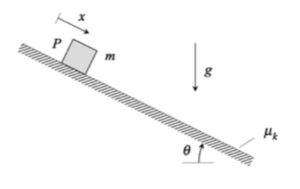
Any questions?? Please ask/answer questions regarding this homework problem through the “Leave a Comment” link above.
| Problem statement Solution video |
DISCUSSION THREAD

Any questions?? Please ask/answer questions regarding this homework problem through the “Leave a Comment” link above.
| Problem statement Solution video |
DISCUSSION THREAD
NOTE: This problem is asking for the distance that the rocket travels between when the speed is v1 and when the speed is zero (“at rest”).

Any questions?? Please ask/answer questions regarding this homework problem through the “Leave a Comment” link above.
| Problem statement Solution video |
DISCUSSION THREAD

DISCUSSION
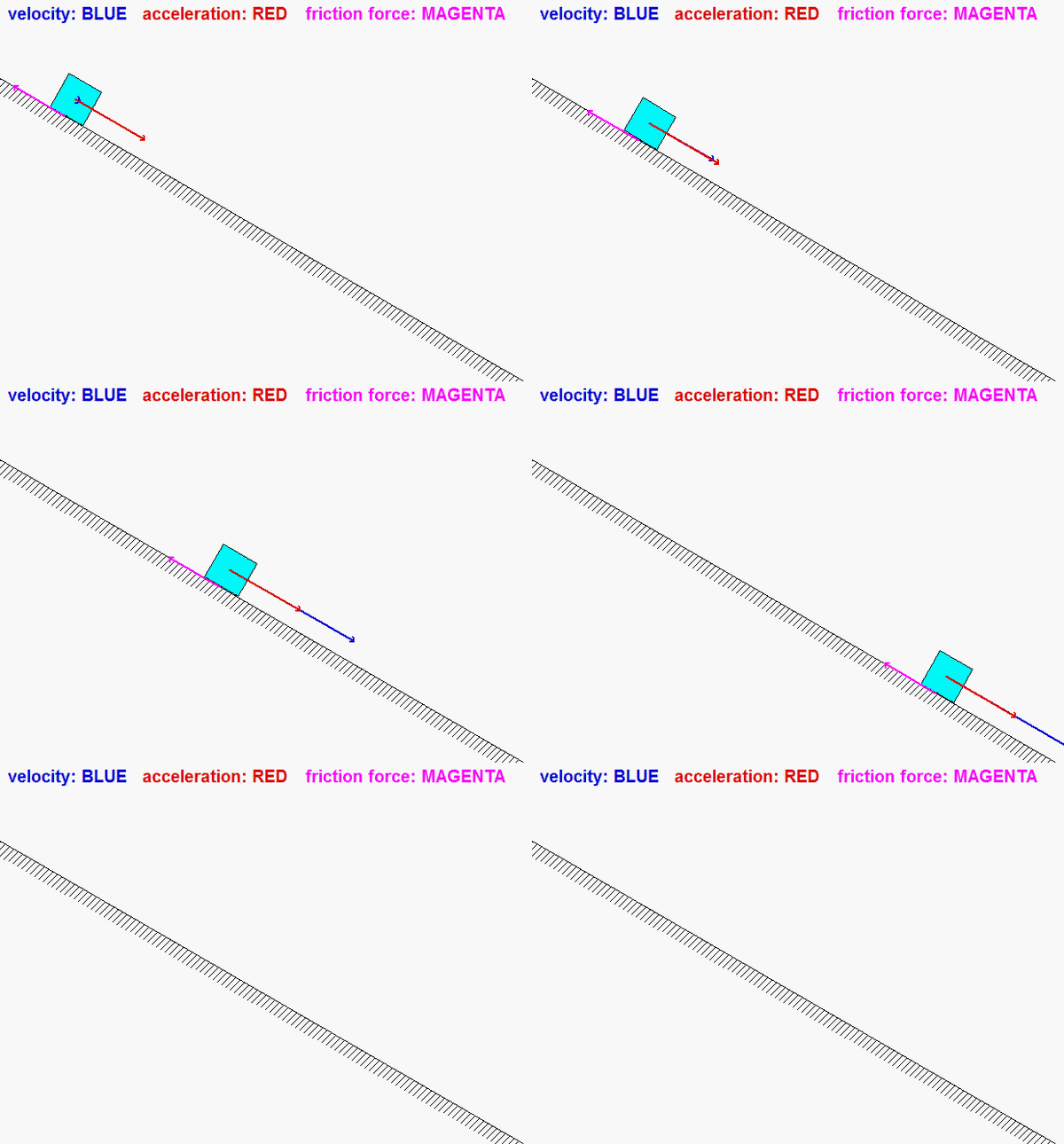
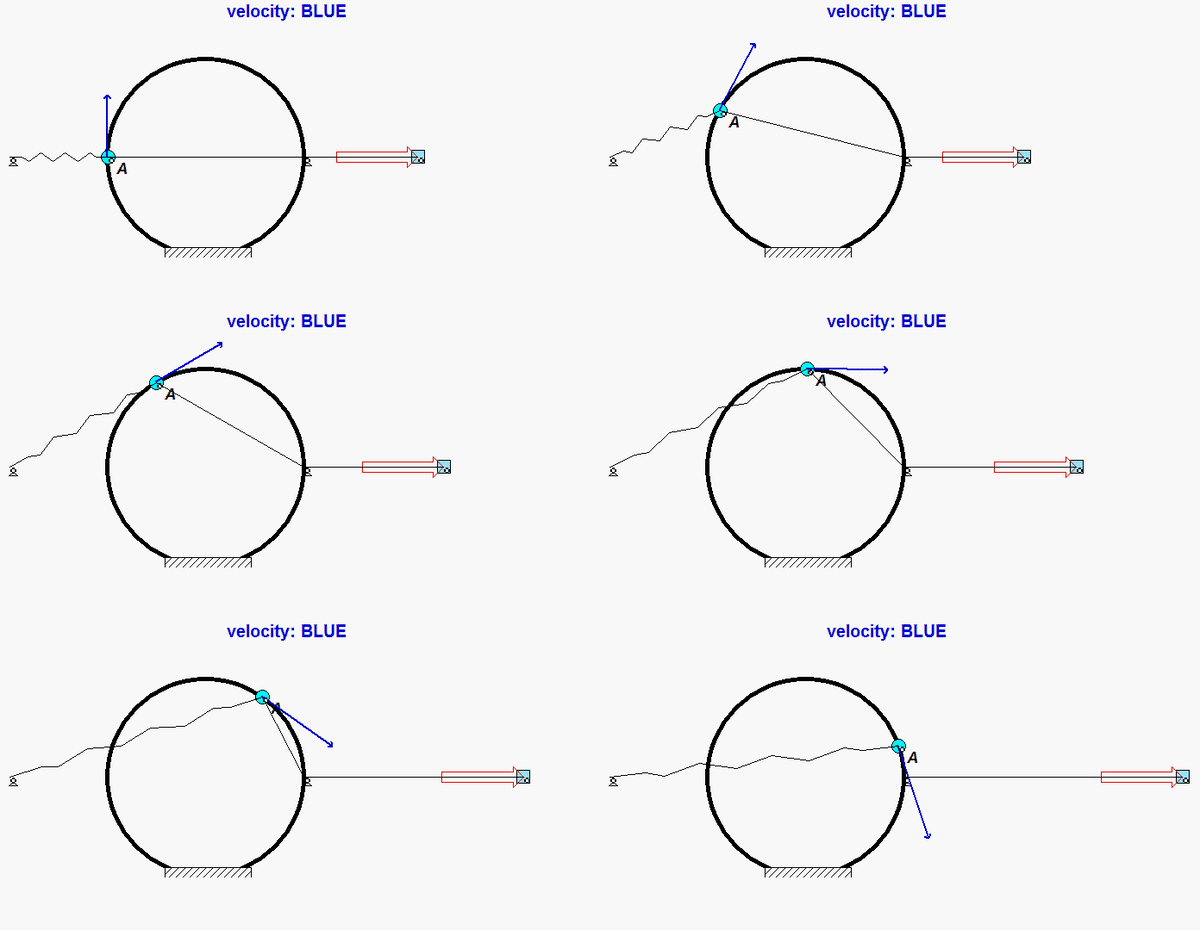
Particle P moves in a way that it is constrained to move along the parabolic-shaped guide, as well as within the vertical slot. Your task here is to determine the reaction forces acting on P by the guide and the slot that are needed to enforce these motion constraints.
As you watch the animation above for the motion of P, why is the acceleration of P always pointing in the y-direction?
Hints:
You should follow the four-step solution plan described in the lecture book, and as discussed in lecture:
Step 1: Free body diagram (FBD) – Draw an FBD of P alone.
Step 2: Kinetics – Write down the Cartesian components of Newton’s 2nd law for P.
Step 3: Kinetics – You need kinematics here to related the known x-components of velocity and acceleration of P to its y-components.
Step 4: Solve – You will have two equations and two unknowns. Solve these for the two reaction forces.
Ask and answer questions below. You will learn from both asking and answering.
| Problem statement Solution video |
DISCUSSION THREAD

Any questions??
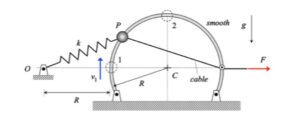
As P moves around on the circular track, two things occur:
From this, we see that the friction force goes to zero as the speed goes to zero. What does this imply about P coming to rest? Can you see this in the animation of the motion below?

HINTS:
You will need to use the chain rule of differentiation to set up this problem: dv/dt = (dv/ds)(ds/dt) = v (dv/ds).
| Problem statement Solution video |
DISCUSSION THREAD

Any questions?? Please ask/answer questions regarding this homework problem through the “Leave a Comment” link above.
Discussion

FOUR-STEP PLAN
Step 1: FBD – Draw individual free body diagrams of A and B, along with an FBD of pulley C.
Step 2: Newton – From each FBD, write down the Newton’s equation for components along the incline. Recall that the pulley has negligible mass.
Step 3: Kinematics – You will need to use the cable-pulley system kinematics that we worked with earlier in the semester. Please review the material from Section 1.D of the lecture book to relate the accelerations of blocks A and B.
Step 4: Solve – Combine your equations from Steps 2 and 3 to solve for the accelerations of blocks A and B.
| Problem statement Solution video |
DISCUSSION THREAD

Any questions?? Please ask/answer questions regarding this homework problem through the “Leave a Comment” link above.
In the animation of the simulation shown below, the RED vectors shown are the forces of reaction acting on particles A and B (such as the force on each particle by member AB, and the normal forces of reaction by the floor and wall).

| Problem statement Solution video |
DISCUSSION THREAD

Since the motion of P is being described here in terms of polar variables of r and θ, it is recommended that you use a polar description for your forces and acceleration.
Use the Four-Step solution plan outlined in the lecture book:
Step 1 – FBD: Draw a free body diagram of C. NOTE: The arm rotates about a vertical axis, meaning that the arm moves in a horizontal plane; that is, the gravitational force acts perpendicular to the plane of the paper.
Step 2 – Kinetics (Newton): Resolve the forces in your FBD into their polar components. Sum forces in the r-direction and set equal m*ar. Sum forces in the θ-direction and set equal to m*aθ
Step 3 – Kinematics: Use the polar kinematics descriptions of ar = r_ddot – r*θ_dot^2 and aθ = r*θ_ddot + 2*r_dot*θ_dot.
Step 4 – Solve. When solving for the normal force, N, acting on C take note of the sign on your answer. What does this sign mean in terms of answering Part (c)?
Any questions?? Please ask/answer questions regarding this homework problem through the “Leave a Comment” link above.
| Problem statement Solution video |
DISCUSSION THREAD

Please note that since P is not sliding on the rotating guide, P is traveling along a horizontal circular path having a radius with the radius r being the perpendicular distance from P to the vertical shaft. It is recommended that you use a set of polar coordinates: er pointing outward from the vertical shaft to O; eφ tangent to the above-described path of P; and, k pointing upward.
Use the Four-Step solution plan outlined in the lecture book:
Step 1 – FBD: Draw a free body diagram of P. With the guide being smooth, there will be only two forces acting on P: the weight and the normal force N from the rotating guide.
Step 2 – Kinetics (Newton): Resolve the forces in your FBD into their polar components. Sum forces in the r-direction and set equal m*ar. Sum forces in the k-direction and set equal to 0 (since P has no vertical motion for all time).
Step 3 – Kinematics: Use the polar kinematics descriptions of the acceleration of P. Note that r is constant for all time and Ω is constant.
Step 4 – Solve. With the above equations you will have sufficient number of equations to solve for the unknowns in the problem, which includes N and θ.
Any questions?? Please ask/answer questions regarding this homework problem through the “Leave a Comment” link above.