| Problem statement Solution video |
DISCUSSION THREAD
Discussion and hints

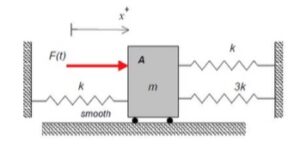
The above shows the results of simulations on this problem for two frequencies of excitation, ω. The upper plot where ω is less than the natural frequency, ωn, and the lower plot where ω is greater than ωn. In each plot, the RED curve is the forcing F(t) and the BLUE curve is the particular solution of the EOM, xP(t). As can be seen from these simulation results:
- The response for ω < ωn has the steady-state response of xP(t) moving in phase with the forcing F(t). That is, during the time that the block is displaced to the right, the force is acting to the right. Conversely, during the time that the block is displaced to the left, the force is acting to the left.
- The response for ω > ωn has the steady-state response of xP(t) moving 180° out of phase with the forcing F(t). That is, during the time that the block is displaced to the right, the force is acting to the left, and during the time that the block is displaced to the left, the force is acting to the right.
In your analysis for this problem, you will be determining the natural frequency ωn of the system, along with the steady-state response. Be sure to check your answer in the end: does it demonstrate the phase relations seen in the above simulation results?
Any questions?? Please ask/answer questions regarding this homework problem through the “Leave a Comment” link above.
does the fact that all springs have equal displacement always mean they can be treated as an equivalent single spring?
Yes, you can usually treat them as one equivalent spring, but it depends on the setup. In this problem, all three springs are connected directly to the same block, so they all stretch or compress by the same distance x. That means they act like parallel springs, so you just add their stiffness: k+k+3k=5k. If they were connected one after another instead, then it would be different.
Yes since they are experiencing the same displacement on the same plane they can be treated as one spring
Yes, since they all have the same displacement and act in the same direction, they can all be added together. This is the main idea of the uppercase K in the formulas for the natural frequency, zeta, etc.
Yes, the springs can be treated as one equivalent spring in the EOM equation; however, it is still better to treat them as three separate forces in the FBD.
In part c.), since there is no dashpot in the system, can we assume the particular solution will be x(t) = Asin(omega(t)), where A is the formula [F0/K / (1-(w/wn)^2]?
Or is the derivation to find that equation always expected?
The derivation is always expected.
Since the surface has no damping, is the EOM simply mẍ + k*x=Fsin(ωt), with no ẋ term at all?
There will not be a x_dot term in the final EOM since this system is not damped. But, the EOM is not as simple as the given values F_o, k, and m. You need to find the coefficients for x and x_ddot by setting up Newton/Euler equations for this problem and solving
I agree! Since the surface is smooth, there won’t be an x_dot term. However all thee springs deform by the same specific amount. Thus, the EOM has more factors/values.
When adding forces, how do I determine the correct sign for each spring force? Should all spring forces be written as −kx, or does the direction of each spring relative to the displacement matter?
I was wondering the same thing since we are now handling systems that are oscillating based on a sine/cosine wave. I think it would make sense to draw the FBD and assume spring displacement in the direction of positive x since F(t) points in the same sense.
the direction of the spring force usually acts in the opposite direction of motion because the spring is trying to restore itself to its equilibrium position before it was displaced by the object.
I think the key idea is that each spring force should oppose the block’s displacement, not just be written as −kx automatically. So if the block moves to the right (+x), the left spring is stretched and pulls left, and the two right springs are compressed and also push left. That’s why all three ultimately contribute negative forces to the EOM. It helped me to think about the physical deformation first (stretch vs. compression) before assigning signs.
No matter the side the spring is on, it will always oppose the positive motion of the system, so all the spring forces will be in the negative x direction.
The direction of each spring force is where the spring is pulling or pushing. When a spring is being extended, it wants to pull in towards the spring. If the spring is being compressed, the spring would want to push out.
It can also depend on what you/the problem defines as the positive x direction. Like someone else says, springs usually oppose the motion, but wether it’s positive nor negative in the EOM is based off of what positive x is defined as
I always like the think of the instance the system is released. If the applied force is pointing to the right. I will assume the springs will act in the opposite direction of the applied force. If springs or dashpot on both sides one will be in compression and the other in tension.
I like to assume that the object is moving in the positive x direction on release, and springs oppose the motion of the object. Therefore, for this problem, the two springs on the right would push the block in the negative x direction, and the spring in the left pulls in the negative x direction.
For the FBD, if the block is displaced in the positive x-direction, should all three spring forces act in the negative x-direction even though one spring is on the left and two are on the right? I want to make sure I’m assigning the spring-force signs correctly before combining them into the EOM.
Yes. This is because the springs want to “return” to the normal state. The one spring on the left is stretched, thus has a force to go “left”. Then the two springs on the right, are compressed, thus also exert a left force on the block. So all spring forces are negative.
Since the left one is being stretched, the restoring force is opposite in the negative direction. For the right springs, they are being compressed so the restoring force is the negative direction again. Usually the forces are opposite of displacement when writing the equation.
For the equation of motion, can the three springs be treated as an equivalent stiffness acting on the block?
Yes, because the displacement for all three springs is the same and they are all connected to the same block, they can be combined into one equivalent spring force. I find writing the Newton-Euler equations will give this result automatically, so I don’t tend to overthink the equivalent spring too much.
I concur with Ishita on this topic. As you learn this material, I recommend that you keep it simple. If you set up your FBDs using the established sign conventions, the derivation of the EOM using the N/E equations makes moot the questions on effective stiffnesses, effective masses and effective dashpots, and naturally produces the correct EOM.
For some problems such as the base excitation problems covered next week, thinking in terms of effective springs and dashpots can create more confusion and uncertainties than just making it simple with the usual N/E development of the EOM.
How would the equations of this system look different if A were replaced with a no-slip drum instead?
If A were a no-slip drum instead of a sliding block, you couldn’t just use the sum of forces. You would have to account for rotational inertia by setting up a moment M = Ialpha and then relate x = rtheta
Should we work out the full solution, or are we not given the initial conditions to do that? Is the particular solution just relating to the solution involving the F0 term?
I believe that you can reach the full solution. We are given numerical values for the variables F_0, m, k, and w. Additionally, the particular solution in an undamped system is given by x_p (t) = Asin(wt), where A = (F_0 /K) / (1 – (w/w_n)^2). You can find w_n from the EOM, and plug the known values and w_n into this equation to find the particular solution in terms of time.
You are asked here to find only the particular solution.
I’ve seen a few other people ask similar questions to this, but the answers didn’t quite make sense to me. Will we always be allowed to use generalized equations for these questions? On the other hand should we derive for coefficients every time?
I think generalized equations are fine once you know the system matches that form. You should derive the coefficients from the free body diagram each time so you do not accidentally use the wrong terms.
^^ On exams, if we just have the formulas for X(t), x_dot(t), and x_doubledot(t), is it fair to just show the formulas for the coefficients? Or is the derivation between all those steps necessary?
You need to show your derivations.
Since all three springs experience the same displacement x, can we always treat them as a single equivalent stiffness k_eq=k+k+3k=5k? Or are there situations where even with the same displacement, we shouldn’t combine them like that?
I believe you can always combine them as long as the displacement is the same among the springs. Since they are all connected to the same block that must be the case.
If the given force only has sin or cos, is it safe to assume that A or B respectively will end up being zero? (assuming you use Asinwt + Bcoswt as your particular solution equation). So using xp(t) = Asin(wt) instead of the full equation.
I think the A and B coefficients come from plugging in the initial conditions into the general solution, not from the forcing term.
A and B are found from substituting the general form of the particular solution into the forced EOM.
The response coefficients C and S are found from enforcing the ICs on the total solution.
Do we have to worry about writing the EOM in terms of only x or can we leave the force in terms of t? I’m confused with the instructions saying find a EOM in terms of x but I don’t know how to remove the t-term from the forced response.
I believe the force can be left in terms of t. For in-class examples, answers to questions with the same wording contained t as a parameter.
t is the independent variable and x is the dependent variable. The EOM will be explicitly in terms of x and its derivatives, with both x and the forcing be explicit functions of the independent variable.
Would it be preferable to leave our EOM for part (b) in standard form? That is, should we divide the entire EOM by whatever coefficient we find for x double dot?
I believe either way is an acceptable answer, but I prefer standard form because it will simplify solving for Xp.
Yeah, the standard form gives you the W_n almost immediately for part c.
When solving for the particular solution, is it best to assumpe xp = Asin(omega * t) + Bcos(omega * t), or can we use a simpler guess? For example, since the force is sinusoidal can is it fine to just guess xp = Asin(omega * t)?
You can use the simpler guess you suggested only if there is no damping (no x_dot term in your differential equation). If there were a dashpot (damping), you would have an x_dot term. Because the derivative of sine is cosine, the x_dot term would need a cosine term to balance it out. It is also acceptable to use your simpler guess if there is an x_doubledot term. This is because the aforementioned cosine would turn back into a sine.
I noticed the surface is smooth here, so we don’t need to worry about moment equations or no-slip conditions. It seems like we just need a single Newton equation for the sum of forces in the x-direction.
What is the difference between two springs with spring constants of k and 3k and one spring with spring constant 4k?
In this problem there isnt really a difference since they experience the same displacement at all times. So whether the two right springs are separate or replaced by one 4k spring, the EOM remains the same.
In this specific question there is no difference between the two. Its like in circuits when you find an equivalent resistance. But if these springs are compressed at different lengths then the force will be different for each and you’d need to separate the two.
Because the force of F is a function of sin and the particular solution will be comprised of sin and cos, will this mean that the cos function is obsolete and that the B term will go to 0? Can we assume that, in this case, the force of F is the most relevant force for the particular solution?
As far as I can tell, I think the cos term is not considered obsolete and this is because there is a shifting term there. Both the terms are necessary to get to the full steady-state solution.
When finding the particular solution, is it better to assume the full form xp(t)=Asin(ωt)+Bcos(ωt) every time, even if the forcing is only sine?
No, you do not always have to use the full sine and cosine form if the forcing is only sine. For this system, assuming only a sine particular solution works, but the full form is a safer general method to use.
When I derive x_p(t), do I need to compare the forcing frequency ω to the system’s natural frequency ω_n first to check for resonance before choosing my assumed form of the particular solution?
No.
When finding Keq, do we treat the spring on the left and the combined springs on the right as being in series or parallel? They’re on opposite sides of the block but are still connected so the displacements are the same so it would be considered parallel right?
While the springs are technically in parallel, I find it helpful to keep the springs separate in the FBD instead of combining them into one spring. That way, it it is clear with addition that the springs create a total force of 5kx to the left.
I like your approach.
the problem only asks for the steady-state response, Xp(t), but since the system is smooth, doesn’t that mean that the transient solution wouldn’t die out? or do we just ignore it for the problem?
From my understanding it would be included if they asked for the full solution but the particular and transient solutions are separate and we were only asked to give the particular portion this time
the problem is pretty straightforward if we combine all spring effects into one term, and then setup the EOM. Since the guide is smooth we dont have to worry about any friction. The final EOM looks like the standard forced vibration form, which makes it easy to setup the particular solution.
When we draw out the overall FBD of the block, does it really matter which direction of the forces we do for the spring? So long as they are consistently opposite, they should be fine, correct?
Yes, it does matter in which direction that you draw your spring forces. The directions that you draw for these forces should be consistent with the sign conventions that are used in the problem.
Do not take shortcuts. You can get burned if you try to use rules of thumb such as being consistently opposite.
I understand there is a formula to calculate for the coefficient of the particular solution, but we should still be able to solve this through a differential equation method right? I said x_p was A sin(wt) and plugged in for x and x double dot but got a different answer. Does anybody know why this does not work?
I did it this way but I also made sure to include the cos term so my full guess for the particular solution was x_p=Acos(wt)+Bsin(wt) and then I took the derivatives from there
Sorry I simply messed up my calculation. Now both methods produce the same number
When we are making the free body diagram for this problem, do we need to include forces that are irrelevant to the problem (friction and gravity)?
i would include them, but as you said, they don’t factor into the problem.
You should include ALL forces in your FBDs whether or not they will appear in your equations.
I found that in this problem writing down the basic equations for the EOM and the forcing equations was helpful in finding what I would not have. Like the x_dot term as there is no dashpot.
One thing that helped me was combining the 3 springs into an equivalent stiffness of 5k since they all act in the direction of the block when the block moves. Then the EOM becomes much more straightforward to set up with 3 terms instead of 5.
I would recommend to keep things simple and not get into equivalent springs and dashpots.
How would the equation of motion change if the surface was not smooth and there was friction acting on the block?
That adds a resisting term to the equation of motion, and depending on how you model it, it can make the equation nonlinear or act like damping. Basically, instead of a clean spring mass system, the motion would die out more over time.
It would get messy. We will not ask you to deal with any vibrations problems having sliding friction.
Is the final equivalent equation necessarily periodic with the same frequency as the force acting upon the block?
I don’t think so, the steady state motion ends up matching the forcing frequency, but at the start you also get that transient part from the system itself. That part can be different and then it dies out over time, so long term it matches the input force.
I think the particular solution will always match the forcing frequency, but the total response probably isn’t periodic at the same frequency since it also includes the homogeneous solution oscillating at ωn\omega_n
ωn.
Spring forces and damper forces should always point in the same direction, right?
Depends on how the block is moving at that moment. The spring force is based on displacement and always tries to pull it back toward equilibrium, while the damper force depends on velocity and always opposes the motion.
Not all of the time. Since dampening forces use x dot, those rely on where the particle is going, while spring forces just use where it is currently (x). For this class it seems they line up most of the time.
That is not a reliable rule of thumb.
One interesting real-world fact that I can think about when doing this homework is that since the system has no damping, the steady-state response will become larger as the forcing frequency gets closer to the natural frequency. The strings can be considered to have an effective stiffness of 5k, so the natural frequency will be wn = (5k/m)^(1/2). This means that in the undamped version, the amplitude at the resonance frequency is unbounded. Therefore, it is so important to have damping systems in the real-world, especially in mechanical systems. It limits the amplitude, decreases transmitted forces, and reduces strain/fatigue which can lead to eventual structural failure.
If the force had a cos involved would that just make our x_p equation be Asinwt + Bcoswt
All three springs in this problem are horizontal, yet one connects from the left wall and two connect from the right wall. A common instinct is to subtract the right-side springs from the left-side spring since they oppose each other. Why is it correct to add all three stiffnesses together into a single keff=5k, regardless of which wall they attach to?
Keep it simple. Stay away from equivalent springs.