| Problem statement Solution video |
DISCUSSION THREAD
Any questions?? Please ask/answer questions regarding this homework problem through the “Leave a Comment” link above.
Discussion
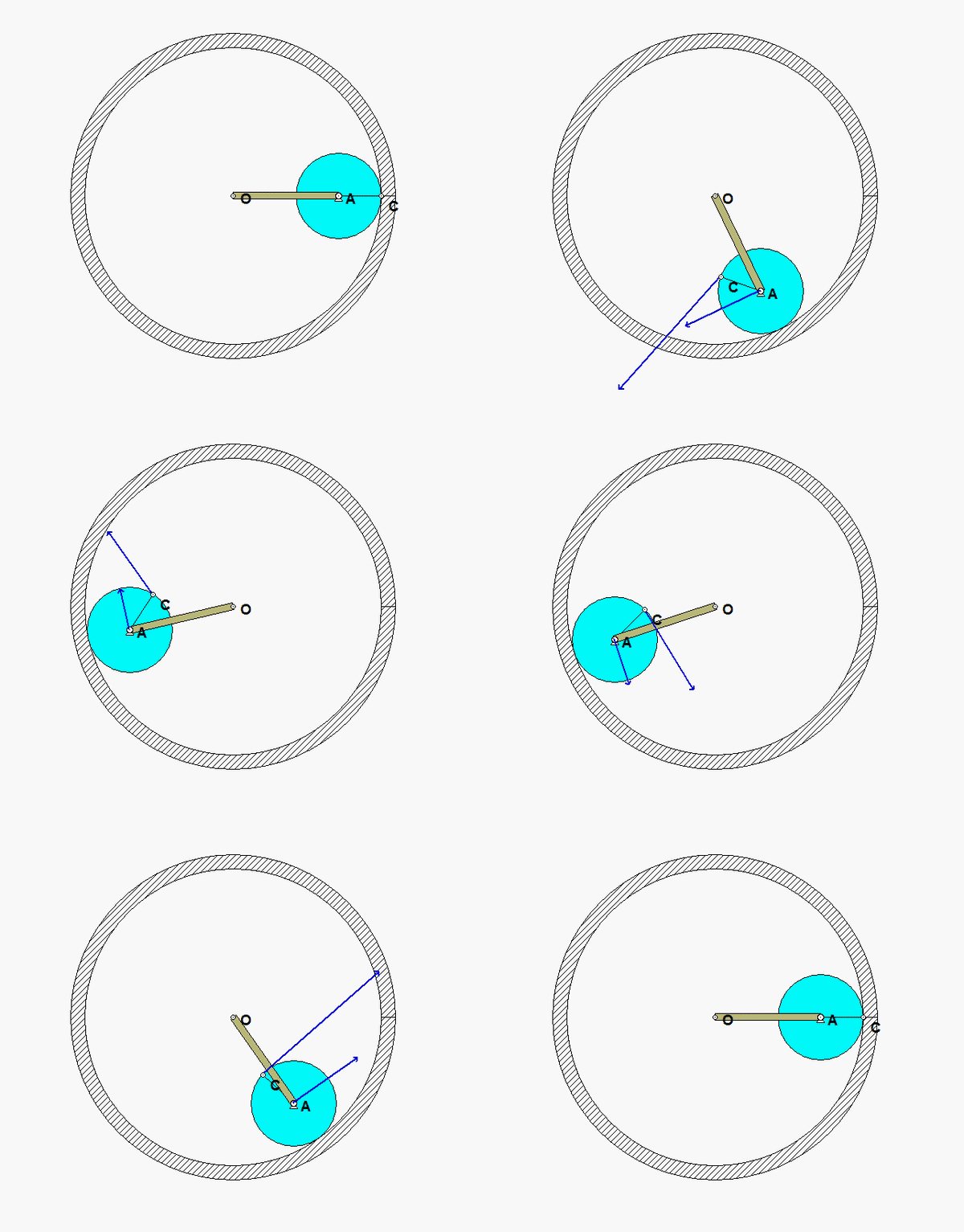
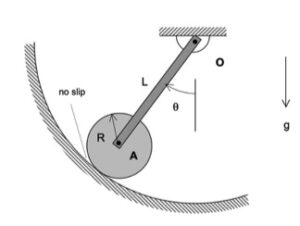
The animation shown above demonstrates the kinematics of the motion of the bar/disk system. The bar rotates about end O. The disk is pinned to end A of the bar, and rolls without slipping on the fixed circular surface. Since the disk rolls without slipping, when point C on the outer circumference of the disk is in contact with fixed ground, the velocity of C is zero. You can readily see this in the animation above.
The instant center (IC) for the disk is the contact point of the disk with the fixed surface. Note the relative sizes of the speeds of A and C in comparison to their distances from the IC. When are the speeds the same? At what positions is the speed of C twice that of the speed of A?
You are asked to determine the rotation rate of the bar when the bar reaches the vertical position shown below.
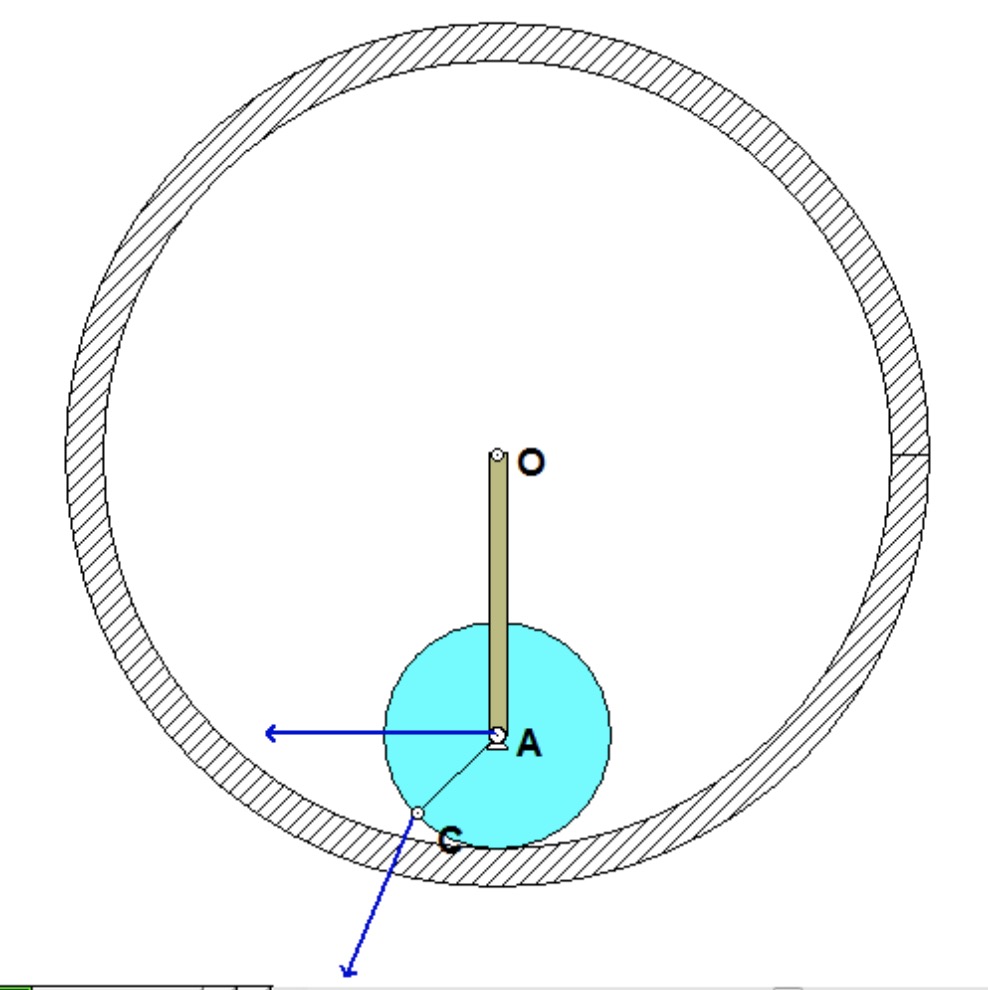
HINT: As always, we should follow the four-step plan for solving this problem.
STEP 1: FBD. We will be using the work/energy equation to determine this angular speed. Based on earlier recommendations, we will make the choice of our system BIG, including the bar, and disk together.
STEP 2: Kinetics (here, work/energy). The total kinetic energy of the system shown in your FBD above is that of the bar + that of the disk. For the bar, it is recommended that you choose the fixed point O as your reference point for the KE. For the disk, it is recommended that you choose the center of mass A. Be sure to identify the datum line for the gravitational potential energy, and use this in writing down this potential.
STEP 3: Kinematics. You need to relate the speed of A to the angular speeds of the bar and of the disk.
STEP 4: Solve
Is there static friction force acting at the point of contact? Even though it does no work, should we still include it in the FBD
Yes. In order for the contact to be “no slip” there must be a tangential force (friction) acting. You should show all external forces acting on your FBD, regardless of whether work is done by the forces.
Does the no-slip condition at the disk affect how we calculate the kinetic energy of the system?
The no-slip condition means that the velocity at the contact point, C, will be zero. This can be used to simplify the kinetic energy for the disk, since only the rotational kinetic energy will be left. Remember to use the parallel axis theorem though
When defining the datum, can we chose either the top or bottom of the system when calculating V1 and V2 for mgh? Will the signs work out as long as the same datum is kept consistent throughout the problem?
The choice of horizontal datum line is totally up to you. As you say, the burden is on you to be consistent in using the same datum for both positions (although you can use different datum lines for each body).
Will both the disk and bar have a non rotational kinetic energy of 1/2 *mass *velocity^2 at their respective centers of masses?
It depends on the reference point that you choose.
* For either rigid body, if you choose its center of mass G as the reference point, then you have T = 0.5*m*v_G^2 + I_G*omega^2.
* For either rigid body, if you choose a point C with zero velocity, then you have T = 0.5*I_C*omega^2. For this problem, you could choose point O for the bar, and for the disk choose the no-slip contact point.
It’s your choice.
When finding the velocity of point A, do we have to attach a moving observer to the disk or is A considered to be on the same rigid body as the contact point with the surface?
I would use the standard rigid body velocity equation between the contact point and point A (since they are on the same rigid body).
Will there be reaction forces at both pin A & pin O of A_x, A_y and O_x, O_y respectively?
If you choose for your system OA + disk, then the FBD for this system with have reactions at point O. The reactions at A for this system will be internal and will not appear on your FBD.
can we ignore friction due to no slip?
In my analysis I included it as part of the FBD but found that since the friction force does not travel a distance, it does no work and so it didn’t impact my work energy equation.
1
One thing that helped me for this problem was using work-energy on the combined bar and disk system so all the internal forces cancel out. Then we can just use the no-slip condition to relate the disk rotation to the velocity of A.
I also found it very helpful in step 3 to use the velocity of A found from the no slip condition and then relate it directly to w_disk. This ensures that in step 4 when you solve, you are only dealing with the angular velocity the problem asks for: w_bar, which should be your only unknown in the work energy equation after simplifying T_2.
should we find IC of the disk or find another point to use?
Knowing the location of the IC of the disk would be helpful in solving this problem.