| Problem statement Solution video |
DISCUSSION THREAD
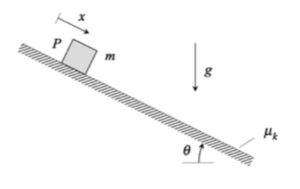
DISCUSSION
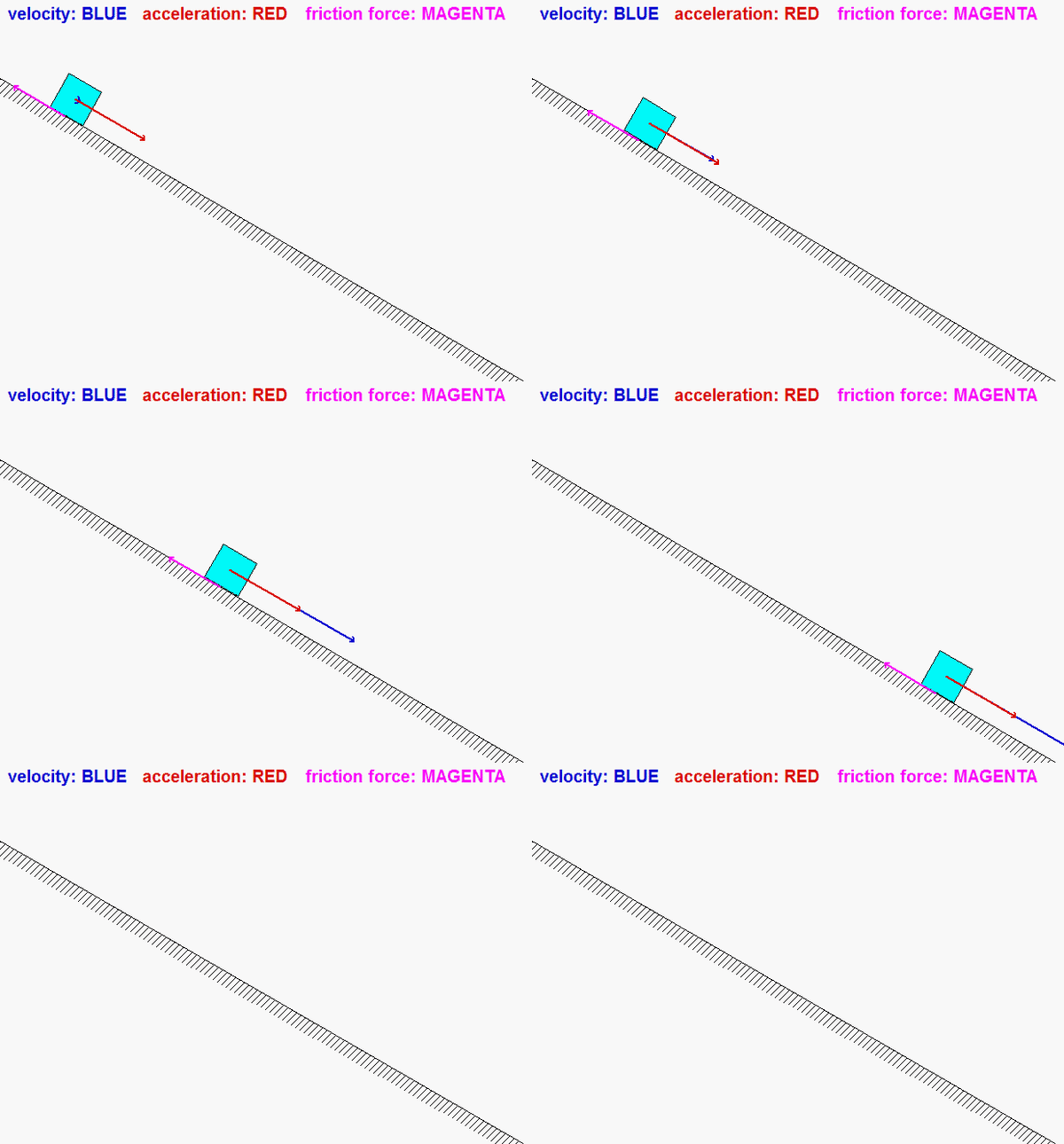
As P moves along the rough incline, the friction force will always oppose the motion of the block. As you see above, the friction force points up the incline as the velocity of the block points down the incline. Be sure to capture this in your FBD.
Hints:
You should follow the four-step solution plan described in the lecture book, and as discussed in lecture:
Step 1: Free body diagram (FBD) – Draw an FBD of P alone.
Step 2: Kinetics – Write down Newton’s 2nd law for P.
Step 3: Kinetics – Newton’s 2nd law relates the forces acting on P to its acceleration. In this problem, you are asked to relate the speed of P to the distance that it travels along the incline. To this end, it is recommended that you use the chain rule to convert the acceleration to speed through x: a = v*(dv/dx).
Step 4: Solve – Solve for the speed through the integration of Newton’s section law in terms of x.
Ask and answer questions below. You will learn from both asking and answering.
For this problem, I found it helpful to break the (dv/dx) derivative by multiplying both sides of the equation by dx, and then integrating each side for their respective variable.
Does downward speed refer to the vertical component of the speed or is it the overall speed of the block sliding down the hill, with the “downward” just to indicate its going down the hill.
I believe downward speed refers to the speed of block P as it slides down the incline, which we can solve for by using Newton’s 2nd Law in the x-direction, which is specified to point downwards along the incline.
(Replying to Aiden Burke about downward speed of block P) Are you implying that you redraw the coordinate system of the motion such that the X-direction is parallel to the incline, making v correspond to the blue arrow in the animation given? (1)
There is no acceleration or speed in the y direction going into the incline, so that makes it easier to solve for the normal force.
What if our block was moving fast enough that air resistance (which depends on velocity, F_drag = -cv^2) became significant? Would the v(dv/dx) substitution still work?