| Problem statement Solution video |
DISCUSSION THREAD
Any questions??
Discussion and hints:
It is recommended that you use an observer attached to the boom. As we have discussed in class, your choice of observer directly affects four terms in the acceleration equation: ω and α (how the observer moves), and the relative velocity and relative acceleration terms (what the observer sees). Note that the remainder of the discussion here is based on having the observer attached to the boom.
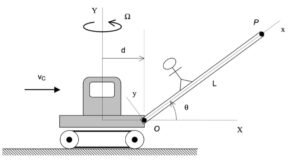
The boom shown above has TWO components of rotation:
- a rotation rate of Ω about a fixed axis (the “+” Y-axis), and,
- a rotation rate of θ_dot about a moving axis (the “+” z-axis)
(Be sure to make a clear distinction between the lower case and upper case symbols.)
Therefore, the angular velocity of the wheel is given by:
ω = Ω J + θ_dot k
The angular acceleration vector α is simply the time derivative of the angular velocity vector ω : α = dω/dt. In taking this time derivative,
- Recall that the J-axis is fixed. Since J is fixed, then dJ/dt = 0.
- Recall that the k-axis is NOT fixed. Knowing that, how do you find dk/dt?
With the observer attached to the boom, what motion does the observer see for point P? That is, what are (vP/O)rel and (aP/O)rel?
NOTE: Pay particular attention to the motion of the reference point O. What path does O follow? And, based on that, how do you write down the acceleration vector of point O, aO?
How do we find the acceleration of point O?
This might be incorrect but I believe that because point O is moving at the constant velocity v_C along with the rest of the crane, it does not have any acceleration at that point.
Please note that O is not moving on a straight path; the curved path will induce a centripetal component of acceleration. The easiest way to determine the acceleration is to use the rigid body acceleration equation with the reference point being point C (the point on the cab about which the cab rotates).
For this question, I feel using the insight as mentioned in the discussion that the observer placed on the boom can help simplify terms of relative velocity and acceleration I think which makes the problem easier to solve than an alternate plan of placing the observer somewhere else.
At what point in my equations should I convert from the fixed axis to the moving axis? Can I initially convert the angular velocity to the moving axis and solve the problem from there, or keep it in the fixed axis and convert my final answer to the moving axis?
You must wait until AFTER doing the differentiation of omega to find alpha before doing the transformation of coordinates from one system to the other. If you do it before the differentiation, you will pick up extraneous terms in alpha.
The hint said to attach the observer to the boom. If I had attached the observer to the cart instead (so it rotates but doesn’t look up or down), would that have made things significantly harder? When approaching this kind of problem how do we come to decide where to put the observer?
This is an excellent question. I hope that everyone is asking this question!
With the observer attached to the boom, they experience two components of rotation: 1) a fixed-axis rotation at a rate of Omega, and 2) a moving-axis rotation at a rate of theta_dot. Through differentiation, you find that the observer has a NON-ZERO angular acceleration, alpha. The observer on the boom sees NO MOTION for end P on the boom; therefore the relative velocity and relative acceleration terms are ZERO.
Suppose that the observer moves to the cab. In this case, the observer has only a single component of rotation Omega about a fixed axis. Since Omega is constant, the angular acceleration of the observer is ZERO. The observer on the cab sees a circular path for end P on the boom. This gives a NON-ZERO relative velocity and relative acceleration for P (don’t forget that although the observer sees a constant speed for P, there will be a centripetal component of acceleration observed for P).
You asked above about which is more difficult – having the observer on the boom or on the cab. The answer to that is “it depends”. If you find it easy to differentiate omega to find alpha, then you will like having the observer on the boom. On the other hand, if you are good a visualizing the relative motion of P from the cab, then you will want to have the observer on the cab. It is YOUR preference, generally. On exams, we will prescribe which observer to use to make the exam question easier to grade.
Does this help?
For these types of problems should the goal be to write the final vectors in terms of the moving unit vectors or the fixed unit vectors?
Either way: in terms of moving coordinate unit vectors or fixed coordinate unit vectors. Just be sure that the final form of the vector is in one or the other, not a mix.
Personally, I prefer the moving coordinate unit vectors as they seem more relevant in interpreting the final result in most cases. But that’s just me.
Do we have to use the relative acceleration formula for P respect to O? If so why?
Your reference point needs to be a point on the same rigid body onto which the observer is attached. The path of point O is the simplest of any point on boom OP; it is recommended that you use that point as your reference point.
Is it okay to leave the omega term and other intermediate solving steps in a mix of moving and fixed coordinates? For example, when writing out omega, is it okay to leave it as ω = Ω J + θ_dot k as the hint described it, or are we expected to rewrite this?
Please write these vectors in their final form in terms of a common set of unit vectors.
Professor, in class you said that if we attach the observer to the rotating boom then v_rel = a_rel = 0, however, on the example about the tank, which is similar, you treated it as v_rel = vrel i. For this problem, should we treat v_rel as 0 or as v_c in the big I direction?
I believe for this problem v_rel should be zero since the distance between point “o” and “p” should be constant. The tank problem had the bullet moving relative to the barrel.
I am a bit confused on converting from J to j, since there is a distance d from J to j does that effect the conversion or are they equal?
Unit vectors represent only a direction. The placement of the origin is not relevant when transforming from unit vectors in one coordinate system to another. In short, the distance d is not relevant.