| Problem statement Solution video |
DISCUSSION THREAD
DISCUSSION
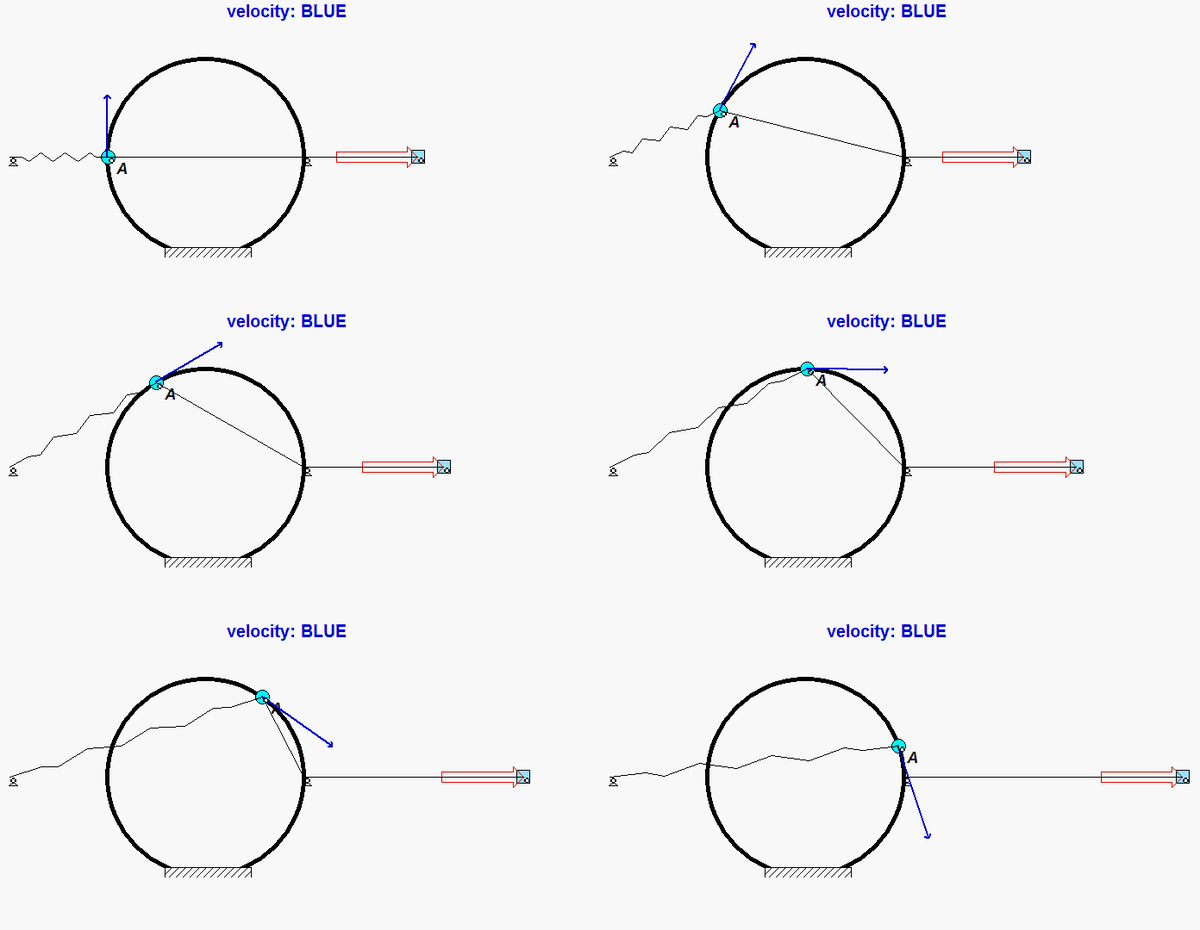
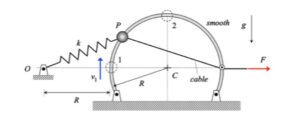
Since the problem asks for a relationship between the change of speed of P and the distance traveled by P, the work/energy equation is a natural method of choice. Recall that with the work/energy equation, we typically want to include as much in the system in order so that we can make as many forces to be workless, internal forces within the system. To this end, consider a system made up of P and the cable connected to P.
Hints:
You should follow the four-step solution plan described in the lecture book:
Step 1: Free body diagram (FBD) – Draw an FBD of the system made up of P, the spring and the cable. Which forces in your FBD do work on the system?
Step 2: Kinetics – Write down the work/energy equation for the system, and the terms included in this equation.
Step 3: Kinetics – In order to determine the work done on the system by the applied force F, you need to find the distance traveled by the end of the cable as P moves from position 1 to position 2. HINT: This distance is equal to the amount of cable that is pulled over the pulley as P moves from position 1 to position 2.
Step 4: Solve – Solve for the final speed of P at position 2.
Ask and answer questions below. You will learn from both asking and answering.
Should we include forces from the spring in our FBD if we are following the BIG philosophy? I’m thinking no because the spring is anchored to both the particle and the fixed O, which would not cause work. If this not the case how should I go about finding work-producing spring forces for this case?
I recommend including the particle, the spring and the cable in the system. For this choice, the spring adds to the potential energy.
Is it possible that the force from the spring could be “stronger” than F, and would prevent P from ever reaching point 2?
That is possible. Are you finding this to be true?
Not for this problem, as my V2 value would be positive for P to reach position 2, indicating that the particle is moving in the direction of F at position 2.
I was thinking that given the right initial conditions, it would be possible for the particle not to make it to position 2 at all, which would be indicated by a negative value inside the square root in the final V2 value. This would then be an imaginary number, which makes sense, as there would never be a velocity at position 2 if the particle never makes it there.
I am struggling to figure out the potential energy component of the spring at position 2 when it is stretched. Are there any pointers you can give me?
You know that the potential energy in a stretched/compressed spring is given by V = 0.5*k*Delta^2, where Delta is the amount of stretch/compression in the spring.
* The spring is known to be unstretched when the spring length is R.
* At position 2, the spring length is sqrt((2*R)^2 + R^2).
With this, Delta = sqrt((2*R)^2 + R^2) – R.
When solving for the non-conservative work done by the applied force, where is e_t measured from? How do we evaluate that dot product?
Since W = Fd, the distance is the amount of string that was pulled.
If I made my datum even with O and C, should the mgR component of V2 (potential energy, not velocity) be positive or negative? Because potential energy has increased, however the force of gravity is pointing downwards in the negative direction (assuming my coordinate system has +y in the upward direction).
Once you have chosen the datum line for gravitational potential energy, the gravitational potential energy is positive if the particle is ABOVE the datum line and is negative if the particle is BELOW the datum line. This comes from the derivation of the gravitational potential energy found in Section 4.A of the lecture book.
Does the work done by F depend on the specific geometry of the arc, or is it purely a function of the change in the cable’s total length?
I don’t quite understand why the energy given to the block by the string is proportional to the force times displacement of the string. I understand work is equal to force times displacement, but I don’t understand how that is mathematically equal to the nonconservative energy the block gets, U_1-2(nc) = integral(F_vec * e_t)ds, since the direction of F_vec is not always in the tangent direction.