| Problem statement Solution video |
DISCUSSION THREAD
Ask and answer questions here. You learn both ways.
DISCUSSION and HINTS
Recall the definition of angular momentum of a particle P (of mass m) about a fixed point O: HO = m rP/O x vP.
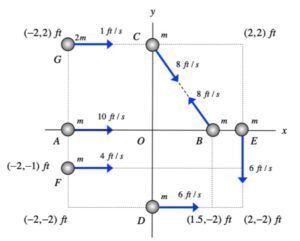
For this problem, use this equation to find the angular momentum for each particle and add these together. As you work the problem, consider the number of cancellations that occur among these terms and consider why these cancellations occur. This will help you get insights on the meanings of angular momentum.
Is this similar to the concepts used in pg.256-266 of the lecture book?
This is a problem involving the calculation of angular momenta for a particle as covered in Section 4.D of the lecture book:
H_O = m*(r_P/O x v_P).
You are asked to do this for all seven particles individually and add the results together. If you can see that one of the seven might cancel with one of the other six, then say so with explanation and without calculating.
Let me know if I am not addressing the question that you have asked.
Do I need to draw an FBD for this problem?
No. There are no kinetics in this problem. It is just the mathematics of calculating angular momentum.
In a more general scenario, what does it mean if, for a system at an instant in time, the angular momentum sums to zero about a certain point?
There is not much that we can say in general. We would need more information on what is acting on the system as a whole.
Let’s say, for example, that for this system there are no moments about O due to forces acting externally to the system. (Maybe the motion of these particles is due to an internal explosion. A big bang.) In that case, the angular momentum for the system does not change. So, since the angular momentum of this system about the fixed point O is initially zero, it remains zero. This is true even if the particles collide with each other. Please note that having zero angular momentum does NOT mean zero motion.
Does this help?
I think so, thank you!
Why does particle A contribute 0 angular momentum even though it has the highest velocity?
I am pretty sure it’s because, if the line of action passes directly through the point of rotation (the origin), d = 0, the cross product is zero. Velocity doesn’t matter if there’s no perpendicular distance.
Thank you, that helps very much!
Think about the form of the expression for the angular momentum of A about O:
H_O = m*(r_A/O x v_A)
Note that r_A/O is parallel to v_A. What does that say about the cross product of: r_A/O x v_A ?
Would it just be the mass * velocity * perpendicular distance?
And since there is no perpendicular distance, it’s 0?
What direction are C and B in, or can they just cancel each other out?
Information on the direction of the line BC is provided in the figure for the problem. The velocities of B and C are along that line.