| Problem statement Solution video |
DISCUSSION THREAD
Any questions?? Please ask/answer questions regarding this homework problem through the “Leave a Comment” link above.
Animation

HINTS:
STEP 1 – FBD: Draw three free body diagrams (FBDs): A, B and A+B.
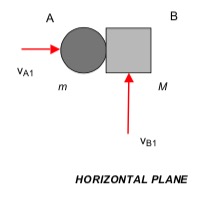
STEP 2 – Kinetics: From the FBD of A, we know that it will continue to move along the same line of travel. In addition, the FBD of B shows that the t-component of velocity for B will remain unchanged, where the “t“-direction is tangent to the plane of contact of A and B. In the n-direction (perpendicular to the t-direction), you have both the linear-impulse equation and the coefficient of restitution equation.
STEP 3 – Kinematics
STEP 4 – Solve: Solve for M and e from your two kinetics equations above.
COMMENT: This problem is posed in a somewhat “backward” way as compared to many problems in impact. Typically mass and COR parameters are given, and we solve for final velocities. Here we are given some information on the final velocities, and we are asked to find mass and COR values. You use the same equations for either type of problem, you just solve these equations in a different way.
Is the coefficient of restitution calculated using vector magnitudes or do I need all of the values to be projected onto the same axis–for example velocity in x.
As was discussed in class yesterday, there are typically four equations at our disposal for solving impact problems for particles moving in a plane: three LIM equations and one COR equation.
The LIM equations typically arise from three FBDs: the two FBDs for the individual particles and one combined FBD for the particles. The actual form of these equations depends on the details of the impact.
The COR equation is specifically for only the “n” components of the velocities of the impacting particles. The equation does NOT relate the vector magnitudes, only the “n” components.
Let me know if I have not addressed your question.
I was a little confused on how to find the value for Vb2n. So, I ended up using the fact that Vb2t=Vb1t since the t-component of Vb remains unchanged, and finding the Vbn component from Vb since it is given as a magnitude of 5m/s. Therefore I set it up at 5= sqrt( Vbn^2 + Vbt^2). Is this a valid way to solve for Vb2n, or would this not work?
The “n” direction for the contacting surfaces is perpendicular to the contact plane (that is, it is the line connecting the centers of mass for the two particles). The initial velocity of B is only in the “t” direction (tangent to the contact plane); therefore, v_B1n = 0.
Looking at the FBD of A+B, you conclude that linear momentum in the n-direction is conserved. Therefore:
m*v_An1 = m*v_An2 + M*v_Bn2
This conservation of linear momentum equation is solved along with the COR equation to find v_An2 and v_Bn2.
Let me know if I am not addressing your question.
How does ball A not change direction? If it imparts some x component of velocity to B, how does B not impart some y component to A?
Oh there is no friction, and the normal component of impact is parallel with A’s velocity. Is this correct?
You are correct. As described in the lecture book, the impact surfaces are smooth. Therefore, the tangential component of the contact force (i.e., friction) is zero.
from drawing the FBDs, how can we figure out what you have described can be seen from them?
* The FBD for A by itself has only a force in the “n” direction.
* The FBD for B by itself has only a force in the “n” direction.
* The FBD for A and B together has no forces acting on it.
Those are the bases for the momentum equations described above.
In the horizontal momentum equation, why is Block B’s initial momentum treated as zero, even though it’s already moving at 4 m/s before the crash?
The “t” direction is tangent to the contact of A and B. The “n” direction is normal to “t”. It is given that B is initially moving in a direction that is aligned with the “t” direction; therefore, the “n” component of the initial velocity of B is zero.
Above, it is written that the n-component of the initial momentum for B is zero; however, the t-component of the initial momentum of B is not zero, as you point out.