| Problem statement Solution video |
DISCUSSION THREAD
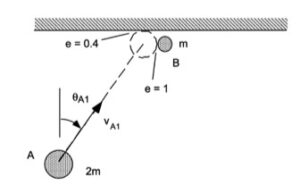
NOTE: B is initially at rest when it is impacted by A.
Any questions?? Please ask/answer questions regarding this homework problem through the “Leave a Comment” link above.
Discussion and hints
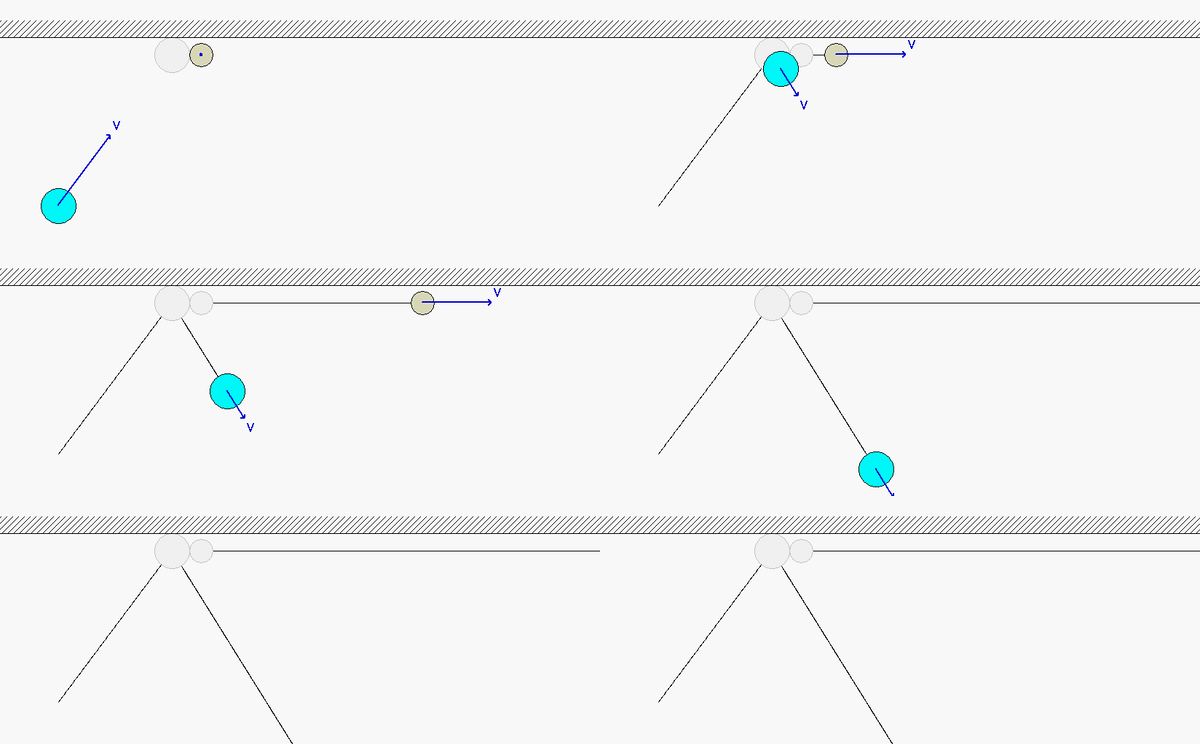
The four-step solution procedure:
- Step 1 – FBDs: Draw individual free body diagrams (FBDs) for A and B, along with an FBD of A+B. Since you have two impacts occurring at the same time, identify the “n” direction for each impact (they are different for each impact).
- Step 2 – LIM and COR
- For the impact of A with the bumper, use the coefficient of restitution (COR) equation.
- For the impact of A with B, use conservation of linear momentum in the n-direction and the COR equation in the n-direction.
- Step 3 – Kinematics: None needed.
- Step 4 – Solve
Should we give our answer in magnitude or vector form?
Since velocity is a vector, vector answers make sense.
Should the vector answer be in terms of n and t or i and j?
Either way is fine.
If the two impacts were not perpendicular to each other how would we go about using COR?
Good question. Let me think about that.
I’m confused how we’re supposed to label two different n’s on the FBD for A. Since A has two impacts occurring at the same time, I just don’t get how were supposed to label this on a FBD. In class, all the examples only had one “n”, which made it easy to just put the n on the y-axis, so I just don’t understand how that would apply in this problem.
The name given to an axis is not important. If it would help, simply switch over to x and y. Say you choose x to be parallel to the wall, and y to be perpendicular to the wall. Then:
* For A alone: use the COR equation in the y-direction for the impact with the wall, and use the COR equation in the x-direction for the impact with B.
* For A and B together: use conservation of linear momentum in the x-direction
These give you three equations for three unknowns: v_Ax2, v_Ay2 and v_Bx2. Solve those equations.
Ok, this makes sense. Do we still need to label the n and t directions somewhere on the FBDs though?
You are free to choose your own names for the axes as long as you make it clear in the drawings how the axes are named and that you stick with the names throughout.