| Problem statement Solution video |
DISCUSSION THREAD
Note: Assume that the coefficient of static friction is large enough that once the crate stops sliding, it sticks at that position (i.e., no sliding back down the incline).
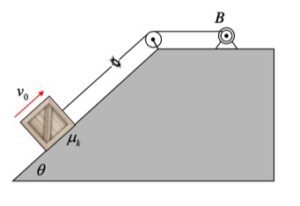
Any questions?? Please ask/answer questions regarding this homework problem through the “Leave a Comment” link above.
When doing the integral for the external forces, do we include the x-component of the gravity and the friction or just the friction?
I assume that your “x” is along the incline, is that correct?
For the LIM equation, we need to include ALL forces, regardless of whether they do work.
When setting up the equation, should we include every force acting on the crate, even if some of them are perpendicular to the direction of motion?
The LIM equation is a vector equation. When you write down the x-component of the LIM from an FBD, include ALL x-components of forces. Similarly for the y-components.
Even if a force does not do work, it can still come into play in an LIM equation.
In my calculations, I found it important to understand that if a direction does not have a net force, the linear momentum remains the same throughout the problem. In this case, the normal force and y projection of weight (assuming “y” is perpendicular to the incline) are equal to each other.
Clarification: Linear momentum along that direction.
Should our gravitational force be positive or negative work? I think it should be negative because it is moving up the slope and gravity is “pulling” it down, but what if after delta_t the block is now moving down the slope; in that second case, gravity would be in the same direction as motion? which sign should I use?
The weight force acting on the crate is a conservative force. This means that you can include the work done by the weight force as a potential term. With the potential term, the signs take care of themselves as long as you follow the correct definition for the potential energy.
What I have said here is correct; however, this problem is dealing with a change in velocity for a change in time. This is a LIM problem, NOT a W/E problem. Work is not an issue.
Just confirming this is a alright approach, there is only 1 non conservative force acting on this box. After that cable breaks the only non conservative force would be the force of friction, the gravity is accounted for in the movement of the box upwards, and the normal force balances with the gravity.
And within that, can we place our Datum at the “initial position” so that then we only have to deal with gravity on one side?
Meaning my equation will look like.
T_1 = T_2 + V_2 + Uc 1-2
Then figure out H by relating force balances with the time variance and solve from there?
Let me say here at the beginning that this problem is in regard to a change in velocity with a change in TIME. The linear impulse momentum equation (LIM) is more appropriate for this particular problem.
Your approach is based on the work/energy equation. That would be a good method to use if the question were asking for a change in speed for a change in POSITION. For this problem, it will not be very useful.
My recommendation is to focus on using the LIM equation. Draw the FBD of the crate for the time period after the rope breaks. Along the incline, only gravity and friction acts. Use the two forces in the LIM equation to relate the change in velocity to the change in time.
Does this help?
When setting up the LIM equation with the x-axis along the ramp, in the integral would we only use forces acting along this x-axis? If yes, is it because the motion is along that axis? Again if yes, would you need to use the forces in every axis if the vector components of motion are in every axis?
The LIM equation is valid along any axis, regardless of whether there is motion along that axis.
The phrasing of the given says that at the instant the cable fails the block is moving upward with a given speed, but at the point where it starts to go downward the velocity (with the x axis aligned with the ramp) would be zero. Should we use the given velocity of when it started to move up the ramp or zero in the LIM equation?
I believe we should use the given velocity, V_0 , as the initial velocity in the LIM. I used the LIM equation and plugged in known values to find V
What approximation of g does this class use? g = 9.81 or 10 m/s^2?
Please use 9.81 m/s^2,
If the block changes direction during the given time period, the friction would be acting in the opposite direction. How do we account for this in the integral? do we have to find the time that it changes direction and use that to make two integrals?
As the crate slides up the incline its speed is decreasing. Once this speed is decreased to zero, the crate sticks. There will be no further motion of the crate.
You need to use your LIM equation to determine the time at which the sticking will occur.
* If the time for sticking is larger than the delta_t provided, then just use the speed that you get when you substitute in t = delta_t.
* If the time for sticking is less than the delta_t provided, then the answer for the speed of the crate at t = delta_t is zero.
Does this make sense?