| Problem statement Solution video |
DISCUSSION THREAD
Any questions??
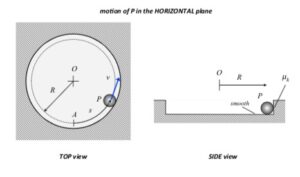
As P moves around on the circular track, two things occur:
- The normal force N on P due to the circular guide is proportional to the centripetal acceleration of P: N = mv2/R.
- A friction force opposes its motion, where the sliding friction force is proportional to the normal force between the circular guide and P: f = μkN = mμkv2/R.
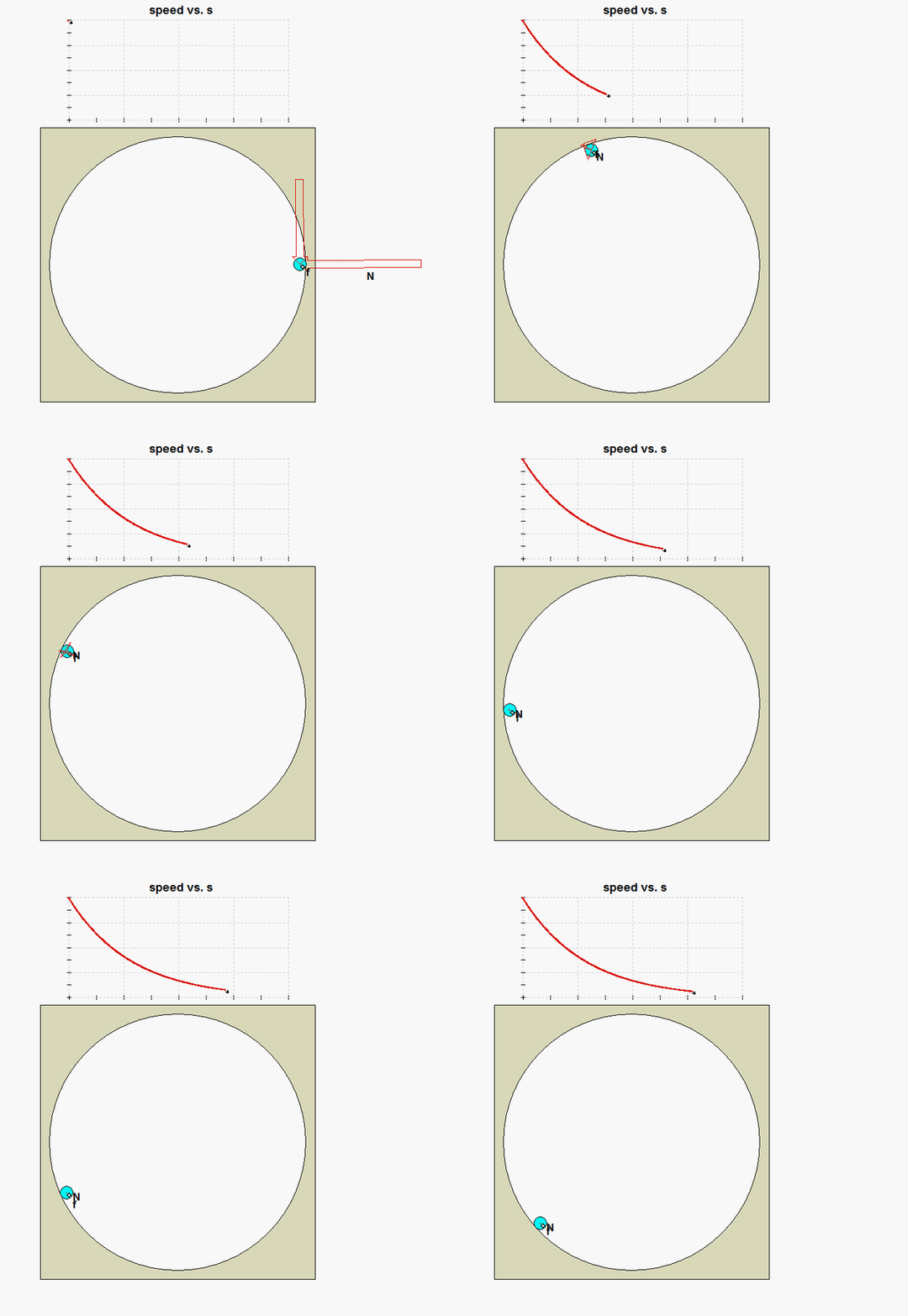
From this, we see that the friction force goes to zero as the speed goes to zero. What does this imply about P coming to rest? Can you see this in the animation of the motion below?
HINTS:
You will need to use the chain rule of differentiation to set up this problem: dv/dt = (dv/ds)(ds/dt) = v (dv/ds).
For this circular cavity problem, I understand friction acts along the wall and the wall provides the centripetal force, but I’m confused about what the normal force equals.
Is the normal force equal to mv^2/r, and is that what determines the friction force?
Please follow the four-step plan:
Step #1: FBD
Step #2: Newton
Step #3: Kinematics. This will include using the chain rule and integration of the tangential component of Newton’s second law for the particle.
Step #4: Solve the resulting equations from this analysis. The result for the normal force will come out of these equations.
Does P ever actually reach rest?
If your analysis says that it does not come to rest, then say so in your response.
There’s no mg if you’re creating an FBD of the top view, right?
You are correct. The weight force is perpendicular to the plane of motion for the particle.
Are we using the chain rule form a_t = v(dv/ds) instead of a_t = dv/dt?
You need to be integrating the tangential component of the acceleration equation to find the speed as a function of POSITION “s”. You need to use the chain rule of dv/dt = v*dv/ds in order to bring the dependence of “s” into the problem.