| Problem statement Solution video |
DISCUSSION THREAD
Any questions??
Discussion and hints:
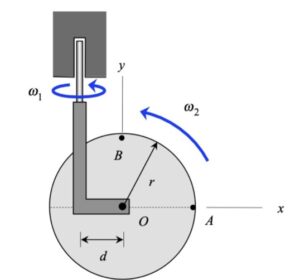
It is recommended that you use an observer attached to the wheel. As we have discussed in class, your choice of observer directly affects four terms in the acceleration equation: ω and α (how the observer moves), and the relative velocity and relative acceleration terms (what the observer sees). Note that the remainder of the discussion here is based on having the observer attached to the wheel.
The wheel shown above has TWO components of rotation:
- a rotation rate of ω1 about a fixed axis (the “+” Y-axis), and,
- a rotation rate of ω2 about a moving axis (the “+” z-axis)
(Be sure to make a clear distinction between the lower case and upper case symbols.)
Therefore, the angular velocity of the wheel is given by:
ω = ω1J + ω2 k
The angular acceleration vector α is simply the time derivative of the angular velocity vector ω : α = dω/dt. In taking this time derivative,
- Recall that the J-axis is fixed. Since J is fixed, then dJ/dt = 0.
- Recall that the k-axis is NOT fixed. Knowing that, how do you find dk/dt?
With the observer attached to the wheel, what motion does the observer see for points A and B? That is, what are (vA/O)rel and (aA/O)rel, and (vB/O)rel and (aB/O)rel?
NOTE: Pay particular attention to the motion of the reference point O. What path does O follow? And, based on that, how do you write down the acceleration vector of O, aO?
At least in my problem solving, just like in problem H3.G, you can solve for the acceleration vector of O by placing an analysis point on the L-bracket along its axis of rotation and using the rigid body acceleration equation in regards to point O and the analysis point.
This is what I did as well. I tried to use points A and B, but solving for their acceleration vector would have been complicated, so a fixed point with a known distance from O made it easier. I made a point “C” opposite from O which had a distance d.