| Problem statement Solution video
https://youtu.be/1sYmvpvCopY |
DISCUSSION THREAD
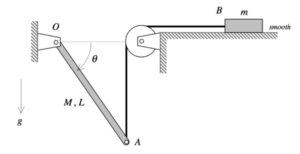
Discussion and hints:
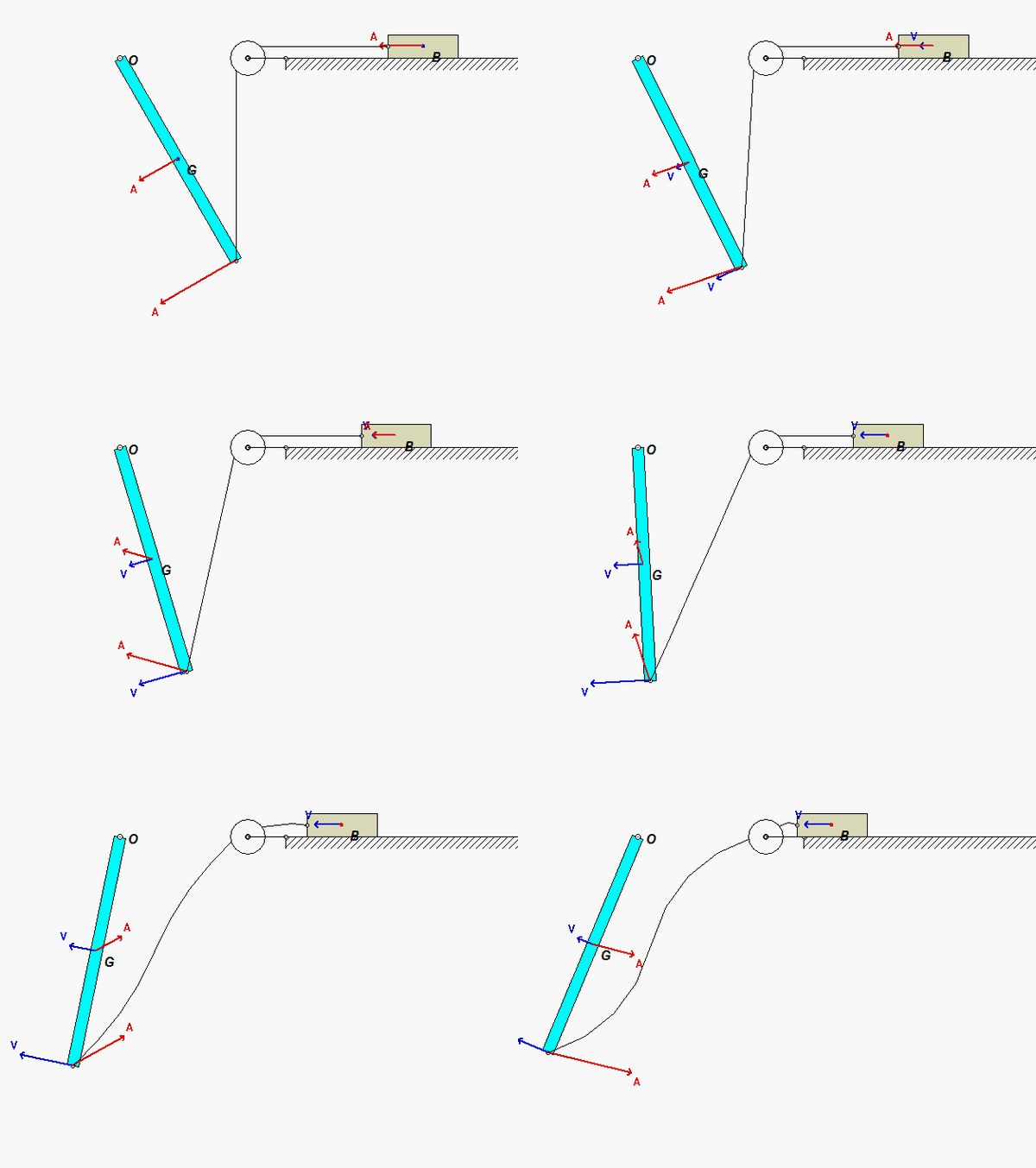
Recall the following four-step plan outline in the lecture book and discussed in lecture:
Step 1: FBDs
Draw individual free body diagrams for bar OA and block B.
Step 2: Kinetics (Newton/Euler)
Write down the Newton/Euler equations for the block and the bar using your FBDs above. Take care in choosing the reference point for your moment equation for the bar. In order to use the “short form” of Euler’s equation, this point should be either a fixed point or the body’s center of mass. For this problem, you have a choice between using the center of mass of the bar or the pin joint O. Be reminded that if you use point O, you will need to use the parallel axis theorem when calculating the mass moment of inertia of the bar.
Step 3: Kinematics
Put some thought into the kinematics for this problem. This is the most complicated part of the solution. Importantly, the acceleration of A is NOT equal to the acceleration of B. Why? But then, how do you find the relationship between these two accelerations?
Step 4: Solve
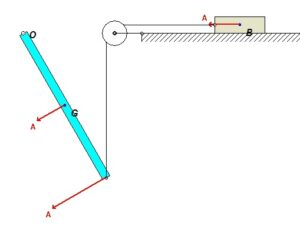
Solve your equations above for the acceleration of block B.
Any questions?