
Researchers

Elizabeth Allmon, PhD
Purdue FNR

Youn Jeong Choi, Analytical Chemist
Purdue Agronomy

Jason Conder, GeoSyntec
New York

Zachary Pandelides, GeoSyntec
Louisiana
Marisol Sepúlveda, Professor and Associate Head of Research
Purdue Forestry & Natural Resources

Matt Hamilton, Research Scientist & Lab Manager
Purdue FNR
Tyler Hoskins, Research Assistant Faculty
Purdue FNR

Jason Hoverman, Professor
Purdue FNR

Linda Lee, Professor
Purdue Environmental and Ecological Engineering & Agronomy
Research Objectives
The main goal of this research, is to develop toxicity reference values (TRVs) and bioconcentration factors (BCFs) for perfluorooctanoic acid (PFOA), perfluorooctane sulfonate (PFOS), 6:2 fluorotelomer sulfonate (6:2 FTS) and perfluorohexane sulfonate (PFHxS) in three main amphibian groups (toads, frogs and salamanders). We completed close to 20 experiments exposing different amphibian species to four PFAS using different exposure routes and length of exposure. Major findings include: PFOS bioaccumulated and the precursor 6:2 FTS metabolized; LC50s are in the thousands of ppb, several orders of magnitude above environmental levels; LOECs for effects on growth, development, and condition factor ranged between 10 – 1000 ppb; and effects varied depending on the species.
Developing Toxicity Reference Values (TRVs) and Bioconcentration Factors (BCFs):
- PFOA, PFOS, PFHxS, 6:2 FTS
- Effects on development, growth and condition factor
- First comprehensive Ecological Risk Assessment for PFAS in amphibians
Animal models:
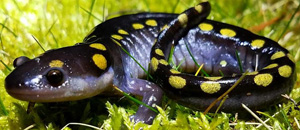
- Native amphibians: Toads, frogs and salamanders
- Model species: Xenopus laevis
News:
Research Shows Toxicity of Forever Chemicals Varies Among Amphibian Species, Purdue College of Agriculture News