Learning Objectives
From reading and studying this chapter you should be able to:
- Know what a weed is
- Differentiate between annual, biennial and perennial weeds
- Understand how weed types influence management approaches
- Understand weed management including non-chemical and chemical approaches
- Understand herbicide types, and be able to differentiate between preemergence and postemergence herbicides and know when to use each type
- Distinguish between selective and non-selective herbicides
- Distinguish between systemic and contact herbicides
- Identify factors that affect herbicide performance or non-performance
Introductory Comments
Weeds in ornamental nurseries and landscapes present serious problems for nursery operators and landscape professionals. Weeds are aesthetically unpleasant and can decrease desirable plant growth through competition for light, water, and nutrients. In some instances, weeds can also pose chemical and physical hazards. Weeds with sharp spines, such as Canada thistle or horsenettle, can decrease landscape enjoyment. Weeds like poison ivy and poison hemlock can cause skin irritation. Others, like common ragweed, can be an allergen. A balanced weed management program includes an integrated approach of prevention, sanitation/exclusion, hand-weeding, mulches, mowing, cultivation, and/or herbicides.
The most suitable weed control methods will vary with the types of weeds present, the type and stage of production, and the overall ideology of the nursery, client, or landscape professional. In home landscapes that utilize a balanced approach to weed management, herbicides do not have to play the major role. The objective of this chapter is to provide information concerning weeds, the methods used to control them, and the approaches to use when designing a weed control program for ornamental nurseries and landscapes.
Weed control in landscapes is unique in that there are many different species of plants growing in small areas. This makes chemical control of weeds in landscapes a challenge because selective herbicides, that can be used on many crops, will cause damage to some of the plants in the landscape.The importance of weed identification and knowledge of herbicides are paramount in controlling weeds while limiting phytotoxicity (damage to landscape plants).
What is a Weed?
Weeds are most frequently defined as “plants out of place.” By this definition, any plant growing where it is not wanted can be referred to as a weed. This can include some of the ornamental plants used in landscape plantings. Typically, “weed” refers to naturally occurring, aggressive plants that are injurious to people or to agriculture. Weeds can compete with desirable plants for essential growth factors including light, soil moisture, nutrients and space resulting in poor growth of ornamental plants. Weeds present in containers or in root balls of ornamentals for sale detract from their appearance and can result in future problems when the plant is placed in the landscape.
Weeds can harbor other pests such as insects, diseases, nematodes and mammals (such as rodents) that reduce ornamental plant growth. In addition, in the landscape, weeds can be unsightly and detract from aesthetic appeal. For these main reasons, weeds must be controlled. Unlike other pests, weeds can always be counted on to be present and they must be dealt with. However, there are many methods of control available.
In order to best control weeds it is important to know what type of weed is causing a problem. Weed identification is critical to choosing the most appropriate method for management. There are many good printed resources, websites, and smartphone apps available to assist in weed identification. However, before attempting to identify a weed it is important to understand some basic biology related to weed types.
Growth Form
Plants can be divided into gymnosperms, monocots and dicots. Gymnosperms include pines, firs, spruces, cedar, redwoods and hemlock and are generally not considered to be weeds of nurseries or landscapes. Monocots tend to have narrow leaves with parallel veins and include lilies, iris, grasses, sedges, palms, orchids and bananas. Grasses and sedges are the most common monocot weeds. Dicots have broader leaves and include most of the common non-grassy weeds we encounter. Some examples include pigweeds, dandelion, lambsquarters, purslanes, carpetweed, nightshades, mustards, Canada thistle, morning glories and bindweeds.
Lifecycle
Weeds can generally be separated into three groups based on lifecycle and the time of year the plant is present.
- Annuals: the most common weeds. They complete their lifecycle from germinating seed to seed-producing plant in one growing season. Annual weeds can be classified as either summer or winter annuals. Summer annual weeds germinate in the spring, grow and flower over summer, produce seed and die in the fall. Winter annuals emerge in late summer or early fall, and often over-winter as a rosette at the onset of cold weather. In the spring, winter annuals flower and produce seeds early the following summer. Exceptions to this pattern are henbit and chickweed which do not form rosettes, but over winter as immature and mature plants.
- Biennials: plants live for two In the first year, biennials remain vegetative, producing only stems and leaves aboveground. In their second year, biennial plants flower and produce seeds. Wild carrot and poison hemlock are two examples of biennial weeds.
- Perennials: grow for a number of years, sometimes indefinitely, and can be herbaceous (soft stemmed) or woody and propagate by seed or vegetative (asexual) reproduction. Herbaceous perennials include field bindweed, yellow nutsedge, and quackgrass; woody perennials include trees, woody shrubs and vines. Since perennials can have extensive above (stolons) and below ground (rhizomes, roots and tubers) vegetative parts, they are much more difficult to control with all removal techniques once they become established.
Within these groups of weeds, annuals are most easily controlled, followed by biennials then perennials.

Figure 1. Yellow nutsedge (Cyperus esculentus), an herbaceous perennial, grows in a parking lot island along-side Liriope.
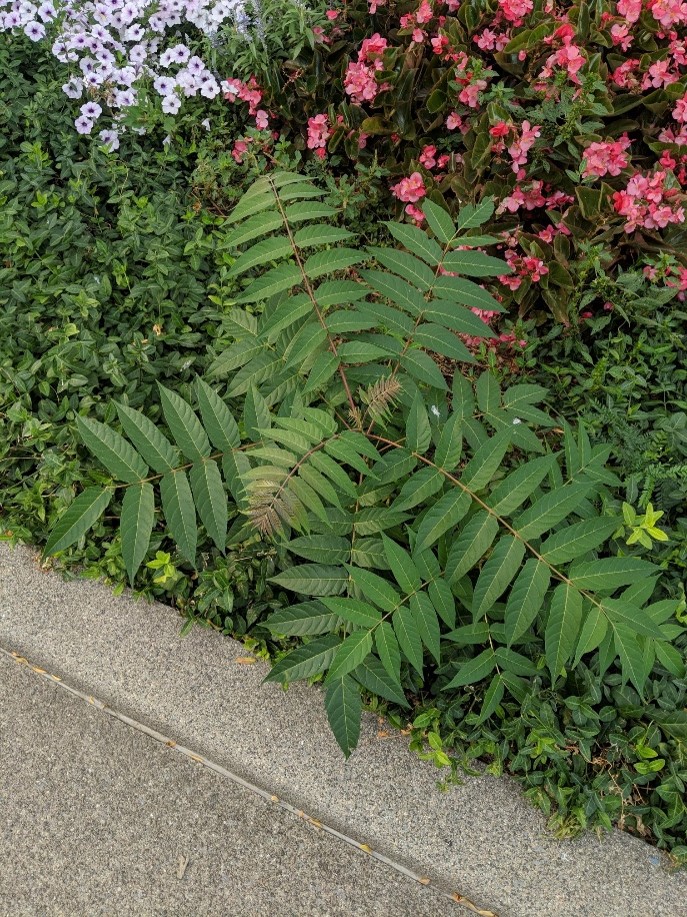
Figure 2. A tree-of-heaven (Ailanthus altissima), an invasive woody perennial, sapling grows in a mixed border planting.
Weed Control Methods
No single weed management method will solve all weed problems. For this reason, an integrated weed management program that utilizes a combination of methods will be the most effective. The key to success in weed management is to have a plan for how weeds will be managed and a good knowledge of the variety and effectiveness of available control tactics. The steps in an integrated weed management approach are:
Site Preparation
The first step of weed management is to “start clean” by eliminating problem weeds from a site prior to planting. When establishing a new in-field nursery production site or landscape planting, site preparation is critical to long-term weed management. In nurseries this may include cropping the site with agronomic crops and maintaining a high level of weed control, fallowing the site and using non-selective herbicides to eliminate problem weeds, cover cropping with cereal grains or legumes (green manures), or use of chemical fumigation prior to planting. If possible, site preparation should begin several months or years before planting, especially in locations with problematic perennial weeds. Once you have a clean start, use the following methods to “stay clean”.
Exclusion and Sanitation
Weeds can propagate and spread through various plant parts, including seeds, above- or underground stems (stolons and rhizomes), and root fragments. Weed seeds and other propagules can be introduced into nurseries or landscapes naturally by wind, water, and animals. Additionally, humans can contribute to introducing weed seeds and propagules through contaminated equipment (mowing decks and soil attached to shovels and tires, for example) and contaminated inputs. Inputs potentially containing weed seeds and propagules include crop seed/plants, top soil, compost, mulch, and hay/straw. To avoid spreading weed seeds, remove visible plant matter and soil from equipment before leaving a job site or moving among nursery zones. Only use seeds from lots that have been tested for purity and meet the tolerances for total, restricted, and noxious weed seeds. (To learn more about Indiana seed laws, visit: https://oisc.purdue.edu/seed/index.html.) This information should be found on the seed package. Use soil amendments from reputable suppliers. In both nurseries and home or public landscapes, avoid container and balled-and-burlaped plants that contain weeds.
Avoid planting invasive species
Many once common landscape plants, such as Japanese barberry and wintercreeper, have become invasive species- often making them difficult to control in landscapes and within natural ecosystems. For this reason, Indiana established the Terrestrial Plant Rule to limit the spread of certain invasive plant species. According to the Indiana Terrestrial Plant Rule (312 IAC 18-3-25: https://www.in.gov/dnr/rules-and-regulations/invasive-species/terrestrial-invasive-species-plants/) it is illegal to sell, gift, barter, exchange, distribute, transport, or introduce plants on the state plant rule list. Violation of the rule can result in a fine up to $500 per plant per day and the loss of a nursery license. The Indiana Invasive Species Council maintains a list of potentially invasive plants (https://www.entm.purdue.edu/iisc/). Because the list can change to include new species each year, review the list routinely.

Figure 3. Japanese barberry (Berberis thunbergia) growing in a sand dune next to Lake Michigan.

Figure 4. Wintercreeper (Euonymus fortunei) grows on a hardwood tree in Southern Indiana.
Cultivation
Cultivation involves removing weeds by manual or mechanical methods. Manual hand-removal is tedious and expensive but is occasionally necessary in nurseries, especially in containers. Mechanical techniques in liner beds and other in-ground plantings in nurseries can include rototilling, disking, plowing and hoeing, but care must be employed to avoid physical damage to valuable plants during weed removal. Cultivation is most effective against small, annual weeds and can actually promote a worse problem when used in perennial weed infestations since vegetative propagules can be spread. Repeated cultivations are necessary in perennial weed control and this is not always possible in nurseries. Cultivation on wet soils should be avoided as this results in damage to soil structure and leads to compaction.
Mulching
Mulching is a very effective method of weed control for residential and public landscape beds and in certain nursery beds and container production. Mulching the soil surface reduces light and oxygen exchange necessary for the germination of many weed seeds and also presents a physical barrier to weed emergence. Other beneficial properties include moisture retention, soil stabilization and aesthetics, and a reduction in the need for herbicides. Mulches include natural organic, natural inorganic and synthetic materials.

Figure 5. Sow thistle growing on top of hardwood bark mulch. Although growth of weed seeds under the mulch is suppressed, seeds deposited on the mulch surface can germinate and grow.
Natural organic mulches can be composted yard wastes or animal wastes, wheat straw, peat moss, and pine straw, but the most common types are wood chips, hardwood bark or softwood bark. Organic mulches are placed on the soil at 2-3 inch or greater depths and provide good weed control and have good stability over 1 to 2 years. Bark mulches are extremely popular in landscaping situations. Although natural organic mulches work well to control weed seed germination, they can be ineffective against some perennial weeds and weed seeds that are deposited on top of the mulch. Additionally, natural organic mulches degrade over time and can be displaced by heavy rainfall or landscape equipment. Degraded and/or disturbed mulched areas will have greater weed emergence.
Inorganic mulches are not commonly used in commercial nurseries but are fairly common in residential and public landscapes. Inorganic mulches can include sand, rubber from recycled tires, pebbles, stones, shale and other rock types and often are available in a variety of colors. Inorganics are stable over a long time but require geotextile fabric being placed on the soil surface under them or the repeated use of a herbicide since weeds do germinate and emerge through them.
Synthetic mulches are manufactured and are generally polyethylene (plastic) or woven synthetic fabric. These mulches are available as solid sheets, mats, or webbed material and come in a variety of colors, thickness and service lives. Solid sheets are impermeable to water, but mats or webbed materials are permeable. The main purpose of synthetic materials is to prevent weeds from germinating and becoming a problem. These mulches are commonly used in landscapes especially under inorganic mulches and are commonly used as soil covers in nurseries under containers to reduce weed problems between pots.
Geotextiles are synthetic fabrics that cover the soil surface but allow movement of water and air while reducing the light reaching the soil surface which reduces weed germination and growth. These materials are becoming more popular in landscape weed control but also may have some use in nurseries. Although, these materials are expensive and require installation, they become more cost effective over time since they last 4 years or longer. They are as effective as a preemergence herbicide (a herbicide applied to the soil prior to weed seed germination and plant emergence) which requires reapplication each year. Geotextiles are used on perennial plantings that do not require yearly replanting but are unsuitable for spreading groundcover beds since the fabric inhibits plant rooting. Geotextiles often are covered by a mulch to reduce photodegradation and improve the appearance of the beds. Any weeds growing through the textiles should be quickly removed to prevent holes in the fabric barrier.
Cover Crops
Cover crops can be used in field nurseries to improve weed management. Common cover crops include seeded grain crops (rye, oats, wheat) or legumes that can be mowed and maintained as a living mulch, or killed by a herbicide and used as a dried surface mulch. Cover crops are not traditionally used in landscape situations.
Mowing
Mowing is a form of weed control used in nurseries and home landscapes to reduce the reproductive potential of weeds. Mowing needs to be timed prior to seed production and must be repeated when used against perennial weeds in order to weaken the underground rhizomes and roots. Mowing is not effective against low growing weeds or weeds that flower below the mowing blade height. Mowing is not practical in landscape beds to control weeds because the action threshold in maintained beds doesn’t allow for the growth of weeds to mowing height.
Chemical Weed Management Tools
Herbicides are still the most widely used technique for weed control in landscapes and nurseries. However, when herbicides are used alone with no other weed management methods, the result is likely to be unsuccessful. Use an integrated weed management approach for best results and when using herbicides, obtain help in selecting proper herbicides for weed control from local county extension educators or other public agencies.
Prior to choosing and using a herbicide an applicator should know what weeds need to be controlled and then always read the herbicide manufacturer’s literature and labels. The label provides information related to proper use and performance of the herbicide in order to obtain the most effective weed control with no injury to valued ornamentals. Basic label information includes: herbicide name, active and inert ingredients, precautionary statements and directions for use. The precautionary statement includes information about hazards related to product use, clothing that must be worn by applicator, user safety and environmental hazards. Directions for use include how to safely apply the herbicide, proper storage and disposal of the product, weeds controlled, crops where the herbicide can be used, rates of herbicide to use, timing of herbicide application, application equipment, acceptable tank mixtures, acceptable spray additives, crop rotation restrictions and restrictions and limitations on herbicide use.
The types of herbicides used in nurseries and landscapes include both preemergence and postemergence compounds(see below).There is a wide variety of herbicide choices available; however, there is also a wide variety of landscape ornamental plants with significant differences in tolerance to herbicides. The manager should plan ahead by preparing the site properly and planting species having similar herbicide tolerances together in order to simplify herbicide applications and improve the effectiveness of the weed control program. The wide variety of plants in most landscapes results in many limitations relating to a simple herbicide only approach to weed control; therefore, many landscape managers and homeowners choose to use mulches, hand removal and spot sprays with herbicides.
Preemergence herbicides
Preemergence herbicides are those applied prior to weeds emerging from the soil. Emerged weeds are not controlled in most cases, so timing of application is critical for success with preemergence herbicides. Preemergence herbicide use requires choosing the appropriate chemical for weeds at the site (based on scouting and previous experience), and application at the proper rate prior to any weed emergence. Selectivity of herbicides for ornamentals is often achieved by formulation. Many preemergence herbicides in woody ornamentals are formulated as granules and application should be made when foliage is dry and the granules will tend to bounce off the leaves. Most preemergence herbicides work best when uniform distribution is followed by immediate irrigation to wash the herbicide off the plant foliage. The irrigation moves the herbicide into the growth medium or soil where it can inhibit weed seed germination.
Multiple preemergence herbicide applications may be required to provide acceptable season-long weed control. For containers, hand weeding is generally practiced prior to reapplication of preemergence herbicides to eliminate emerged weeds if a selective herbicide isn’t applicable. Preemergence herbicides can be used under containers for weed control and are commonly used in landscape beds if the herbicide has limited potential for causing damage to the ornamentals planted at the site. Preemergence herbicides can also be referred to as “soil-applied” or “residual” herbicides.
Considerations for preemergence herbicides:
- These herbicides must be applied to a weed-free surface. They work best if applied to soil where plant residue is minimal. Even small, emerged weeds will generally not be controlled by most preemergence herbicides and will continue to grow.
- Soil moisture is important for the maximum effectiveness of preemergence herbicides. Preemergence herbicides require rainfall or irrigation shortly after application to be most effective. The rainfall/irrigation moves the herbicide into the top ½” to 1” of soil where weed seed germination occurs so uptake by the emerging shoot and/or roots can be maximized. Application to moist soil is preferable to application to dry soils.
- Soil type and the amount of organic matter can also affect herbicide performance. Rates often need to be adjusted for soil type and organic matter content. Finer textured soils (clay, for example) or those with high organic matter content will require the application of a higher rate of herbicide. Refer to the herbicide label for rate adjustments based on soil factors.
- When applying preemergence herbicide on mulched landscape beds, additional rainfall/irrigation will be required to move the herbicide through the mulch and into the soil. Organic mulches may reduce the effectiveness of some preemergence herbicides. Consult the herbicide label to determine if the product can be applied on top of organic mulches.
Postemergence herbicides
Postemergence herbicides are applied to control emerged weeds. Postemergence herbicides can be further classified as “selective” or “non-selective” and “contact” or “systemic”.

Figure 6. A grass-selective herbicide could be used to control crabgrass growing in this landscape bed containing cranesbill geranium, a broadleaf plant.
Selective postemergence herbicides will only kill certain types of plants, whereas non-selective postemergence herbicides generally kill or injure all types of plants. Non-selective herbicides can also be referred to as “broad-spectrum”. Care should be taken to avoid applying non-selective herbicides to desirable nursery or landscape plants. Selective postemergence herbicides include those that are effective against either grasses or broadleaf plant species. For example, grass-selective herbicides such as clethodim or sethoxydim can be used to control grasses in broadleaf landscape plantings or broadleaf nursery crops. Conversely, broadleaf-selective herbicides can be applied to control broadleaf weeds without killing grasses or sedges. However, growth regulator herbicides, such as 2,4-D, should not be used near ornamental plants due to the likelihood of phytotoxicity due to volatility and drift issues.
Generally speaking, contact herbicides kill any “green” plant tissues they contact and do not move great distances through the sprayed plant. Systemic herbicides are taken into and moved throughout the sprayed plant. Often systemic herbicides are moved to the above- and below-ground growing points. Injury and control from contact herbicides is generally more rapid than systemic herbicides because it takes time for systemic herbicides to move throughout the plant. Depending on weather conditions and the condition of the sprayed weeds, systemic herbicides may take a week or more to kill weeds.
Considerations for postemergence herbicides
- Regardless of which postemergence herbicide is used, they should be applied to small weeds, less than 4” tall or wide. Larger weeds may require increased rates or multiple postemergence herbicide applications and are more likely to not be effectively controlled by herbicides. Refer to the product label for timing of application and the types of weeds controlled. Generally speaking, the best results from postemergence herbicides are realized when they are applied to actively growing weeds.
- Postemergence herbicides must be applied so good coverage of the foliage occurs. Complete coverage is important for contact herbicides such as paraquat, Scythe and Finale. Although complete foliar coverage is less important for herbicides that translocate after foliar absorption (glyphosate, 2,4-D, grass specific herbicides), good coverage is still important.
- Most postemergence herbicides need to applied in combination with some type of an adjuvant such as crop oil or a surfactant to improve leaf coverage and aid in herbicide absorption. Also, some labels require the use of ammonium sulfate or liquid nitrogen for best activity. Use only agricultural adjuvants recommended by the herbicide label on the product you plan to apply. Some adjuvants can result in minor injury to sensitive nursery or landscape plants.
- It is not recommended to apply contact and systemic postemergence herbicides together, as the contact herbicide can result in decreased effectiveness of the systemic herbicide.
Herbicide Resistance
Use of the same herbicide type over time can result in the development of herbicide-resistant weed populations. Currently documented herbicide-resistant weeds can be found at weedscience.org. Allowing herbicide-resistant weeds to “go to seed” will increase the number of herbicide-resistant weeds in future years.
To minimize the risk of herbicide-resistance, avoid using herbicides with the same mode of action (or the same HRAC number) and hand-remove weeds that survive a herbicide application. Just like the IRAC code for insecticides and the FRAC code for fungicides, herbicides with the same HRAC number have the same mode of action. The HRAC number can be found on the herbicide label. You can look up the HRAC number for any herbicide and find out more about its mode of action at this website. https://hracglobal.com/tools/classification-lookup

Figure 7. Glyphosate-resistant marestail (Erigeron canadensis) is common throughout Indiana. This barren patch of soil was repeated treated with glyphosate to manage emerged weeds and contributed to the selection of glyphosate-resistant marestail.

Figure 8. Close up of Glyphosate-resistant marestail (Erigeron canadensis)
Review and Study Questions – For Thought and Discussion
- What are three lifecycles found in weeds?
- Why are perennial weeds more difficult to control than annuals?
- What problems do weeds cause in ornamentals?
- What is included in site preparation?
- What types of mulch materials are most commonly used in landscape?
- What steps should be used to ensure that mulches control weeds in the landscape?
- What information does a herbicide product label tell the applicator?
- What is the difference between a preemergence and a postemergence herbicide?
- What are the main considerations when using a preemergence herbicide?
- What are the main considerations when using a postemergence herbicide?
- What is the difference between a selective and a non-selective herbicide?
- (True or False): In addition to “a plant out of place” a weed can be defined as “a naturally occurring, aggressive plant that is injurious to people or agriculture.”
- (True or False): For successful weed control, a landscape manager should select the one best weed management method for the situation and use only that.
- (True or False): Weeds only move around by the movement of their seeds.
- (True or False): Weed management success requires good knowledge of control tactics and a plan for how the tactics will be used.
- Weeds with which of these life cycles are most difficult to control?
- Annual
- Biennial
- Perennial
- Geotextile fabrics cover the soil surface to prevent weed growth, and can be expected to last about how long?
- 1 year
- 2-3 years
- 4 + years
- A post-emergence herbicide is best used when?
- before weeds appear
- when young weeds are present
- just before weeds set their seeds
- Which of these factors may affect the effectiveness of pre-emergence herbicides?
- soil moisture
- soil type
- amount of organic matter (OM)
- all of the above
- (True or False): In weed management, the expression “start clean” typically refers to always using a clean sprayer and nozzles when applying herbicides.
- (True or False): Systemic herbicides kill plant tissues they contact and do not move great distances through the sprayed plant.
Answers to Review and Study Questions
-
- True
- False
- False
- True
- C
- C
- B
- D
- False
- False