Purdue researchers to examine chronic kidney disease effects on balance, more
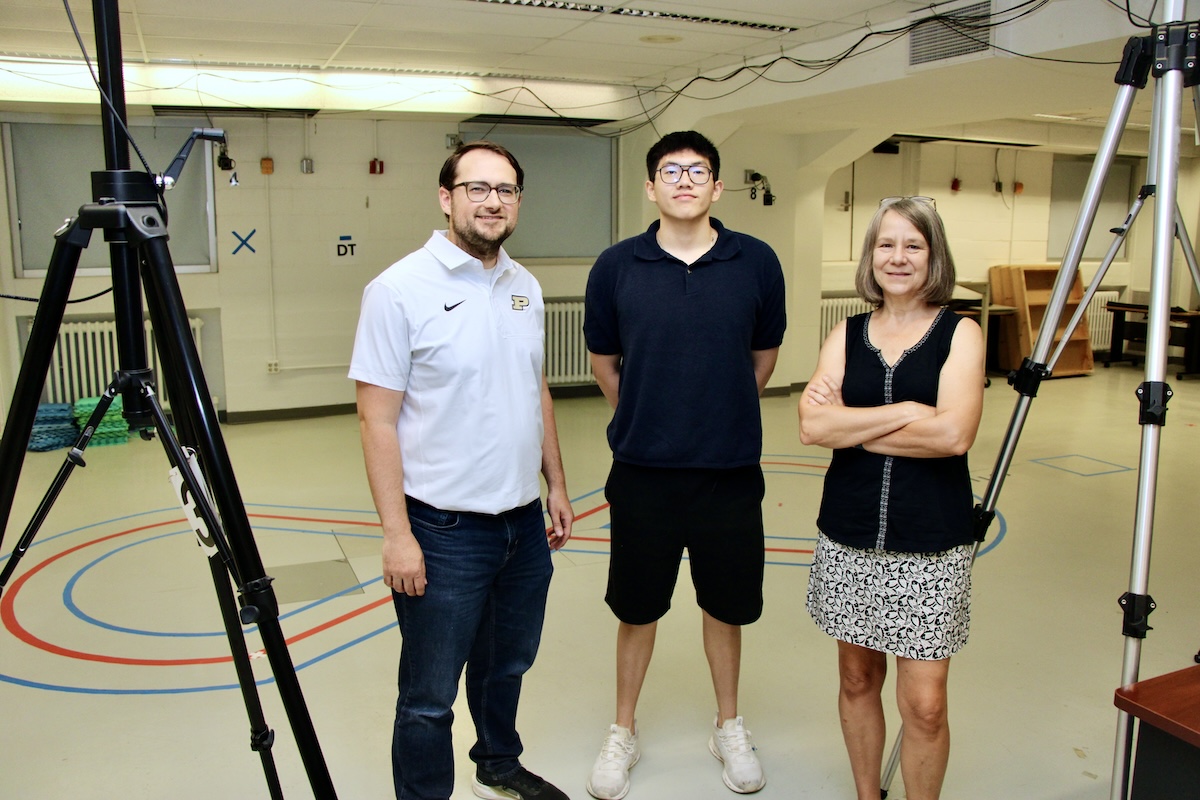
Purdue University Nutrition Science Assistant Professor Brandon Kistler, left, and his graduate student Dave Kunsi, center, are teaming up with Health and Kinesiology Professor Shirley Rietdyk, right, to measure balance issues in chronic kidney disease patients.(Tim Brouk)
Written by: Tim Brouk, tbrouk@purdue.edu
Purdue University College of Health and Human Sciences (HHS) researchers hope to discover why people with chronic kidney disease (CKD) might fall more often than others through a new pilot study examining how kidney disease affects balance, mobility and fall risk — research they believe could improve fall prevention for those living with CKD.
Chronic kidney disease affects more than 36 million Americans, and the effects are debilitating if left unchecked — diabetes, high blood pressure and fatigue are just some of the symptoms faced in advanced stages of CKD.
Brandon Kistler, has spent years studying chronic kidney disease. Now the assistant professor of nutrition science is expanding that work through collaborations across HHS to better understand how the disease affects nearly every system in the body.
While balance will be the pilot study that will begin this fall with collaborator Shirley Rietdyk, a professor in the Department of Health and Kinesiology, Kistler has mapped out research ideas to monitor CKD’s effects on hearing (Department of Speech, Language, and Hearing Sciences) and cognition (Department of Health and Kinesiology and School of Health Sciences) too.
People with CKD experience muscle weakness, fatigue and neurological changes that increase fall risk, Kistler said.
“One of the things (kidneys) do is they filter out toxins from the blood, and as they start to fail, you start to get a buildup of what we call uremic toxins in the blood. Because blood goes everywhere, pretty much every single system in the body is affected. That’s where a lot of the departments around HHS can have a real role in looking at falls and kidney disease,” Kistler added. “We have a good idea that people with kidney disease fall more often, but we really don’t know why they fall. One of the things that we’re hoping to get out of this is information about the circumstances that surround a fall as well as what symptoms are related to people who fell both retrospectively but then also prospectively.”
Rietdyk, Kistler and nutrition science graduate student Dave Kusni will welcome study participants to the Department of Health and Kinesiology’s Human Motor Behavior Group. After an initial CKD screening and dietary assessment, the participant group, comprised of the middle-aged and older adults, will be equipped with new marker-less motion capture technology to monitor balance and gait speed. Participants will also navigate obstacles, which is a telling task in Rietdyk’s field of study.
“All of these changes — the muscle weakness, the anemia, the fatigue, the coordination, the cognitive ability — all that really gets demonstrated when you give them a more challenging task,” Reitdyk said.
This study is being funded in part by an HHS pilot grant.
Healthy kidneys key in balance
The researchers suspect cardiovascular disease — a common complication of CKD — may contribute to falls in ways current prevention programs overlook.
“One of my hypotheses is that cardiovascular disease is a much greater contribution in people with kidney disease than in other populations. And if that’s the case, a lot of fall prevention programs don’t address the cardiovascular disease component,” Kistler said. “In fact, it’s pretty rare to see a fall prevention program focus on anything cardiovascular-related. It tends to be more coordination training, strength training.”
Fall prevention for those with CKD is also crucial because of higher incidence of serious injury after a fall. CKD patients often lose bone density and are more likely to fracture or break bones. Kistler, Rietdyk and their team aim to bring more attention to fall prevention for this population.
“I don’t think there are a lot of people talking to their CKD patients about avoiding trip hazards and (adjusting) the lighting in the home,” Kistler said.
Decades of balance
Rietdyk brings decades of experience studying fall risk in vulnerable populations, making the collaboration a natural fit. This study will further broaden Rietdyk’s research portfolio on falls in at-risk populations.
“We’ve done research on people with Parkinson’s disease. I’ve done research on people with visual impairment,” she said. “We’ve also done some work on people with multiple sclerosis.”
Over the decades, Rietdyk has found the more systems negatively affected — muscle strength and the vestibular system, for examples — the worse the balance. CKD’s overall effect on the human body means the potential for more falls.
“With the chronic kidney disease, all of those systems are affected. So, (people with CKD) are especially compromised,” she said.
Future kidney work
The balance study is the first in what Kistler hopes will become a broader interdisciplinary research program. Future collaborations will examine how CKD affects hearing, cognition and brain health, bringing together researchers from across HHS. Because kidney disease touches nearly every organ system, Kistler believes solving its biggest challenges will require researchers from many disciplines working together.
“Researchers from all around HHS would be highly relevant because every system is affected by kidney disease,” Kistler said. “One of the things I hope is that I can get the other faculty interested in this work. My focus is on nutrition, but if we can get a lot of other people interested, I think there’s a lot of science questions the team would be able to answer.”
Discover more from News | College of Health and Human Sciences
Subscribe to get the latest posts sent to your email.