Purdue Psychological Sciences undergraduate researcher examines how TikTok may amplify eating disorder content
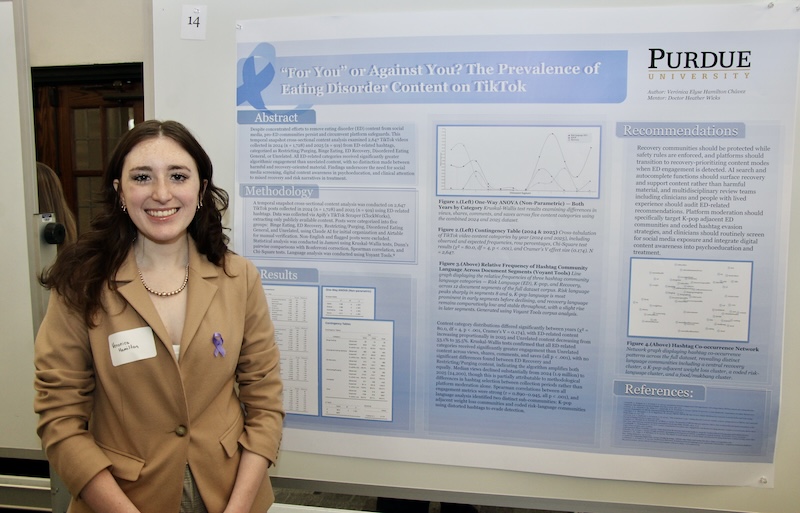
Since 2024, Veronica Chavez Hamilton analyzed more than 2,600 TikTok videos for eating disorder content. The Purdue Psychological Sciences senior found coded hashtags that could lead vulnerable users to view content that promotes disordered eating. The work culminated in a research project, which she will continue in graduate school after her summer 2026 graduation.(Tim Brouk)
Written by: Tim Brouk, tbrouk@purdue.edu
TikTok’s landing page states “trends start here.”
Many of these trends are light-hearted or dance-based. Some have been bizarre and even dangerous. Remember the so-called “Tide pod challenge”?
But most trends come and go. Tide pods are still on the market (while the dangerous fad associated with them has faded) and dances that were popular in 2023 are long forgotten. However, Veronica Chavez Hamilton uncovered an unsettling push toward disordered eating in thousands of TikTok videos in recent years. This troubling, pervasive discovery was the basis of the Purdue University Department of Psychological Sciences senior’s research project, “‘For You’ or Against You? The Prevalence of Eating Disorder Content on TikTok.”
Hamilton said the research serves as a temporal snapshot of cross-sectional content analysis. She examined 2,647 TikTok videos collected in 2024 and 2025 from eating disorder-related hashtags. Early in the work, Hamilton found hashtags “pro-mia” (“pro-bulimia”) and “pro-ana” (“pro-anorexia”). Those hashtags were banned, but users are finding workarounds to post videos featuring binge-eating, restricting caloric intake or purging.
“Users within eating disorder communities often use coded language to bypass TikTok’s moderation systems,” Hamilton added. “For example, hashtags such as ‘#ednotedsheeran’ appear unrelated at first glance but actually reference eating disorders. In this context, ‘ed’ refers to an eating disorder, while the phrase “not Ed Sheeran” clarifies that the hashtag is not referring to the musician.”
The interest in the topic started in Hamilton’s community college classes. The summer 2026 College of Health and Human Sciences graduate started the research for classes at Ivy Tech before taking the work to Purdue after earning her associate degree.
Methodology
Hamilton categorized the videos into three broad groups: restrictive and purging behaviors, binge eating, and general disordered eating. She examined publicly available TikTok content gathered through Apify’s TikTok Scraper. The hashtag #ednotedsheeran appeared 383 times in the dataset, making it the study’s fourth most common hashtag.
The young researcher also identified “risk-associated language” in captions accompanying eating disorder-related videos, including coded terms used within online eating disorder communities.
“One example that could be seen as dangerous is videos that include words such as ‘meanspo,’ which is shorthand for ‘mean inspiration,’” Hamilton said. “These videos often use harmful rhetoric to motivate people not to eat, whether it be ridiculing the viewer for being hungry, eating that day or not eating below a certain caloric threshold.”
The study did find numerous eating disorder recovery videos during the hashtag analysis. Hamilton stated recovery videos and pro-eating disorder videos intersected in the TikTok algorithm. A user seeking recovery content may also encounter harmful content in the same online environment. While this could be good for someone battling an eating disorder who might need tips to overcome it, a user who is freshly recovered from an eating disorder could be triggered back into disordered eating.
However, Hamilton found much more risk-associated language than recovery words and phrases in the posts. She also discovered posts from years ago that promote eating disorders are still hanging around in current searches.
“Risk-associated language is significantly more concentrated and prevalent than recovery language throughout the dataset,” Hamilton said. “Not only is the algorithm amplifying all eating disorder content equally, but there is already substantially more harmful content in the space to begin with.”
Years-long project
Hamilton compared 2024 data with 2025 and discovered more eating disorder content was found in 2025 despite 2024 hashtags disappearing from the algorithm. The researcher also looked at AI content suggestions attached to the videos. Suggestions like “anna food tips” — “anna” being short for “anorexia” — and “stay hungry motivation,” which encourages users to not eat when hungry, could lead the user to even more eating disorder content. This suggests TikTok’s recommendation system may contribute to the continued exposure of vulnerable users to eating disorder content.
“They represent a consistent pattern of algorithmic behavior rather than an isolated incident,” Hamilton said. “This is perhaps the most direct evidence in my study that the platform’s own systems are contributing to the problem. These continued to show up on my suggestions for videos on TikTok during and weeks after having the 2025 data.”
Research that hit home
Hamilton is in the process of recovering from an eating disorder. She said the project helped her continue her healing, but it was also challenging.
“This experience was triggering at times,” Hamilton said. “I found myself engaging in the same types of harmful behaviors I was researching.”
The student researcher had to take breaks from the project, but Hamilton credited her partner, Edgar Robles, in keeping her on-track and healthy. He also helped with translation for videos in Spanish that were part of the study. Hamilton came out of the project with a better understanding how popular social media platforms can prey on users fighting eating disorders.
“I have struggled with disordered eating since high school and have seen how these communities exist on social media platforms,” Hamilton said. “Conducting this research meant acknowledging my relationship with food and choosing recovery. While it has been hard, I feel for those currently struggling to recover or struggling to want to recover. Doing this research has allowed me to shed light on communities that aren’t known unless you are part of them.”
Hamilton plans to pursue a PhD in molecular neuroscience, with an eventual focus on neurodegenerative diseases and disorders of the brain and spinal cord. She will continue to work in the Purdue Center for Paralysis Research, which is led by veterinary medicine professor Riyi Shi, as she applies to schools. Hamilton’s undergraduate research, however, has reinforced a broader commitment to helping people feel less alone in their struggles.
“My passion for neuroscience is immense,” Hamilton said. “I want to help
people find recovery and feel themselves again. Working toward bettering my own relationship with food has allowed me to do so. Above all, I want people to know they’re not alone, and they have people who care about them, and there are communities out there for recovery.”
Discover more from News | College of Health and Human Sciences
Subscribe to get the latest posts sent to your email.