Purdue PURE Tox program expands access to undergraduate toxicology training and research nationwide
Written By: Rebecca Hoffa, rhoffa@purdue.edu
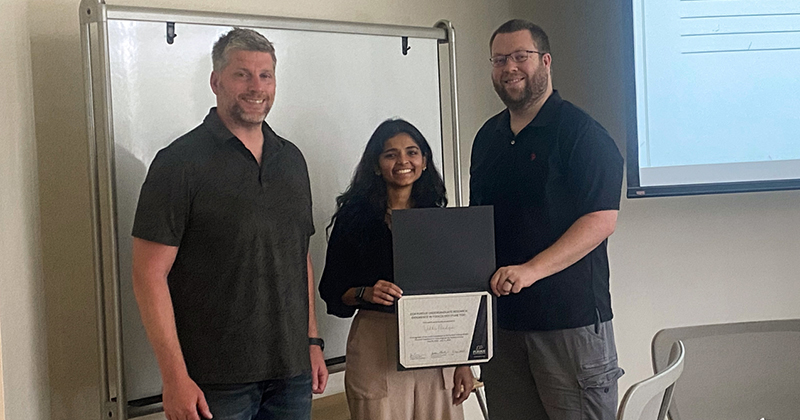
For many students, discovering toxicology isn’t a straight path, often encountered by chance outside of core classes. The Purdue University School of Health Sciences’ PURE Tox program is working to change that by introducing undergraduates to the discipline earlier and giving them hands-on research experience to explore it as a career.
“Toxicology is an applied discipline, which means people come from a lot of different backgrounds, like chemistry, biology, public health, epidemiology and physiology,” said Jonathan Shannahan, professor of health sciences and director of the PURE Tox program. “That means it’s not really well-known and recognized because it’s not one of those core classes, so you don’t see a lot of programs with toxicology undergrad degrees. People usually come to it in grad school, and there needs to be more mechanisms for people to be aware of it and receive the training necessary to see it as a viable career path.”
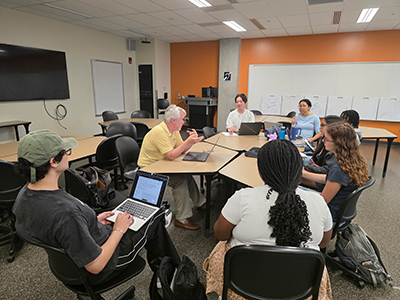
talks with students in the PURE Tox program. (Photo provided)
Funded by a National Institutes of Health (NIH) grant with support from the Society of Toxicology, PURE Tox is an eight-week program during the summer that brings in students from universities across the country to work with a faculty mentor in the College of Health and Human Sciences on a research project and receive valuable education and career development focused around toxicology. Students then present abstracts about their work at a symposium through oral presentations. This gives students a tangible item to take back and present at their own universities and add to their resumes.
“There’s a personal passion we have about this here at Purdue in the School of Health Sciences,” Shannahan said. “We have a tremendous number of undergraduates that are very promising (toxicology) students, and we also realize that there’s lots of those students across the country with variable access to research experiences. We felt like a program such as this can meet multiple needs: amplifying toxicology as a viable career path, getting people introduced to the field and the core concepts, and allowing students who have not had access to research opportunities another path to get experience within a laboratory environment.”
For Shannahan, Purdue’s research environment is particularly valuable to students because during the experience, they have the opportunity to utilize and observe a tremendous variety of novel methods and innovative technologies.
“It’s a great advantage of being at Purdue because of access to a lot of instrumentation and technologies in a variety of labs on campus,” Shannahan said. “When students come in, they might work in one research lab, but there’s a lot of different research going on across campus that they will be exposed to through the program.”
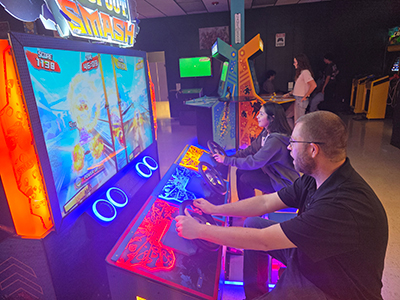
during one of the PURE Tox program’s community-building
outings. (Photo provided)
Shannahan explained the program is about more than simply gaining research experience in toxicology but also gaining knowledge and skills surrounding graduate school, responsible research conduct, communicating research and toxicology careers.
“One of our major goals here is for them to have a positive research experience where they felt like they learned something; they gained some new skills, some new perspective on something; and that they built the confidence necessary to be able to continue in a research setting if they choose to,” Shannahan said. “As a program, we really want our faculty thinking about, ‘How do I make this a positive, impactful experience for the trainees I have in my lab for eight weeks?’”
Vidhi Pandya, who completed the program in its first year when she was a rising senior at Rowan University in New Jersey double-majoring in molecular and cellular biology and biochemistry, received her first-ever published research paper from the experience under the direction of Thivanka Muthumalage, assistant professor of health sciences. Although she is currently studying to take her MCAT exam, the experience has left her considering pursuing research and a PhD in her future.
“I think that summer was my first really independent project,” Pandya said. “I was very thankful for Dr. Muthumalage for letting me take the lead on it, and it was also really nice that he was present as a PI for a lot of the training and experiment. I ended up getting a first-author publication, which I was very, very happy about as an undergrad at that time.”
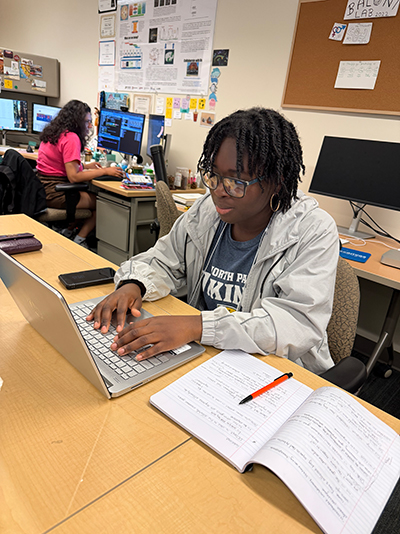
(Photo provided)
Blessing Klevor, a rising junior at the University of Illinois Chicago, has been working this summer with Priyanka Baloni, assistant professor of health sciences, studying the neurological effects of PFAS (perfluoroalkyl and polyfluoroalkyl substances) exposure. She noted the positive environment has made it easier to adjust to a brand-new research setting.
“I think one of the most meaningful moments so far has been one of the graduate students in the lab is finally publishing her paper, and so we went to Greyhouse Coffee to celebrate and get drinks,” Klevor said. “The community in the lab is solid and very welcoming. I’ve grown in terms of communication because I’ve been doing a lot of communicating with the people around me. I think I was very lucky that the people in the lab and the mentors have been very receptive to curiosity.”
For Shannahan, the most rewarding part of leading the program has been the impact the students have left on him in hearing about their successes after they leave.
“Quite a few students have stated they are now considering graduate school when before they were not considering graduate school as an opportunity,” Shannahan said. “We’ve had students say, ‘I had always thought I was going to go to med school and now I’m considering, going to graduate school as a viable option for my career.’ We’ve actually had students who have come out of the program and applied to our graduate programs and gotten in and continue their research in toxicology. I think that’s pretty rewarding to be able to help in just a little way in someone’s overall career development.”
Discover more from News | College of Health and Human Sciences
Subscribe to get the latest posts sent to your email.