Learning from alumna, Purdue Public Health student works to build better maternal care through mobile integrated health internship
Written By: Rebecca Hoffa, rhoffa@purdue.edu

Making a difference in women’s health has been a motivator for Arianna Chavis, a 4+1 Master of Public Health (MPH) student in the Purdue University Department of Public Health, which led her to pursue an internship with the Mobile Integrated Health Department in Crawfordsville, Indiana, focusing on Project Swaddle, a home-based maternal and infant health program. As an intern, Chavis is developing a toolkit that could help translate the program to other cities and counties across the state and country.
“It’s super cool because I feel like even with it being incomplete, it’s going to be really helpful,” Chavis said. “I feel like this is a project that really needs to be spread. It needs to be incorporated in a lot of different areas, and I think having a document that’s easy to read for everybody to share will be really helpful to encourage people to take that step. You can create a program like this, and it is hard work, but here’s all the steps on how you do it to impact all of these mothers and babies.”
Finding a path in advocacy
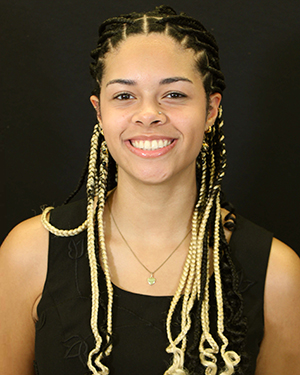
Arianna Chavis(Photo provided)
Chavis, who is currently finishing up her undergraduate education as she works on her graduate coursework, was always interested in advancing her degree through graduate school, but it was her anthropology minor that helped her uncover her interest in maternal and women’s health.
“I’ve always been really big on advocacy,” Chavis said. “I remember taking an anthropology class about pregnancy, birth and babies. Sitting in that class, every day I was so engaged. We’d learn about the process of birth, but we’d also learn about doulas and midwives and access in other countries. I remember thinking, ‘This is what I want to do,’ because I was so passionate in class.”
For Chavis, having the opportunity to shadow the providers in the program has been one of the most meaningful parts of the program in helping her see its impact for mothers and babies.
“I remember not really knowing what to expect or how the community worked there,” Chavis said. “It was kind of interesting because it is pretty rural, so there’s not a lot of resources, and I remember talking with my mentor, and she had said there’s only like three or four doctors there who can really take care of maternal and child health. Comparing that to the population is just insane. I think I’ve learned a lot of how important the community is to each other and how important it is to have these sorts of places where people feel comfortable and feel like they have a place to really talk about their problems and get the help they deserve.”
This experience has also enabled Chavis to work under the direction of Samantha Mitchell, director of mobile integrated health and fellow Purdue University College of Health and Human Sciences alumna.
“I definitely think her knowledge of Purdue makes her more relatable,” Chavis said. “I think her experience almost reassures me there is a path outside of Purdue that I can follow and that the goal I have in women’s health is achievable.”
Pioneering mobile health access
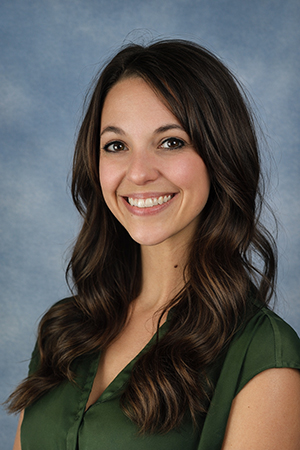
Samantha Mitchell(Photo provided)
For Mitchell, the path toward mobile integrated health began with her career with the Montgomery County Health Department after earning her degree in what was then public health promotion from Purdue. After seven years of moving through the ranks, Mitchell was connected with the Crawfordsville Fire Department and helped get the initiative off the ground.
“Mobile Integrated Health actually started out as what we call community paramedicine under our local fire department,” Mitchell said. “In 2024, the mayor and city council decided to make us our own department — the city’s Mobile Integrated Health Department. I think we’re one of the first in the country to do this. I was named director in that same time period. We have three robust programs: chronic disease management, maternal infant health and substance use behavioral health.”
For Mitchell, who grew up in Crawfordsville, studying public health opened her eyes to the issues in her hometown. As she soaked up all the knowledge the major provided, an internship with the health department led her back to effect change in the county.
“As I got into my studies, public health was where my heart was,” Mitchell said. “The public health courses really opened my eyes to disparities. At the time I graduated, I was really focused on substance use, sexual health, the lack of education, teen pregnancies — all the areas where I came back to my community and saw gaps. I wanted to make a difference.”
As a former intern herself, Mitchell said guiding interns like Chavis holds a special place in her heart. Her goal is to provide interns with meaningful experiences that will have a lasting influence.
“I have that experience, so I know what I would like to see them experience when they’re in that role, and I have taken that here,” Mitchell said. “Typically, we have them shadow with all of our providers the first few weeks they’re here so they really get an understanding of what some of these homes look like and the people we’re working with. I think that alone is pretty eye-opening for a lot of people. We’re giving them that hands-on experience with multiple different areas because we want them to have an actual experience.
“We also want them to walk away having contributed something that we are going to be using and not just for their schoolwork. It’s beneficial for us too.”
Prepared for what comes next
Chavis noted her experiences with Project Swaddle have been instrumental as she works toward the goal of becoming a patient navigator in a hospital to help patients understand their care plans and communicate with their care team. She credits the Department of Public Health with setting her up with the foundational knowledge to succeed in her internship, grad school and beyond.
“The switch from undergrad to grad was subtle, but it was really there, really impactful, because undergrad really sets you up for the basics,” Chavis said. “It is really drilling in these terms, definitions and structures that you will use in your grad studies and in everyday life. With the MPH’s more specific concentrations, I’ve had a lot of classes where I’m sitting in there and I’m like, ‘Wow, this is so me.’”
Discover more from News | College of Health and Human Sciences
Subscribe to get the latest posts sent to your email.