Purdue researchers explore space tourism health effects, potential policy and sustainability
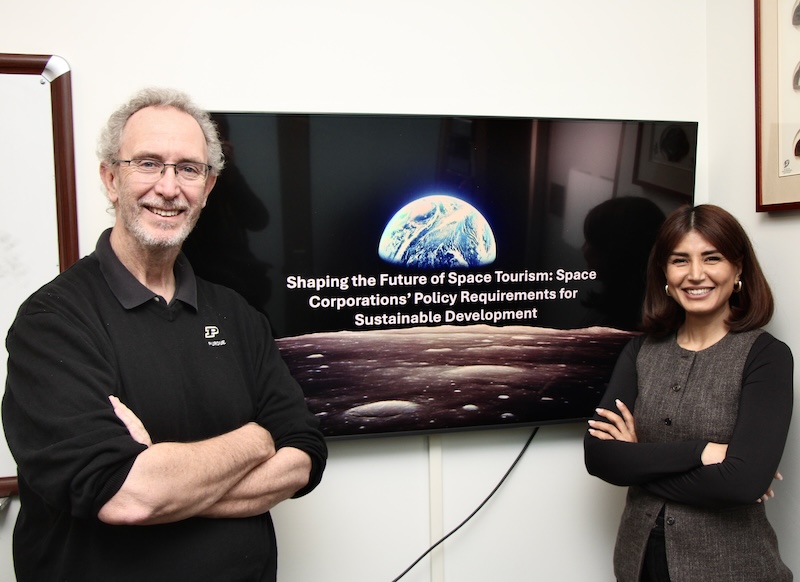
Jonathon Day, associate professor for the Purdue University White Lodging-J.W. Marriott, Jr. School of Hospitality and Tourism Management (HTM), and HTM PhD student Roya Alavipour have established the first space tourism research projects for their program.(Tim Brouk)
Written by: Tim Brouk, tbrouk@purdue.edu
At the moment, space tourism is more suited for pop stars and former captains of the USS Enterprise.
Purdue University tourism researchers Jonathon Day, associate professor in the White Lodging-J.W. Marriott, Jr. School of Hospitality and Tourism Management (HTM), and his PhD student Roya S. Alavipour see such space flights becoming more common — and not only for the financially elite — in coming decades.
“It’s one thing to take an astronaut to space who has this commitment to exploration and so forth. It’s another thing to take Vera from down the road, who wants to visit space and to be brought back safely,” Day said.
But before that happens, there is a lot to be done. Purdue tourism researchers have begun to work through some of the issues facing the growth of space tourism.
Health concerns
One of the first issues is understanding the possible health challenges facing space tourists.
Alavipour and Day’s current study, “Is Space a Health Hazard? — An Analysis of Health Issues Faced by Space Tourists,” will be sent for publication soon, and it is the first such research in Purdue HTM.
While astronauts must go through rigorous physical and mental health training and screenings, would Bill and Sue Tourist have the same such tests? This is among the first considerations, according to the Purdue researchers. Today, most space tourism is still close to earth with space travelers such as Katy Perry and William Shatner experiencing low Earth orbit visits. Since these tourists will be in space a fraction of the time a NASA astronaut spends above the Earth, would those health factors differ? And what kind of physical and mental effects will there be after the trip?
“There’s a lot of ‘We don’t know what we don’t know,’” Day said. “Our work is just beginning to work through some of the many possibilities. For instance, what happens if there is a medical emergency during a trip?
“I have a heart attack because I’m experiencing g-force. What do you do with that person who’s having a heart attack while they’re on that trip? For the shorter trips, it’s less problematic because they’re coming straight back. But as we get into these longer trips, how do we manage health-related issues? It’s going to be more problematic.”
The g-forces that these tourists will experience was the first health concern Alavipour explored. Good news for future tourists: They won’t have to undergo NASA-level training and conditioning.
“G-force and the effects of acceleration as you leave the earth are some of the most important factors that influence the body and that needs to be considered,” Alavipour said. “The amount of g-force they experience is not that much. But even for that amount, it is reasonable that tourists undergo training.”
Common g-force training for non-astronauts like fighter pilots and even race car drivers includes cardio exercise, weight-training, deep breathing exercises, hydration, no smoking and no alcohol. As space tourism becomes more common, it will be interesting to see what hurdles these travelers will be expected to meet to safely travel to space, explained the researchers.
Policy
One hundred years ago, the first piece of national aviation policy was passed — the Aviation Commerce Act, which charged the Department of Commerce with fostering air commerce, licensing pilots and certifying aircraft. Twelve years later in 1938, the Civil Aeronautics Act was passed to regulate safety and economic aspects of aviation.
Such legislation must be written for space tourism to grow. Alavipour has sunk her teeth into this arm of the research — attending space symposiums; interviewing Blue Origin leadership; and earning two Purdue graduate certificates in political science and policy development while working on this project, which she initiated in 2023. While the initial paper will look at health issues, Alavipour is using “scenario planning,” a strategic academic research method used to navigate uncertainty by developing, analyzing and preparing for multiple plausible future scenarios, rather than relying on a single forecast, to further develop space tourism.
“(Scenario planning) has a lot of industrial application,” Alavipour explained. “But in terms of academics, it is a very novel way of looking at tourism, specifically the space tourism area work.
“It is very interesting to use this methodology because it gives you a lot of good insights from different disciplines. We are currently using it to get insight from industry people, policymakers, academics who are working on space tourism or the space industry. And this methodology helps us to get a lot of insights from them. It gives us that freedom to develop scenarios around space tourism.”
Day added, “The thing about scenario planning is that it doesn’t assume a single future. It could end up being this, or it could end up being that. But no matter what, here are some things that we need to think about.”
One scenario would be looking to “extreme tourism” for examples in how policy was formed and health impacts measured. Traveling to frigid Antarctica or even climbing death-defying Mount Everest are million-dollar industries today and can welcome most adults with the funds and physical capabilities. Will space tourism be the same in years to come?
“I think the biggest story is that if (space tourism) was to grow and continue and we’re all excited about the future of space, then what do we need to be thinking about so we can have some responsibility around it as well?” Day asked.
Sustainability
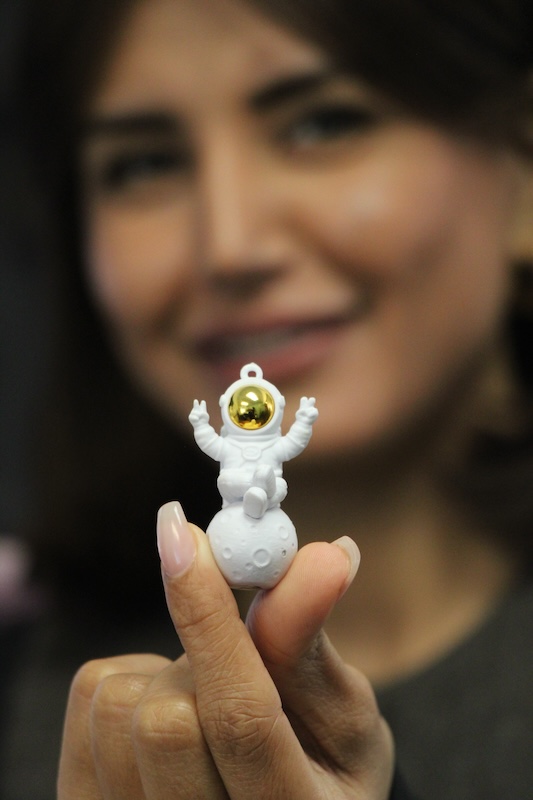
Alavipour holds a toy astronaut sitting on the moon.(Tim Brouk)
One of Day’s research foci is sustainability issues in tourism — environmental and economic. Space tourism opens a huge number of issues in sustainability, from the threat of space debris interfering with flights to the environmental impact of would-be launch sites that would need to be built.
“I know there are a lot of conversations around space debris and how they are going to get rid of those debris once space tourism happens,” Alvipour explained. “But none of these people talk about how they are going to protect humans and environment on Earth. Specifically, when space tourism becomes as possible as a flight — like every day, three times, four times from a launch site.”
A recent Associated Press article found “a roundtrip flight from New York to Los Angeles emits more than 1,300 pounds of planet-warming carbon dioxide per passenger, according to an emissions calculator from the International Civil Aviation Organization.” Meanwhile, “suborbital tourism releases 400-1,000 times more carbon dioxide per passenger per hour compared with commercial aviation flights,” according to a recent article published by the Public Library of Science.
Other sustainability issues include the growth of communities around space ports and health issues they may face.
From sustainability to health aspects to policy, Alavipour and Day want their work to be in line with other space research ongoing at Purdue.
“We know that Purdue is the Cradle of Astronauts, and very important work is being done in (the College of) Engineering and other programs,” Day said. “So part of our goal here is to spread the word that there is somebody (Alavipour) in HTM and HHS (College of Health and Human Sciences) who’s working on space research, and we’d love to build relationships across the university.”
Discover more from News | College of Health and Human Sciences
Subscribe to get the latest posts sent to your email.