From smoothies to Rice Krispies treats, Purdue Nutrition Science alumna keeps NCAA D1 student-athletes fueled for performance
Written by: Tim Brouk, tbrouk@purdue.edu
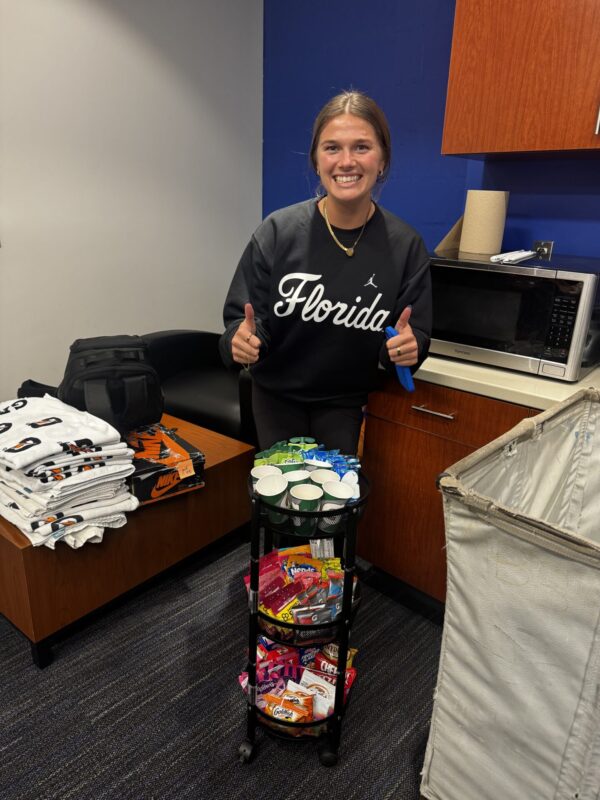
Julia Skinner (BS ’22) gives a double thumbs up while organizing snacks for University of Florida student-athletes.(Photo provided)
As part of the Purdue University College of Health and Human Science’s (HHS) 15th anniversary year, we are catching up with alumni who received the HHS Outstanding Senior award when they were undergraduates.
From her time working in the Purdue sports nutrition volunteer program to her current role as a performance dietitian at the University of Florida, Julia Skinner (BS ’22) has gained advanced knowledge of creating individualized nutrition plans to optimize athlete health and recovery.
She also knows the pickiness and even superstitions of her young athletes in Gainesville, Florida.
“One of my athletes insists on having a room temperature, homemade peanut butter and jelly (sandwich) before our games,” Skinner revealed. “It has to be room temperature, but she puts up 30+ points consistently, so I’m not going to argue with her.”
Skinner works with a wide variety of student-athletes in the women’s basketball, women’s tennis and baseball programs at Florida. She credits the hands-on experience she gained in the Purdue Department of Nutrition Science as well as her time as a student intern for Purdue’s wrestling and baseball programs for her success in Gator Country.
At Purdue, Skinner worked closely with experienced sports dietitians Elaine Wanstreet and Purdue Health and Human Sciences alumna Lauren Link (BS ’11, MS ’19) while also maintaining Purdue Athletics’ Fueling Stations, which are dedicated nutritional hubs for student-athletes located in the Mollenkopf and Mackey training facilities. All of this, and Skinner still graduated in three years.
What made you choose Purdue?
When I was in high school and I was touring campuses, what I was looking for was more of an immersion experience than just studying sports nutrition. I met with some sports dietitians at different schools, and Purdue was one of them. I connected with Lauren Link; she and some of her staff members showed me around, and I decided I wanted to go to Purdue because of it. During undergrad, I was a part of their sports nutrition volunteer program for a year and a half, and I was a Fueling Station manager for a year and a half, which was a paid position working with some of the teams and helping run those Fueling Stations in our athletic facilities. I definitely got a lot of cool experiences doing that. I worked with baseball, wrestling, women’s basketball and a little bit with football and shadowed a lot of dietitians over there to get that experience.
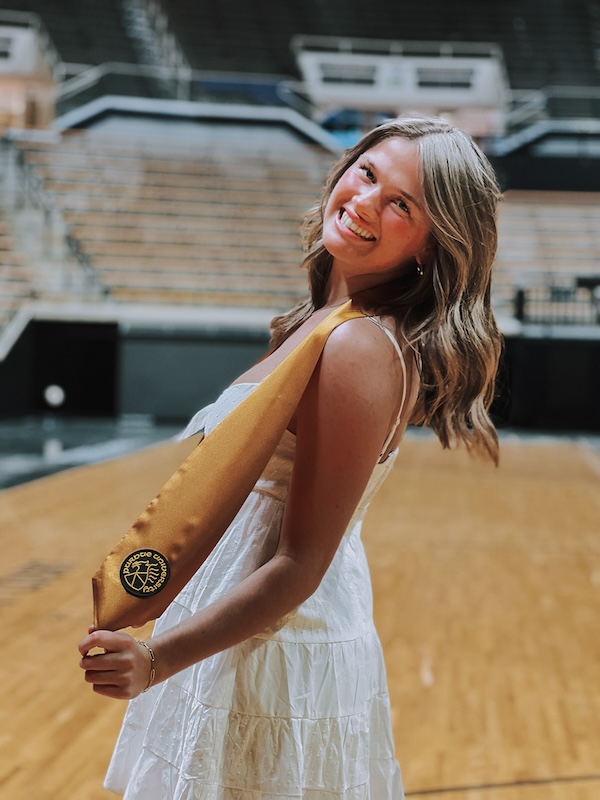
Skinner is all smiles just before her 2022 Purdue University commencement.(Photo provided)
What Purdue experiences have stuck with you?
Because my time at Purdue was pre-NIL era, a lot of our student-athletes were really relying on those Fueling Stations and our guidance for what to do. I wasn’t a dietitian yet, but I was able to provide them with snacks and help them figure out what they were going to eat during tournament time, as well as assist with team education and graphics. My biggest immersive experience was with wrestling at Purdue. Their nutrition needs are pretty specific to the individual and very unique in the sport itself. I was able to help Elaine Wanstreet come up with what they were going to eat down to the ounce and hour on match days because they would have to weigh-in. One of the other memories that sticks out to me is one of the smoothies I had to prepare for a wrestler. We had one who was competing at a weight that was heavier than he naturally fell at, but it was a good competition weight for him. He would have to drink super calorie-dense smoothies and would look so disappointed when he saw me making it for him, but he wanted to be great, and he was.
How does a sports dietitian develop a student-athlete’s diet plan?
We will do an initial intake meeting with them, so I’ll get an idea of what their current nutrition habits are, if they have any body composition goals, injury history, supplement use. Part of that is also gathering their food preferences. We’ll talk about what they like to eat, what they like to eat on a game day, what makes them feel good and what gives them energy. Our athletes aren’t too picky, but we do have a lot of varying tastes. We have some who could eat Chipotle every day of the week, and we have some who are like, “Never feed me Chipotle.”
How does it feel to now be a sports dietitian at a large institution, just like your Purdue mentors Lauren Link and Elaine Wanstreet?
You could major in sports nutrition for undergrad or get a master’s degree in sports nutrition, but you learn the most doing the hands-on learning and shadowing and having somebody who’s been through it to show you the ropes. [Elaine and Lauren] were so welcoming and gave me every opportunity to learn from them and kind of see what their day-to-day was. That’s what really made me fall in love with it and stick with it. I don’t think I would be where I am without the two of them showing me the inner workings at Purdue. I keep up with Lauren via social media and still text Elaine. (Elaine) has baseball too, so we’ll text about weird trends our guys are doing or supplements that they’ve seen on TikTok and asked about. It’s cool to transition from the student to being at a similar level to her and being able to share those experiences with her.
Discover more from News | College of Health and Human Sciences
Subscribe to get the latest posts sent to your email.