Health and Kinesiology alumna makes splash as new, first associate head coach of Purdue Women’s Swimming
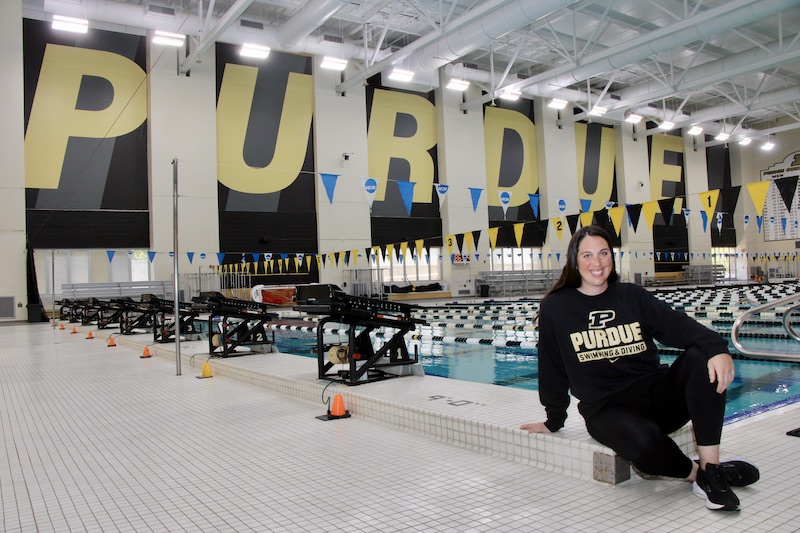
Caitlin Hamilton (BS ’13) was named the team’s first associate head coach for women’s swimming under her former coach John Klinge, whom Hamilton competed for at Purdue from 2009-13.(Tim Brouk)
Written by: Tim Brouk, tbrouk@purdue.edu
Purdue University Women’s Swimming and Diving team added a familiar face to a new coaching position this summer.
Caitlin Hamilton (BS ’13) was named the team’s first associate head coach for women’s swimming under her former coach John Klinge, whom Hamilton competed for at Purdue from 2009-13. A standout distance swimmer, Hamilton assisted Klinge during her time in West Lafayette while nursing a season-long shoulder injury. This impromptu coaching experience and her skills, leadership and understanding of biomechanics, thanks to her two undergraduate degrees from the Department of Health and Kinesiology, made her a much sought-after young NCAA swimming coach candidate after her graduation. Hamilton was an assistant coach at the University of Wyoming (2014-15), IUPUI (2015-17) and Indiana University (2017-19); an associate coach at University of Kentucky (2023-25); and a head coach at Illinois State University (2019-23), which is near where she was born and raised. But it’s Purdue where another homecoming is taking place for her and her young family.
“It’s been awesome to get to bring our daughter here, start raising our family here in a place that’s so special to me,” Hamilton said. “I’ve loved every minute of it being back. It’s been a crazy few months, but it’s been a lot of fun.”
Hamilton has been preparing her athletes with drills in the pool as well as video analysis of their strokes. Hamilton revealed that she, Klinge and women’s diving coaches David Boudia — with his four Olympic medals — and Mark Bradshaw collaborate with ideas and methods to get the ultimate performance from their young athletes.
The next wave of Hamilton’s competitive career started Sept. 26 as her swimmers took on Michigan in Ann Arbor for their season-opening meet.
How is the team looking so far as the season begins?
We’ve got a really nice, balanced team. Getting to know the women has been a lot of fun. It’ll be good to see them in action and get a little bit more data as we continue to develop and evolve what we’re doing here.
You gained phenomenal coaching experience between your two Purdue stops. How has that experience helped form your work now?
I’ve gotten the opportunity to learn from some incredible leaders and head coaches. I also was a head coach in my own right at Illinois State, which was really cool. I feel like I’ve become really comfortable in who I am in this profession. I think you get to learn how to be creative and try new things and not be afraid to put yourself out there when you’re working with the best of the best, which I’ve been very fortunate to do. I also think that every spot I’ve been in has taught me a lot about using my strengths and finding ways to challenge myself to be more creative.
How are you using that biomechanics knowledge today?
We pay attention a lot to how the body’s moving and why. We’re unique in the sense that they’re spending the majority of their life on land, and then we’re asking them to perform in the water. So how are we translating functional strength in the weight room on land to the water? I’m looking at how all of these joint structures are working together and how we can optimize muscle recruitment, how we can optimize technique, how we can do all these things to continue to help them improve.
What kind of technology are you using to achieve that improvement?
I would say the sport in general in the last handful of years has exploded with technology. So, there’s a variety of different toys that we can play with. I would say most of our monitors right now that we use are looking at the heart rate side of things. Those have gotten so much better just for in-water use over the last decade. It’s kind of wild — we can get live heart rate data through sensors in their swim caps. So, when I’m planning a training session and I want it to be in a certain energy zone, now I can actually see if my athletes are in that energy zone. I can adjust in live time to make sure that we’re not overdoing it. Maybe I need to elevate somebody and put them in a different stroke or a different time interval or whatever to get them into the correct energy zone. That’s been really huge. We have a velocity measure as well. We’re going to start using it more, especially for our power-based swimmers so we can measure any deficiencies in their stroke while looking at their ability to maintain speed and power as they go through their primary event.
You were a three-time Academic All-Big Ten honoree as an undergraduate student here. What advice do you give your athletes in balancing athletics with academics?
I’m a full believer in the fact that you can do both well. If you’re excelling and succeeding in the classroom, you’re going to excel and succeed in your sport. I don’t think one has to compromise to benefit the other. As a student, I made the decision to come to Purdue because I was so excited about the prestige of that degree, of walking away with a Purdue degree and getting the opportunity to be at a very well-reputed institution. On the other side of it, as a coach and recruiter people ask what you studied. “How has that prepared you for your role?” There are so many things that I still take away, whether it’s from the biomechanics motor control side or whether it’s looking more into like the holistic health side of an individual and how we incorporate that into what we do with our student-athletes. I really believe if you want to be great, you can be great in all avenues. And I know Purdue has the support pieces in place to make that happen.
Discover more from News | College of Health and Human Sciences
Subscribe to get the latest posts sent to your email.