Purdue School of Nursing receives federal grants to strengthen Indiana’s nursing workforce
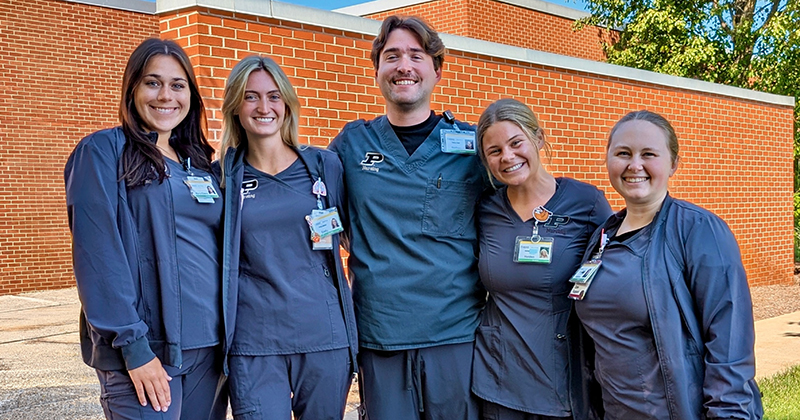
The Purdue University School of Nursing has received two federal program grants from the Health Resources and Services Administration (HRSA) to strengthen Indiana’s nursing workforce, expand pathways into the profession, and increase access to nurses and advanced practice nurses in rural and medically underserved communities.
Together, the two initiatives will create a continuum of nursing workforce development that begins with early exposure to nursing careers, supports students throughout their Bachelor of Science in Nursing (BSN) education and extends into graduate preparation for nurse practitioners serving communities with significant healthcare workforce needs.
“These investments allow Purdue Nursing to address workforce challenges across the entire educational pipeline,” said Libby Richards, professor and head of Purdue’s School of Nursing. “As Indiana’s land-grant university, we have a responsibility to prepare an outstanding nursing workforce while ensuring our educational programs are responsive to the needs of communities across the state. These grants give us an opportunity to connect education, community partnerships and workforce development in a way that can have a lasting impact on healthcare access in Indiana.”
Building the pipeline from nursing exploration to rural practice

The first initiative, From Pathway to Practice: Building Indiana’s Rural Nursing Workforce, is supported through HRSA’s Nurse Education, Practice, Quality, and Retention — Transition to Practice Program. Purdue’s School of Nursing will receive approximately $2.94 million over four years for the initiative.
The initiative will establish a comprehensive pathway beginning with nursing career exploration for middle and high school students and continuing through BSN education and transition into professional nursing practice. Purdue will work with Purdue Extension 4-H Youth Development, the Indiana Area Health Education Centers Network, rural schools, career and technical education programs, and healthcare organizations to introduce students to nursing and strengthen pathways into nursing education.
Once at Purdue, students selected as Rural Nursing Fellows will receive scholarships, mentoring, professional development and opportunities to engage with rural healthcare employers. Students will also participate in enhanced rural and community-based clinical learning, including a 100-hour rural health summer capstone in settings such as rural hospitals, federally qualified nurse-led health centers, public health agencies and other community-based healthcare organizations.
The initiative will also expand competency-based rural health education for Purdue BSN students through simulation, virtual reality, telehealth and community-based learning. Faculty and clinical preceptors will receive additional resources and development to increase the capacity of rural organizations to educate and support future nurses.
Preparing the next generation of rural nurse practitioners

graduate Carley Kayabasi
The second initiative, the Rural Indiana Advanced Practice Nursing Pathway, is funded through the HRSA Nursing Workforce Development program and will focus on increasing the number of nurse practitioners prepared to provide primary care, behavioral health and pediatric services in rural and medically vulnerable Indiana communities. The four-year initiative will support BSN-prepared registered nurses from disadvantaged backgrounds as they pursue Purdue’s family nurse practitioner, psychiatric/mental health nurse practitioner and pediatric nurse practitioner pathways.
The initiative is designed to reduce barriers that can prevent rural nurses from pursuing graduate education, including educational costs, work and family responsibilities, limited access to mentoring, and challenges securing rural clinical preceptors. Participants will receive financial support, individualized success planning, academic and peer mentoring, assistance with rural clinical placements, and support transitioning into rural practice after graduation.
Over the four-year project period, Purdue’s School of Nursing plans to provide direct financial and support services to at least 40 trainees and plans to graduate at least 28 nurse practitioner students. The initiative will also recruit and prepare additional rural clinical preceptors and aims for at least 80% of participating graduates to be working, practicing, continuing clinical service or completing transition-to-practice activities in rural or medically vulnerable Indiana communities within one year of graduation.
The initiative places particular emphasis on behavioral health. According to HRSA data cited in Purdue’s proposal, Indiana identified 110 Health Professional Shortage Area designations for mental health providers affecting more than 6.1 million people, highlighting the need to expand the state’s psychiatric and mental health workforce.
Advancing Purdue’s land-grant mission

January 2027.
The two initiatives reflect Purdue’s broader commitment to addressing Indiana’s healthcare workforce needs through education, research and community engagement. From introducing young people to nursing careers to helping experienced registered nurses become advanced practice providers, the programs create connected pathways designed to prepare healthcare professionals who understand the communities they serve.
“Workforce development is not simply about graduating more nurses. It is about creating sustainable pathways that help individuals enter nursing, succeed in their education, gain meaningful experience in the communities that need them most and ultimately choose to build their careers there,” Richards said. “These programs allow Purdue Nursing to work alongside our community and healthcare partners to strengthen that pathway at multiple points.”
The initiatives also build upon Purdue Nursing’s longstanding partnerships with healthcare organizations throughout Indiana. The undergraduate initiative will expand community-based clinical education and rural workforce connections, while the graduate initiative will strengthen rural clinical placement and preceptor capacity and establish a rural NP career bridge connecting students and graduates with employers, alumni and community partners.
Together, the HRSA grants position the Purdue University School of Nursing to develop a more coordinated nursing workforce pipeline while advancing Purdue’s land-grant mission of improving the health and well-being of Indiana communities.
About the Purdue University School of Nursing
The Purdue University School of Nursing prepares nurses to lead and transform healthcare through excellence in education, research, practice and engagement. Through undergraduate and graduate education, academic-practice partnerships and community engagement, the school works to strengthen the nursing workforce and improve health across Indiana and beyond.
Discover more from News | College of Health and Human Sciences
Subscribe to get the latest posts sent to your email.