Nationally recognized nutrition researchers join Purdue Nutrition Science through Movable Dream Hires program
Written By: Rebecca Hoffa, rhoffa@purdue.edu

The Purdue University College of Health and Human Sciences (HHS) recently welcomed two nationally recognized researchers to the Department of Nutrition Science on Oct. 1 as part of the university’s Moveable Dream Hire program. From taking a global approach to iron deficiency to making a difference in the health and well-being of active-duty military service members, Stephen Hennigar and Claire Berryman bring a wealth of expertise as HHS’ first associate professor-level Moveable Dream Hires.
“Being able to bring in these two Movable Dream Hires at the associate professor level is such a boost for the department,” said Laura Murray-Kolb, professor and head of Nutrition Science, “We’re excited about the fact that they’re going to contribute not just to research and teaching, but they’re really going to contribute to the culture of our department. They’re going to be able to help with mentoring some of the faculty who are just starting out. They’re going to contribute to the overall positivity of the department and people wanting to come here and work together.”
Furthermore, with expertise in military-related research, the two will be a welcome addition to HHS’ Health of the Forces initiative directed by Chad Carroll, associate professor in the Department of Health and Kinesiology.
“They both do research using military personnel, so I’m really excited about the fact that within the college we have Health of the Forces, and I think that they can fit in nicely with that,” Murray-Kolb said. “Both of them did their postdocs at a military research center. They bring in a knowledge and expertise regarding military personnel that we don’t currently have in the department.”
Claire Berryman
by Asma Bukhari)
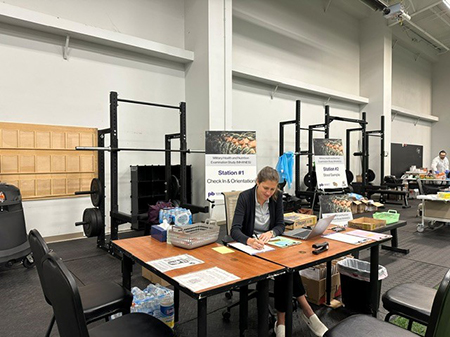
Berryman, associate professor of nutrition science, is coming to Purdue from Pennington Biomedical Research Center at Louisiana State University (LSU), where she served as director of the Nutritional Physiology Laboratory. Her research focuses on the effects of nutritional and environmental interventions on energy balance and cardiometabolic disease risk factors. In addition, she uses large datasets, such as the National Health and Nutrition Examination Survey and the Military Health and Nutrition Examination Study (MHANES), to examine dietary intake, health status, and disease prevalence in civilian and military populations, respectively. Together, this work integrates clinical trials with population-level analyses to investigate strategies to improve cardiometabolic health.
Berryman has authored more than 70 peer-reviewed publications in high-impact journals, including the Journal of Nutrition, the American Journal of Clinical Nutrition, Cell Reports Medicine, and NPJ Science of Food. Her work has been supported by multiple federal and industry grants, including a $2.25 million National Institutes of Health R01 grant and a $3.5 million Department of War-funded project.
“A big focus of my research is looking at both the nutritional intake and health of active-duty soldiers through our Department of War-funded Military Health and Nutrition Examination Study or MHANES,” Berryman said. “In my interventional work, I recently completed a study looking at the effects of low oxygen environments on energy balance and weight status.”
Recently, Berryman, in collaboration with Hennigar, made strides in characterizing the prevalence of low testosterone in active-duty soldiers in a paper published in the Journal of the American Medical Association on Oct. 15. Because the Department of War enacted a policy in September mandating that all male service members age 30 and older be screened for low testosterone, these findings come at a particularly significant time for understanding the outcomes and health implications that will result from this policy.
“We just serendipitously had that data on hand from MHANES,” Berryman said. “We are able to say, based on this new directive, how many Army soldiers this will affect. And then, that has implications for further medical treatment and healthcare costs.”
Berryman noted joining Purdue’s Department of Nutrition Science creates new opportunities for expanding her research, particularly in making her MHANES study a collaborative effort between LSU’s Pennington Biomedical Research Center and Purdue University, and having access to resources, such as the Clinical Research Center.
For Murray-Kolb, Berryman’s expertise in ingestive behavior is particularly valuable in both research and teaching. “Purdue has had such strength in ingestive behavior, and having Claire come in has sparked this renewal and excitement about the ingestive behavior area and how she might be able to contribute to that,” Murray-Kolb said.
Stephen Hennigar
in sub-Saharan Africa. (Photo by Nicole
Stoffel)
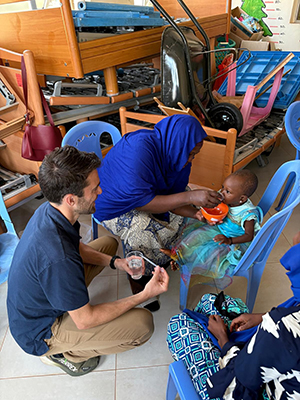
Hennigar, associate professor of nutrition science, is also coming to Purdue from Pennington Biomedical Research Center at LSU, where he served as director of the Micronutrient Metabolism Laboratory. His research focuses on iron deficiency and anemia in both U.S. populations and areas in sub-Saharan Africa where iron deficiency is particularly common.
Hennigar has authored more than 60 peer-reviewed publications in high-impact journals, such as the American Journal of Clinical Nutrition, the Journal of Nutrition, and the British Journal of Nutrition. His work has been supported by multiple federally funded grants exceeding $10 million from organizations such as the National Institute of Child Health and Human Development, the Department of War, and the National Institute of Diabetes and Digestive and Kidney Diseases.
One of Hennigar’s major ongoing projects is a National Institutes of Health-funded study aimed at better defining how much dietary iron adults need. Current iron recommendations are based on data from a relatively small number of studies and participants, drawn largely from homogenous populations that may not reflect the diversity of the U.S. population. Hennigar and his collaborators are using stable iron isotopes to measure iron requirements in approximately 300 U.S. adults, with the goal of generating more representative evidence that could ultimately inform future dietary recommendations.
“With most of my current work focused on iron deficiency and anemia, we’re trying to understand both how much iron people need and how we can provide it more effectively, particularly in vulnerable populations,” Hennigar said.
Hennigar is also part of a Gates Foundation grant investigating alternative forms of iron that could improve iron delivery in populations with a high burden of inflammation or infection. The works builds on previous studies of iron delivered from Aspergillus oryzae (AO), a food-grade fungus used to produce a form of iron that may behave differently in the gastrointestinal tract than convention iron supplements.
Work in Hennigar’s laboratory found that, compared with conventional iron supplements, AO iron promoted less growth, motility and virulence of potentially harmful bacteria such as salmonella. These findings provided some of the initial evidence that AO iron could offer advantages in settings where iron deficiency and infection commonly coexist.
Hennigar’s research, which closely complements Murray-Kolb’s, will provide even greater opportunities for collaboration and elevate Purdue’s already strong reputation in the area.
“Steve really has a focus on micronutrients, especially iron and zinc, and Purdue has had a historically strong focus on micronutrients,” Murray-Kolb said. “In recent years, we’ve had individuals with that strength retire or leave, so there were a few of us here who still do it, but we’re holding it together. Having Steve join that group is going to be really helpful. It’s just going to strengthen that component of our expertise and what we do.”
As Henniger and Berryman get acquainted with Purdue and the Department of Nutrition Science, the two emphasized that the research environment, culture and resources are particularly exciting.
“The reputation of Purdue Nutrition Science in the world of nutrition science — it’s a highly regarded program, and it is a really exciting opportunity to join Laura and the faculty at Purdue in nutrition,” Hennigar said.
Discover more from News | College of Health and Human Sciences
Subscribe to get the latest posts sent to your email.