As youth vaping persists, Purdue University and Underwriters Laboratories collaborate to ‘clear the air’
Written By: Rebecca Hoffa, rhoffa@purdue.edu

While vaping has been framed as a smoking cessation tool in mainstream media in the past, the 1.63 million middle and high school students reported by the Centers for Disease Control and Prevention in 2024 who use e-cigarettes tells a starkly different story. This concerning statistic brings a wave of health concerns for a new generation of individuals experiencing addiction to tobacco products.

Jonathan Shannahan, professor of health sciences and assistant dean for research in the Purdue University College of Health and Human Sciences, and Christa Wright former senior research director of the Center for Toxicology and Human Health within Chemical Insights of UL Research Institutes, have worked to not only explore these health consequences but also inform these demographics of what vaping and e-cigarette use does in the body.
“It turns out there is a gap in our field associated with exposures and oral diseases, even though there has been a known link in the literature for years regarding traditional tobacco products — like smoking cigarettes — and oral health effects,” Shannahan said. “If something came into the body through the mouth, we typically worry about the lungs. That’s where we started. However, for that to happen, it has to go through the mouth, and it spends time in the mouth. That’s the first point of exposure. Especially in vaping products, where flavor is such a key component in a lot of the e-liquids and also the reason behind people vaping, it makes sense to us that likely there’s more going on in the mouth, and not a lot of people are really looking at that.”
Wright continued, “Kids and young adults are adopting these devices at alarming rates, becoming addicted to nicotine during critical stages of brain development. Not only should we prevent exposure to nicotine but also to known and unknown hazardous substances within e-cigarette emissions. Although these emissions were initially thought to be water vapor — we know now that these emissions are complex aerosols that pose unique chemical exposure related health risks.”
Shannahan, who focuses his research in the School of Health Sciences on toxic exposures, began his collaboration with the UL Chemical Insights Research Institute after connecting with Wright at a research conference. The two had overlapping interests and began working on studies to understand the oral health consequences of vaping.
“What we found is that vaping behaviors can directly contribute to poorer health outcomes and increased treatment needs — which ultimately means higher costs associated with e‑cigarette use. Over time, individuals may face substantially higher dental care expenses as a result of their vaping habits,” Wright said. “If we can effectively educate users about this connection, we may be able to reduce both long‑term healthcare costs and the more serious health consequences linked to vaping?”

Having been funded by the National Institute of Dental and Craniofacial Research (NIDCR), the team has taken a multifaceted approach to their work. For their work related to vaping behavior’s role in health outcomes, the team recruited individuals who were vaping and attached a smoking topography device to their vaping device, which measured how the individual used the vape. This included how much of the aerosol they were taking into their lungs, how often they were vaping and at what speed they were vaping, among other measurements about their devices. After collecting that information, they had the person exhale in a sterile room where they captured the aerosols the person breathed out. The team also used a “smoking robot” device that mimicked the way the person vaped to help them create a model to track individual exposures.
Then, the team collected biological samples, such as saliva and plaque samples, and had the person undergo a clinical oral exam by a certified dental hygienist to assess their overall health.
“What was really cool about this study is the integration of multiple innovative research components that span from behavior to clinical outcomes and the technologies and methods that we brought together,” Shannahan said. “We have behavior data, exposure data, molecular data on biological changes and then clinical outcomes.”
Ultimately, because the team found the various vaping behaviors, such as puff volume, make a big difference in the amount of risk the person is undertaking and the health risks aren’t uniform across individuals or populations, this has informed their approach for disseminating the information. The team has developed various materials to raise awareness of the health risks of vaping, including a comic book tailored to the younger audiences for whom vaping is an especially prominent issue.
“Our goal was to generate information to better educate consumers who are vaping or considering vaping or people who are interacting with people who are vaping, such as middle school teachers and clinicians and parents,” Shannahan said. “What we’re really trying to do here is take all the complex data and research that had been done and that we had contributed to and find ways to communicate it with people. From that, we were able to generate a guidance document that outlines the current knowledge base regarding vaping.”
To continue their awareness efforts, Underwriters Laboratories is coming to Purdue for a “Clear the Air and Unplug” event from 9:30 a.m.-2:30 p.m. Aug. 25 at the France A. Córdova Recreational Sports Center featuring speakers, giveaways and information to raise awareness about vaping among college students.
“Our mission is to help students understand the threats or the concerns with vaping,” said Bert Kelly, UL Chemical Insights Research Institute director of communications. “Obviously we’re not trying to scare people. We’re just trying to share what the science says about it, and we want you to understand it. Purdue is going to be the first university where we’ll show up with some displays and information to give away to students as a pilot program for going to college campuses around the country to share this information.”
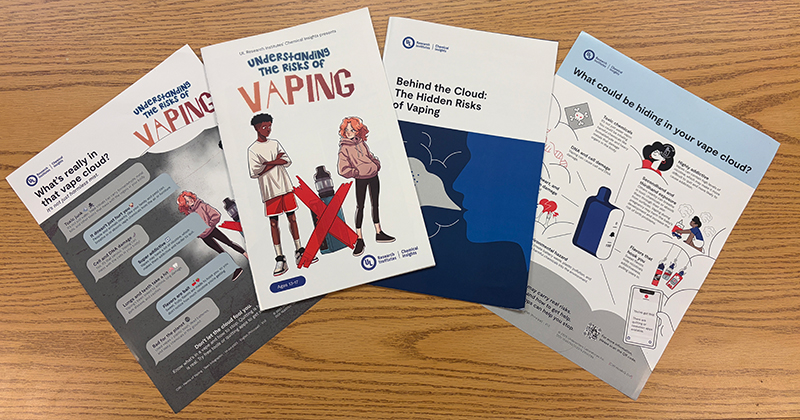
people of all ages about the dangers of vaping. (Purdue University Photo/Rebecca Hoffa)
The event will also feature a panel that will dive deeper into the research related to vaping, both from the UL Chemical Insights Research Institute and throughout Purdue University.
“One of my greatest concerns is that we have not yet realized the full long-term consequences of vaping,” said Maureen Meister, a Chemical Insights Research Institute researcher, coauthor on the UL vaping guidance documents and one of the panelists at the event. “Many users began vaping at a young age, and these products have not existed long enough for us to understand what decades of repeated exposure may mean for their health. The absence of long-term data should not be mistaken for evidence that long-term harm does not exist.”
While Shannahan noted all the team’s work in this area has been impactful and important, the comic book, which was strategically developed using their research findings in a format that would resonate with younger audiences, has been particularly rewarding.
“I think this comic book — plus some of the infographics and the materials we’ve made for consumers through this process — will likely be the most-read stuff I’ve produced in my career,” Shannahan said. “Dr. Wright and I produced this product in a way that was driven by a need. It’s kind of stimulating to develop something that has the potential to be very impactful and make science accessible to meet people where they are.”
Discover more from News | College of Health and Human Sciences
Subscribe to get the latest posts sent to your email.