Purdue Doctor of Nursing Practice graduate prepares ‘exercise prescriptions’ with new app, Kintec AI
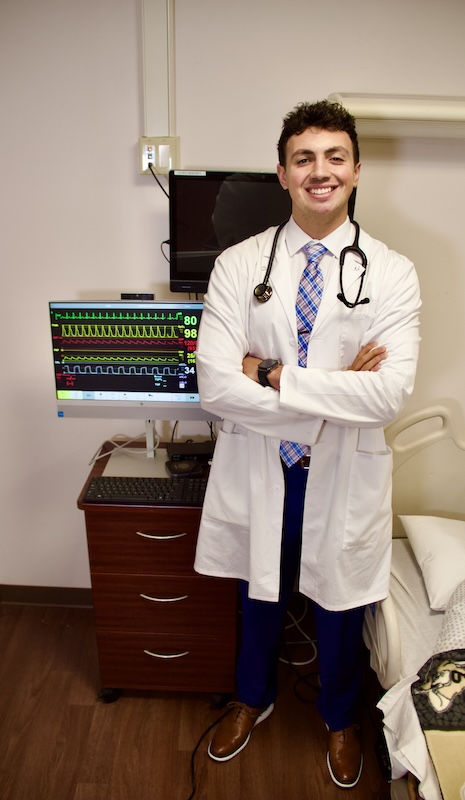
Tyson Magee will be a sports medicine nurse practitioner at the Orthopedic Center of Illinois in Springfield this summer. He will have his Kintec AI app to help his patients keep active in their homes.(Tim Brouk)
Written by: Tim Brouk, tbrouk@purdue.edu
As one of the Purdue University School of Nursing’s newest Doctor of Nursing Practice graduates, Tyson Magee will be able to prescribe treatments for his patients — both for the pharmacy and the gym.
As he readies for his new job as a sports medicine nurse practitioner at the Orthopedic Center of Illinois in Springfield, Magee believes personalized movement plans can be just as important as medications in helping patients recover and improve their health.
“Movement is medicine,” Magee said. “We tell people, ‘Go home and make sure to get your 150 minutes of exercise,’ and that’s what we leave people with. We tell everybody exercise is great and to make sure they get exercise, but we don’t tell people how to exercise or exactly what to do.”
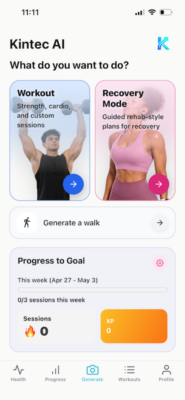
Making it easier for patients to get moving through technology was a driving force throughout Magee’s years in the School of Nursing. This passion resulted in Kintec AI, an app for patients and healthy people that utilizes artificial intelligence to cater specific workouts to their needs. The app is available in English and Spanish on the App Store and Google Play Store.
The “Kin” in Kintec AI stands for kinesiology, the study of human movement, while “tec” represents technology. Together, the name reflects the company’s mission to combine movement science and artificial intelligence to create personalized exercise and recovery plans. The platform also uses customized notifications and motivational support to help individuals stay engaged and consistent over time.
PhotoFit origins
Magee recalled a plateau he reached in his fitness. While catching his breath among exercise equipment at his gym, Magee wished he could take a picture of the equipment and an app could give him new ideas for his routine. So, he made one.
“I’ve done the same three workouts the past six months. I’m over it,” Magee recalled. “And I just started thinking, ‘I wonder what type of workouts I could do if I took a picture of this.’”
After some “vibe” or early coding, Magee teamed up with his co-founder, Kaden Froebe, and chief technology officer Ethan Silverthorne to create an early version of the app, called PhotoFit AI, based on taking photos of equipment or objects to generate exercise recommendations with the help of AI.
“With our large language model, I can take a picture of these two couches or this coffee table, and it’s going to analyze it, tell you what you have, and then give you customized workouts based off what’s in front of you,” Magee said.
Magee expanded his idea to a multifaceted tool for patients to reimplement fitness into their recovery. It’s not just about how to work out better at home; the goal is for total recovery with better customization to ensure fast and better results.
Magee collaborated with a physician to build Kintec AI around 23 different “post-surgical pathways.” These pathways vary to meet the numerous diagnoses an adult patient can have. The needs of a patient looking to recover from elbow surgery are different from someone convalescing from hernia surgery. Recovery takes physical and mental fortitude, and Kintec AI can be a motivator for both sides of the healing process, especially at home.
“We’re just taking down as many barriers as possible toward their recovery. That’s the kind of mission that we have,” Magee said.
The suggested exercises are loaded with the kinesiologic details behind the exercises. Kintec AI also caters lengths and intensity levels of the workouts.
“No two people are the same, so why should everybody get the same medical care, the same exercise prescription in that case?” Magee stated. “Everybody deserves their own specific treatment. Treatment shouldn’t be standardized.”

Motivation meets technology
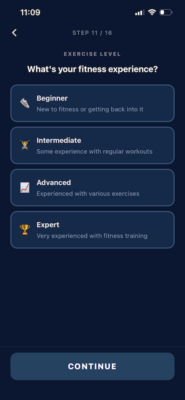
After entering basic information like age and name, Kintec AI quickly gets the user on a path to either “feel better,” “get stronger,” “move easier” or “stay healthy.” During onboarding, users also answer a series of questions rooted in motivational interviewing, an evidence-based counseling approach that explores why movement matters to them, what barriers they anticipate and how confident they feel about reaching their goals.
These responses help Kintec AI understand each person’s underlying motivation and tailor both the exercise plan and the support strategy to fit their needs. Users can choose how they want to be encouraged, selecting reminders that are “gentle and encouraging,” “accountability-focused” or somewhere in between. The platform then uses artificial intelligence to generate customized notifications designed to reinforce each individual’s goals and keep them engaged without adding unnecessary stress.
Kintec AI relies heavily on the user’s personal reason for wanting to move. For some, the goal may be to recover from an injury or illness. For others, it may be to improve overall health, build strength or simply feel more confident and capable.
“A big one that I always hear from older adults, such as grandparents, is, ‘My goal is to be able to get down on the floor and play with my grandkids. But right now, my lower back hurts too much,’” Magee said. “Or they say, ‘I feel like if I get down there, I won’t be able to get back up.’”
The customized movement plans range from light walking programs to strength training routines. Links to demonstration videos help users perform each exercise correctly, while Kintec AI personalizes repetitions, intensity and timing to fit everyone’s needs.
“We want people to exercise, but more importantly, we want people to exercise right,” Magee explained.
Expanding care beyond the clinic
Kintec AI will be a valuable tool for Magee’s patients at the Orthopedic Center of Illinois. While patients receive guided treatment in the clinic, much of the work involved in overcoming injuries and other health challenges takes place at home.
“Exercise shouldn’t be a one size fits all,” Magee said. “And that’s kind of how it is right now. When we discharge people and say, ‘Make sure to get your exercise,’ they’ll say, ‘Oh, but my knee hurts.’ ‘Oh, but I can’t make it to the gym.’ ‘Oh, but I don’t have enough time.’ So, what we’re trying to do is just kind of meet people where they are.”
Kintec AI could also help rural patients who might live 30 or 45 minutes away from the nearest physical therapist or gym. Magee doesn’t want the continuity of care to be broken through the stress of long commutes to exercise or physical therapy facilities. Kintec AI is like telehealth for this population. The home and yard can become their gym with help from the new app.
Magee said his goal is for Kintec AI to help anyone just out of surgery or anyone looking to keep up with their fitness, who just need some guidance and motivation.
“AI and apps will never replace us as clinicians. It will just expand our reach outside the clinic,” Magee said.
Discover more from News | College of Health and Human Sciences
Subscribe to get the latest posts sent to your email.