Purdue professor prepares Boilermakers for life after college through project-based personal finance curriculum
Written By: Rebecca Hoffa, rhoffa@purdue.edu

Mortgages, taxes, health insurance, budgets. A lot of financial decisions await Purdue University students upon graduating and starting their lives in the workforce. While advice like “stick to a budget” or “invest your money” are well-known tips, putting them into action and achieving financial fitness goes far deeper than many students may realize.
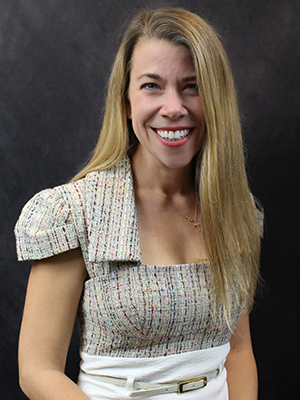
Larissa Adamiec(Photo provided)
Larissa Adamiec, clinical associate professor in the White Lodging-J.W. Marriott, Jr. School of Hospitality and Tourism Management, has revamped the curriculum for her personal finance courses to prepare students throughout the university for life beyond college.
“Really, I want them to be prepared for that first day of work,” Adamiec said. “I really try to make it as practical things that they’re going to have to deal with in their life. By the end, I think they’ll have a language to be able to start talking about finance topics.”
As Adamiec nears the end of the her first year in Purdue’s College of Health and Human Sciences, the new curriculum is reshaping the previous coursework to help students understand how they can apply personal finance principles in the real world.
“I felt there was a lack of understanding from the course material to how it actually applies to your day-to-day life,” Adamiec said. “It didn’t necessarily dive into the nitty-gritty details that I think students actually need to see. So, for example, if you talk about what a mortgage is, I think it’s important to understand the components of a mortgage, even if you’re never going to calculate it yourself. I go above and beyond even a traditional corporate finance class and include things like private mortgage insurance, property insurance and taxes. Because again, at some point, they might be interested in purchasing a home, and even if they’re not, their student loan, their car loan, doesn’t look that different.”
Adamiec takes a project-based approach to her courses, where students complete 12 projects that range from insurance planning to navigating a mortgage calculator to basic stock and bond valuation and beyond. The projects help students get hands-on experience with these skills prior to applying them outside of class, where the stakes are much higher.
“It changes the dynamics when you’re actually applying it, as opposed to this very grand, sweeping motion of, ‘Here’s a topic that you will never see in your life,’” Adamiec said.
As her first semester of implementing the new curriculum nears its end, Adamiec noted she’s heard a lot of positive feedback from her students.
“I think they’ve enjoyed the discussions we have in class,” Adamiec said. “I talked quite a bit about the IPO (initial public offering) market and described how stocks really came into being, and several of my students came up afterward and said, ‘We had no idea.’ You hear what a stock is, but you don’t really understand how it goes from a garage to a publicly traded company. We’re not going deep, deep into it, but having a general idea of what’s happening so that if you’re listening to the news in the financial markets, you can somewhat follow along. I think that’s been a huge benefit to the students.”
In making her courses reflect life beyond college, Adamiec also doesn’t take the consequences of missing deadlines lightly, despite offering extra credit opportunities during the semester to help students make up for mistakes they may have made.
“In life, you miss your taxes, your mortgage payment, your credit card bill, you’re going to be paying late fees, potentially overdraft fees,” Adamiec said. “I mean, there’s genuine impacts to your life. So, I put in that policy of not taking late work because I think that’s part of our daily life.”
In the current economic conditions, Adamiec explained students having these tools under their belts will not only prepare them to handle their early days in the workforce but also prepare them long-term for the changes they could experience throughout their life.
“Having them know this information now, especially as we’re struggling with the economy, will give them better tools for things that are going to happen in the future,” Adamiec said. “Things are going to constantly happen for them because they’re in their early 20s with hopefully 70 years to go, and life is going to be constantly changing, and then the markets react to that, and they should have an idea of how or why they are reacting.”
Discover more from News | College of Health and Human Sciences
Subscribe to get the latest posts sent to your email.