Purdue Nutrition Science faculty share health benefits of National Pack Your Lunch Day
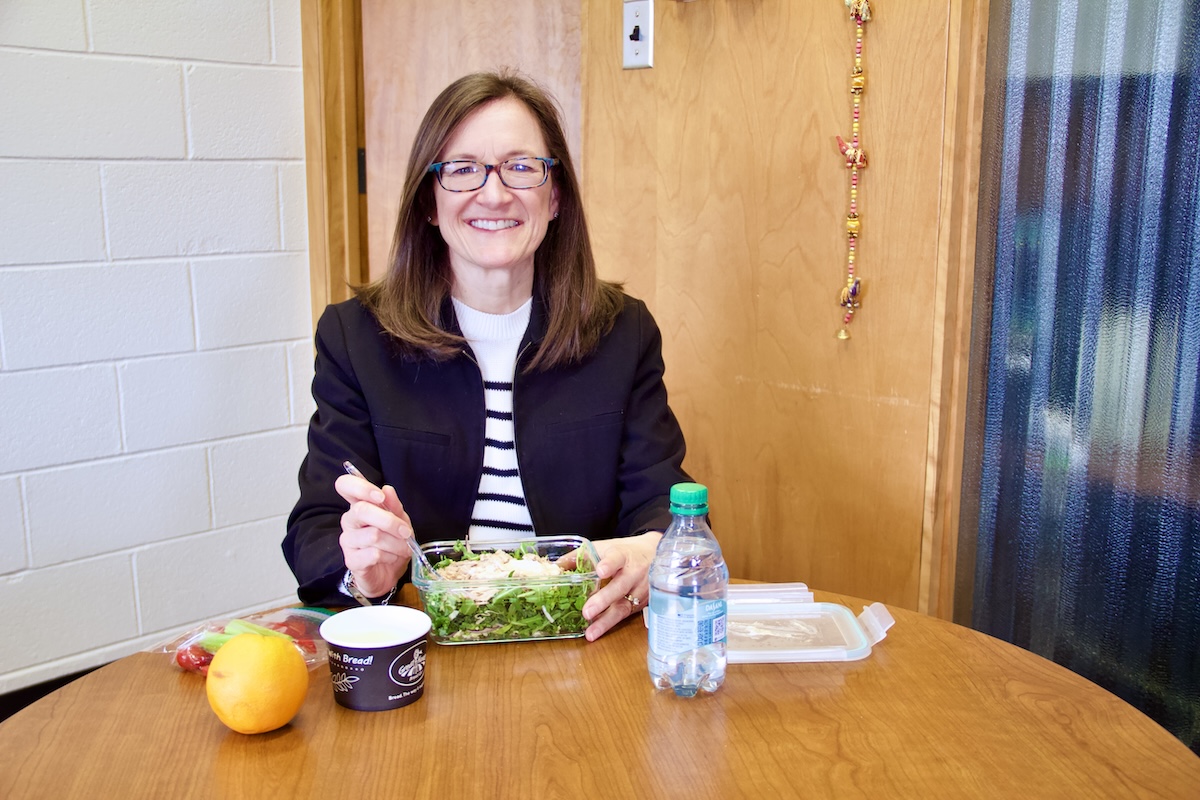
Just in time for National Pack Your Lunch Day, Laura Murray-Kolb, Purdue University Nutrition Science head and professor, said packing your own lunch gives you control over portion size and healthfulness of the meal.(Tim Brouk)
Written by: Tim Brouk, tbrouk@purdue.edu
Purdue University Department of Nutrition Science faculty practice — and eat — what they teach and research.
With March 10 being National Pack Your Lunch Day, bringing your lunch to work or campus can have significant health benefits. The plusses of forgoing the foods from nearby fast food restaurants include having more control over ingredients, portions and nutritional balance.
“One of the things about packing your lunch is you can really make sure that you have the various components of a healthy diet all in your lunch,” said Laura Murray-Kolb, Nutrition Science head and professor. “We talk about really being thoughtful about the different components, so you are trying to maximize the nutrients that are in your meal.”
When Murray-Kolb packs her lunch, she is thinking about proteins, fats, carbohydrates and micronutrients — vitamins and minerals such as iron, vitamin A and zinc. A recent lunch consisted of an arugula salad with tuna (protein), raw vegetables (micronutrients), hummus (fats) and an orange (carbs).
Prepackaged salads and having fruit around the house are two hacks that help Murray-Kolb pack a healthy lunch most workdays. By adding the tuna or another protein like hard-boiled egg, the salad offers micronutrients as well as protein. And grabbing an orange or apple from the kitchen can be done while walking out the door before heading to her Stone Hall office and lab.
And yes, the Nutrition Science department head does indulge in dessert — proportionately controlled, of course.
“I do like to sometimes have just a little piece of chocolate — just one of those small, little squares or something. It tastes really good at the end of the meal and sort of rounds out the meal,” Murray-Kolb said.
What does a U.S. Dietary Guidelines Advisory Committee member eat for lunch?
In 2025, Professor Heather Eicher-Miller became a member of the U.S. Dietary Guidelines Advisory Committee to help shape national dietary recommendations under the U.S. departments of Agriculture and Health and Human Services. The internationally recognized researcher also studies food insecurity in the United States and abroad. So, what does an acclaimed expert like Eicher-Miller eat for lunch? A recent menu she sat down for included a whole wheat bagel with cream cheese and sunflower seeds, raw broccoli and cherry tomatoes, low-fat yogurt, two hard-boiled eggs, a mandarin orange and water to stay hydrated. The bagel with sunflower seeds and cream cheese represented protein, fiber and healthy fats, and the yogurt gives her a dose of dairy.
“I like to try to represent all the different food groups in my lunch, just kind of trying to get that variety of different kinds of foods that offer different nutrients,” Eicher-Miller explained. “Then you really have the energy you need for the rest of your day.”
Packing a lunch can be a major step toward an overall healthier approach to nutrition.
“Eating healthfully can make you feel better — sometimes in ways you might not really realize,” Eicher-Miller explained. “It’s not only good for your physical health, but also your mental health because you have that feeling like, ‘Oh, I had a good lunch. I feel really good to go forward until dinner.’ And some of the parts of these foods, like protein, is going to help you feel more satiated until the end of the day.”
Calorie and money saver
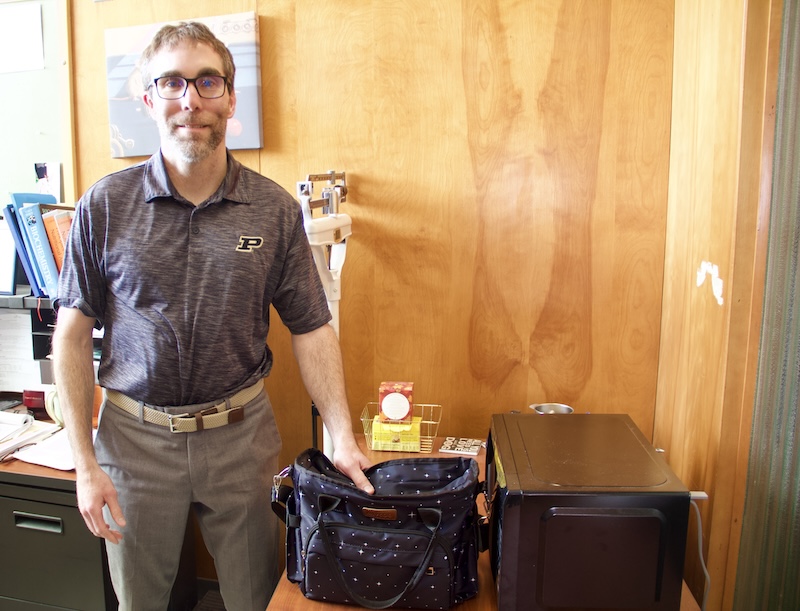
Greg Henderson, assistant professor of nutrition science, estimated that he saves more than $2,000 a year — along with thousands of calories — by bringing his lunch every day.(Tim Brouk)
Greg Henderson, assistant professor of nutrition science, brings his lunch every day. Earlier in his career, he would grab a burrito or submarine sandwich, but that practice began to weigh on his body and wallet. He quickly found bringing his lunch saved him calories and money.
“When we go out to lunch, there’s going to be potential surprises in the meal where we just don’t have control over the health characteristics. A benefit, at least for me, is that by packing my lunch, it can keep me away from making bad choices,” Henderson said.
Henderson calculated by bringing his lunch every day, he has saved thousands of dollars over the years.
“There’s over 200 workdays in the year, probably close to 250 or so,” Henderson said. “We could save easily $10 a day. So, we’re talking about over $2,000 a year by just bringing leftovers rather than buying lunch out every day. And at the same time, we’re limiting food waste, which is good for the environment.”
Henderson found eating healthy at home translates to healthier lunches via leftovers. A recent lunch of his consisted of baked pulled chicken with cheese, potatoes and broccoli.
“We don’t fry food much at all at home. So, if I pack leftovers from home, I’m not going to be packing fried food, which isn’t so good for you,” Henderson explained. “But if I go out to lunch, I’m fairly likely to get some french fries as a side or get a fried chicken sandwich or something like that. So, it’s just going to be less healthy. I’m just going to be vulnerable to making those impulsive decisions when I have a full menu to look at.”
Discover more from News | College of Health and Human Sciences
Subscribe to get the latest posts sent to your email.