Purdue Audiology team studies Mackey Arena’s loudest areas, fans’ hearing
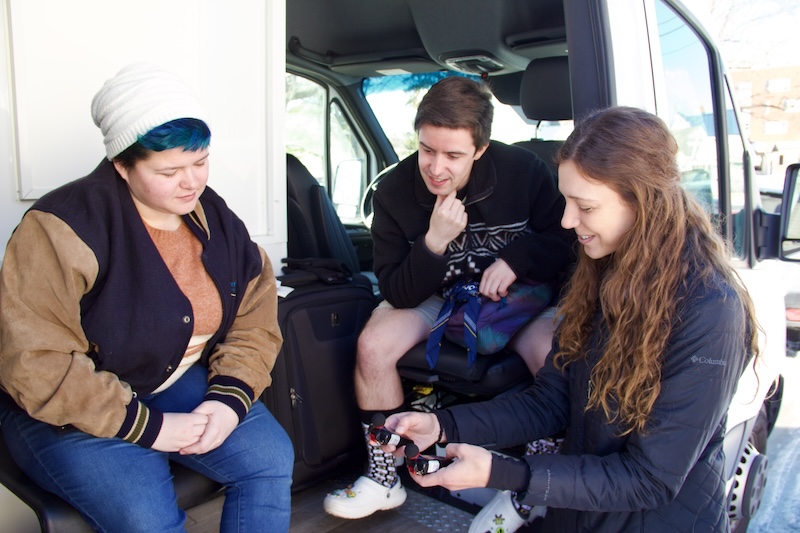
Isabella Huddleston, right and an audiology graduate student in the Purdue University Department of Speech, Language, and Hearing Sciences, explains how audio recorders called dosimeters work to study participants Patton Duvall, left, and Ethan Bowlby, who both play trumpet in the Boiler Brass pep band.(Tim Brouk)
Written by: Tim Brouk, tbrouk@purdue.edu
Down by one with less than a minute to play in a sold-out Mackey Arena, starting senior shooting guard Fletcher Loyer gets a pass beyond the 3-point arc. His University of Oregon defender slips, giving the Boilermaker plenty of space to drain yet another 3-pointer.
The crowd of Purdue University faithful fans explodes with thunderous cheering — sounds like another Purdue University men’s basketball victory.
Among the nearly 15,000 roaring fans in attendance, four participants in an ongoing Purdue audiology study got their hearing tested before the game and after in the new Accessible Precision Audiology Research Center (APARC) van. They also wore sound dosimeters, which measured the volume levels throughout the game.
After the 68-64 victory was in the books, the participants dropped off their dosimeters and had their hearing retested. The dosimeters revealed, unsurprisingly, that Loyer’s game-clinching 3-pointer was the loudest moment of the Feb. 7 game. The second loudest was at the final buzzer, and the third loudest was at the tipoff. All four participants performed slightly worse in the postgame hearing tests, but the Purdue group and the field of hearing science are working to determine any potential long-term significance of these findings.
“It is known in current literature that there can be temporary threshold shifts following a noisy event,” said Isabella Huddleston, a graduate student in the Purdue Department of Speech, Language, and Hearing Sciences. “These temporary thresholds only last a certain amount of time. After you leave the noise, your ears start to recover. So, it’s really critical to get that data within the first hour of the participant leaving the noise.”
Casual fans who take in a handful of home games a season likely need not worry about their hearing long-term, but what about members of the Boiler Brass pep band or a student trainer who sits behind the players’ bench every game?
Assisted by fellow graduate students Annika Schenkel and A.J. Olliff, Huddleston has gathered hearing test and dosimeter data throughout the men’s 2025-26 season. She has mapped out the loudest Mackey moments, and after collecting the final data at the home finale versus Indiana University, she will have a picture of what a full season of Purdue men’s basketball home games puts out acoustically, which will help her to begin to examine the effects on the hearing of Purdue’s vociferous fans.
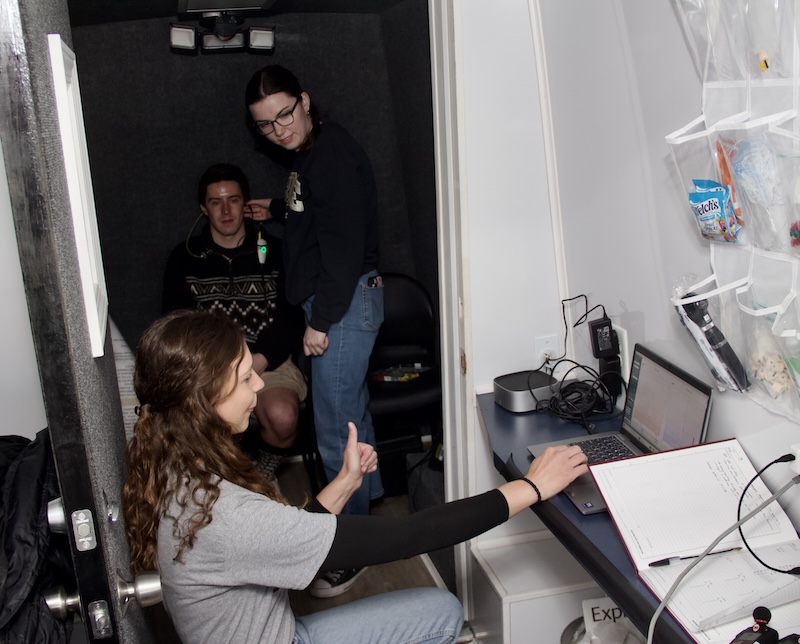
Huddleston gives a thumbs-up during a pregame hearing test while fellow audiology graduate student Annika Schenkel assists.(Tim Brouk)
Methodology
Huddleston and her team provided traditional hearing tests for the Purdue students or college-age participants where they click a button when they hear different tones and pitches. Most have experienced such tests when they were in elementary school.
Then, the researchers dug a little deeper. They measured the participants’ otoacoustic emissions — low-level, inaudible sounds produced by the cochlea’s outer hair cells in response to sound, acting as an objective measure of inner ear health. The Purdue audiology graduate students also completed acoustic reflex testing, which tests how loud a sound must be to trigger a reflex that stiffens the middle ear to let less sound in. They also mapped out subjects’ tympanometry with a quick test that measures the middle ear’s function, specifically how the eardrum moves in response to pressure changes.
The participants were then given small dosimeters, which they clipped on their shirt. Each device was labeled after the Purdue men’s basketball starting five — superstar point guard Braden Smith; big man Oscar Cluff; rebound king Trey Kaufman-Renn; small forward CJ Cox; and Loyer, who would deliver that dagger against Oregon.
Huddleston has compiled Purdue’s loudest moments of the season so far — emotional, hard-fought loses to Iowa State and Illinois had their loud moments as did triumphant plays in decisive victories.
Of course, not every seat in Mackey experiences the same noise, which is why Huddleston is studying students that sit in different areas from each other.
Let’s hear it for the band
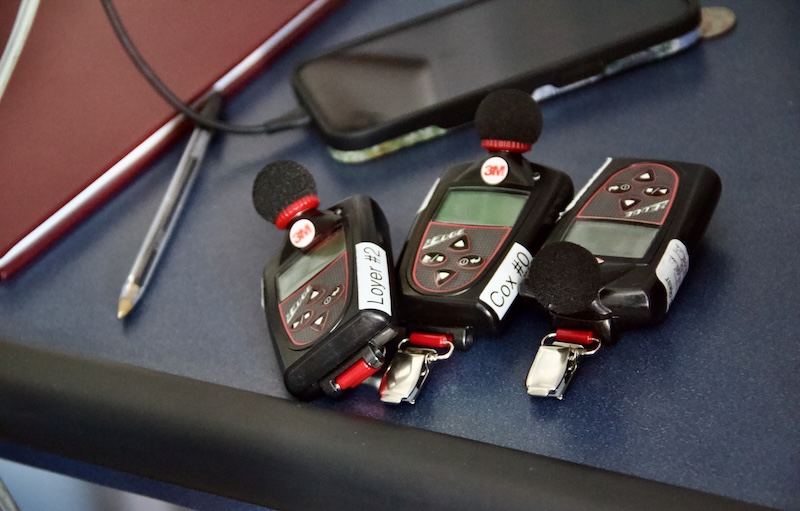
The dosimeters used in the study are “named” after the Purdue men’s basketball starting five including No. 2 Fletcher Loyer and No. 0 C.J. Cox.(Tim Brouk)
Trumpet players in Boiler Brass, Ethan Bowlby and Patton Duvall were interested in getting their hearing checked. They also wanted to know if their section was one of the loudest, especially when they are blasting gametime favorites like the trumpet-driven tunes “Narco” and “Tear It Up” and even the Twisted Sister classic “We’re Not Gonna Take It.” Bowlby explained the trumpets are the last row of the band, and they are right in front of the always-vocal Paint Crew student section.
“When Mackey is really rowdy, the crowd gets into our songs, and there’s a spike in noise,” said Bowlby, a senior studying audio engineering. “The student section is already pretty loud, so the spike from there to playing can be a lot. It’s really fun, and I really do enjoy it.
“I think it will be super interesting to hear the results because Mackey is one of the loudest environments in college basketball.”
Duvall concurred, “In the band, we have the best seats in the house, arguably. We’re right there at the basket, and we have the loudest cheering people in the student section behind us.”
Duvall grew up in a musical family in Columbia, Tennessee, attending bluegrass concerts as a young child, but it wasn’t until Bowlby mentioning the Purdue audiology study that Duvall thought much about hearing and protecting it.
“I didn’t grow up wearing hearing protection, and hearing can get pretty damaged if you’re around 90 to 100 decibels all the time,” said the sophomore majoring in genetics and jazz studies. “If you start people earlier on hearing protection, they’ll be more inclined to wear it when they’re older. It’s so important.”
From behind the bench
Matthew Wagoner, a student manager and junior in the Department of Health and Kinesiology, sits behind the bench of every men’s basketball game. When he’s not helping players’ needs during time-outs, he’s experiencing the crowd noise from a perspective most fans dream of.
“The way Mackey is built, the noise funnels down to the court. It’s certainly not quiet; I’ll put it that way,” Wagoner said with a laugh. “When it starts going, you can feel it through your feet. The chairs are shaking a little bit. It’s wonderful.”
Back in the van
The Feb. 7 game analysis did show slight threshold shifts in the post-game hearing tests from Huddleston’s quartet of participants. All of them said the Loyer shot felt like the loudest moment of the game, and they were as accurate as the beloved shooting guard from behind the 3-point line, according to the dosimeter data.
With Mackey home to many clutch, game-winning moments like Loyer’s memorable 3-pointer versus Oregon, the old arena can now be known as a gigantic audiology lab.
“It’s just an incredible opportunity for us,” Huddleston explained. “It gives a valuable, unique chance to capture the effects of this real-world noise exposure. Young adults experience many different types of noise exposure, and we hope to study those in the future. But Mackey offers a relatively controlled exposure time and type of noise. The dose each participant is exposed to, however, varies, which allows us to compare across doses. I find it interesting just how much the dose varies depending on where the participant sits, what game they attend and how rowdy they and the people around them are.”
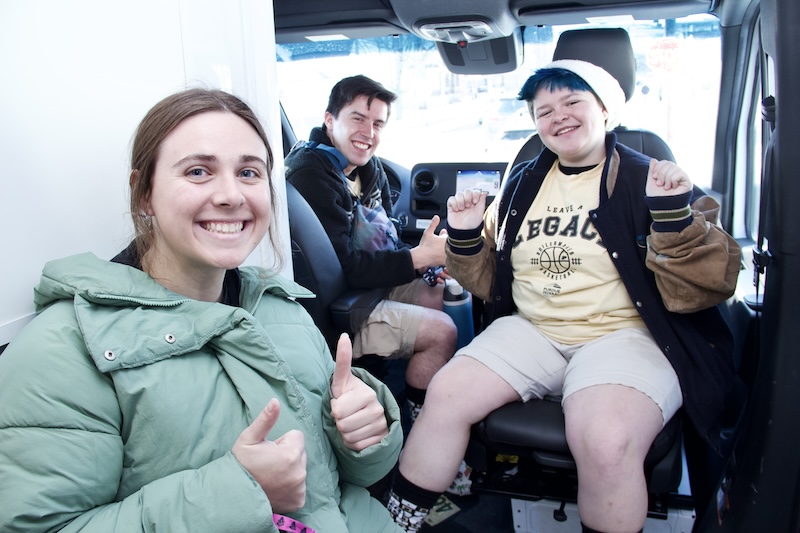
The participants, including pharmacy major Brooke Waddle, left, celebrate postgame hearing test completion and another Boilermaker basketball victory.(Tim Brouk)
Discover more from News | College of Health and Human Sciences
Subscribe to get the latest posts sent to your email.