From personal loss to scientific purpose, graduate student looks to slow multiple sclerosis progression through exercise psychology
Written By: Rebecca Hoffa, rhoffa@purdue.edu
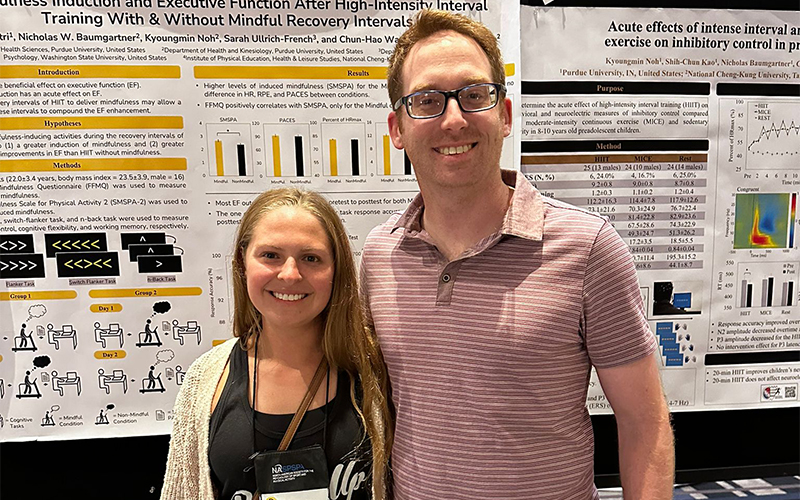
Jakob (left) poses for a photo with her advisor, Steve Amireault (right).(Photo provided)
Watching her grandmother struggle with progressive multiple sclerosis (MS) as she grew up, Purdue University Department of Health and Kinesiology PhD student Emily Jakob had one doctor’s statement stuck in her head: “If Barbara had just exercised, if she were just more active from her diagnosis onward, she would have progressed slower — her quality of life would have been better.”
This statement inspired her to pursue research investigating the interplay between physical activity, MS symptoms and self-efficacy, or the confidence of a person to participate in a task, such as exercise. In doing so, she hopes to contribute knowledge that could help slow disease progression, reduce symptom burden, and improve quality of life for MS patients.
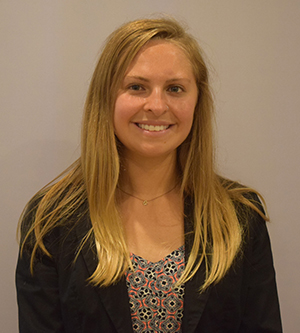
Emily Jakob(Photo provided)
“Although there were a lot of nuances to my grandmother’s experience and the experience of her caretakers, that one statement really stuck in my head,” Jakob said. “Psychologically there was a reason why she didn’t exercise, so combining my interest in psychology, public health and physical activity, that all kind of just led to my dissertation here at Purdue.”
While MS often varies in its appearance from person to person, depending on which nerves and systems the disease affects, patients typically experience fatigue, depression and pain. In preliminary findings, Jakob found in people with MS, having more of these symptoms weakens the influence of self‑efficacy on physical activity.
“What we’re looking at is how self-efficacy associates with physical activity for this population because it has been shown to be a consistent predictor of physical activity for people with MS and in general populations,” Jakob said. “We’re also looking at how symptoms, specifically fatigue, depression and pain, moderate the association between physical activity and task self-efficacy. We’re finding that the higher symptom cluster group does show a weaker association between task efficacy and physical activity.”
Jakob is conducting this research under the guidance of her advisor, Steve Amireault, associate professor of health and kinesiology, who has seen Jakob grow in her research skills since she began her graduate studies at Purdue in 2022.
“She actively participates in discussions — whether in the classroom, research seminars or lab meetings — and consistently contributes thoughtful questions and comments that reflect careful consideration of diverse perspectives,” Amireault said. “I’ve appreciated seeing her continue to develop her research ideas and participate actively in scholarly dialogue.”
Jakob noted as a neurodegenerative disorder, MS presents across a spectrum of varying levels of symptoms and mobility., her work is ultimately geared toward identifying conditions under which self-efficacy is a more effective target for interventions to increase physical activity among people with MS.
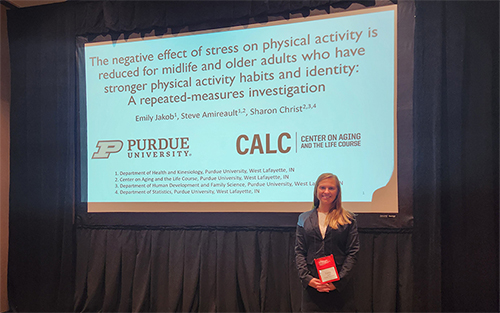
Jakob gives a presentation of her work.(Photo provided)
“There’s two main measurement tools that are used to assess where someone is in the disease course,” Jakob said. “One that we’re using for my research is called the Patient Determined Disease Step Scale. Basically, that’s a rating from zero — where there’s mostly normal function, maybe some symptoms experienced day-to-day, but there’s really not a lot of impact on activities of daily living — all the way to eight, which is fully bedridden. We’re looking at how the symptoms present together, not just in an additive sense, but in a multiplicative sense, having a synergistic effect on one another.”
For Jakob, Purdue’s College of Health and Human Sciences has offered the perfect home for her research, allowing her to dive deeper into her interests while carrying the reputation of a strong research-focused institution.
“When I was deciding on programs, Purdue came up as one that has an exercise psychology program, and I did a little bit more research into my advisor and his work in particular and found it very interesting,” Jakob said. “From the start, he was very responsive and communicative, and I’ve continued to appreciate his attention and commitment to helping me through every step of the dissertation process. Purdue just has a good name, too, in doing health research.”
Discover more from News | College of Health and Human Sciences
Subscribe to get the latest posts sent to your email.