$1M grant expands Purdue Psychological Sciences PANDABox program for helping families nationwide with rare infant developmental syndromes
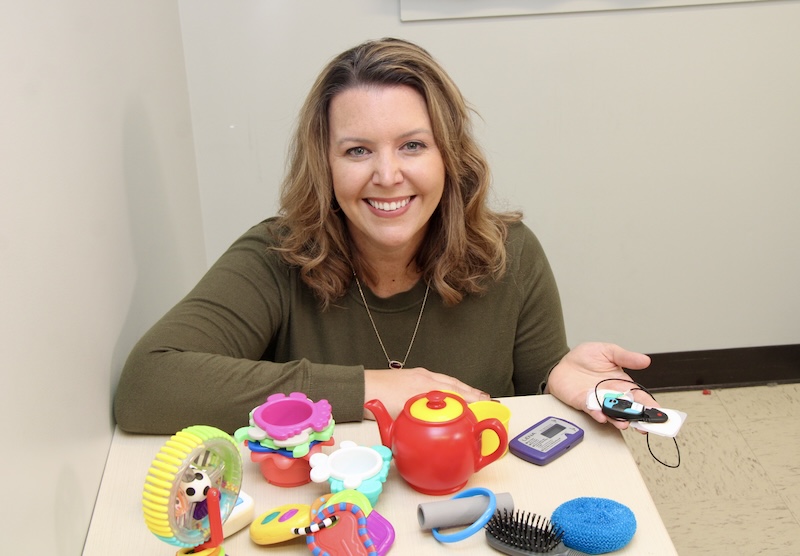
Bridgette Kelleher, an associate professor in the Purdue University Department of Psychological Sciences, displays some of the items in her Parent-Administered Neurodevelopmental Assessment Box (PANDABox) that infants and toddlers with rare syndromes utilize while an audio device records interactions. (Tim Brouk)
Written by: Tim Brouk, tbrouk@purdue.edu
A successful Purdue University-developed tool for assessing babies who may have autism spectrum disorder (ASD) and other developmental disabilities has been reignited and expanded thanks to a $1 million grant from the National Institutes of Health.
The Parent-Administered Neurodevelopmental Assessment, better known as PANDABox, was developed by Bridgette Kelleher, an associate professor in the Purdue Department of Psychological Sciences, several years ago. After a temporary shift to caregiver mental health research, the researcher is concentrating her newest work on infants and toddlers ages 6-18 months to help families recognize signs of rare developmental syndromes, such as Angelman, fragile X, Williams and Prader-Willi, while still assessing possibilities of ASD. The team’s focus is now on how to effectively measure children’s early developmental progress, in a way that can help inform early intervention.
This wave of research will gather data from more than 100 families nationwide while testing Kelleher’s assessment methods and tools within the PANDABox, which is sent to families for free. The new wave of PANDABox recipients will include Spanish speakers for the first time.
“For the babies in particular, we’re still lacking really precise information about how they’re developing and how they differ in that development,” Kelleher said. “How are they different both within and across these groups?
The combination of tasks for the baby is assisted by the caregiver during the session. They are designed to engage the child in ways that could assess the well-being of these young patients with rare syndromes. Like most such research, a primary goal is for early interventions.
“This project will let us really look with our own eyes through video, heart activity and these other things,” Kelleher said. “We’re just hoping to be able to add some more detail that can really help clinicians plan support programs and treatments.”
This telehealth work also helps families in rural areas where specialists for these syndromes are hundreds of miles away.
“For a baby to be able to get to a clinic and see an expert, it takes time to set that up,” Kelleher said. “And so, the telehealth work that we do is really perfect for these ages because traveling with babies is tough, even in the best of circumstances. And these parents are often dealing with other stressors that make travel difficult.”
Technological considerations
Each session with a PANDABox family offers a wealth of data, including heart tracking, vocal measurements, video analysis and ecological momentary assessments (smartphone-based “snapshot surveys” that ask what they are doing at the moment and how the child is behaving).
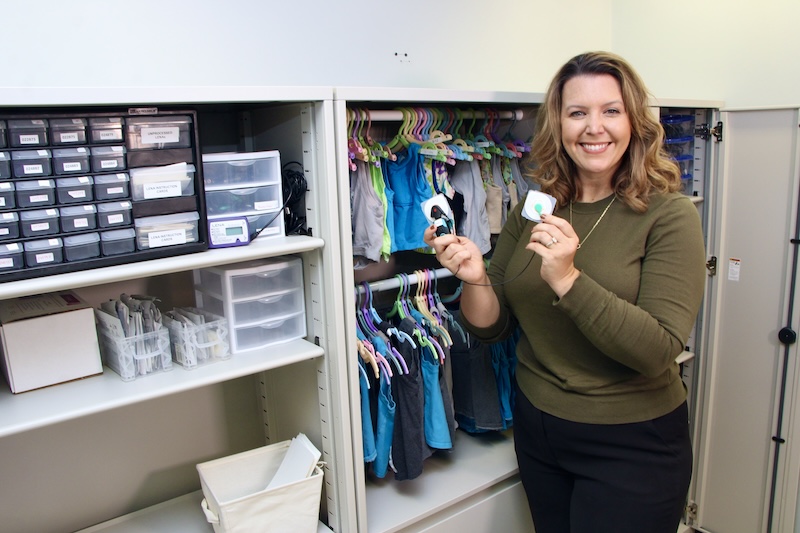
Kelleher stands in front of a cabinet of tiny vests that the infants and toddlers wear, which hold the audio recorders and protects heart monitors during the interactions. The data is then collected by Kelleher and her team.(Tim Brouk)
To pull all the information in, Kelleher was thoughtful in streamlining the technological aspects within each kit. Bulky, complicated equipment could be problematic in shipping, setup and being intrusive to the family’s regular day-to-day lives. The tech also had to be easy to use for the families since Kelleher can’t pop over to make sure everything is plugged in correctly. Plus, too much tech could be distracting to Kelleher’s tiny subjects. A random cord could distract the child and disrupt the session.
Each baby will wear a cotton vest with pockets in it to hold audio device, while heart rate monitors are affixed to the child’s chest using bandaid-like electrodes. Heart monitors are used to characterize the child’s heart rate-defined sustained attention, a measure of cognitive engagement that is particularly useful for a young child who can’t yet communicate verbally. The technique has been used for generations in understanding the cognitive engagement of a developing infant without being intrusive.
“When you’re interested in something, your heart rate decelerates. You can actually measure that deceleration,” Kelleher explained. “When a baby is in this decelerated state and you pop something up in their periphery, they’re less likely to look over because they’re kind of engaged in whatever they’re already doing.”
This simple way to get “under the hood” of an infant’s cognitive levels allows Kelleher to understand her young subjects’ experiences and interactions at home.
While teleconferencing meetings are once every six weeks or so, Kelleher will collect daily audio recordings fed into a LENA Technology System, a hardware and software suite. She will measure for what the child is hearing and what kind of vocal quality the child has communicating with a caregiver.
“It monitors everything that’s happening around the child for about 14 hours. So, we know: How often are they hearing an adult? How often are they hearing a TV? How often are they making noises?” Kelleher said. “We’ve developed some postprocessing tools that help us look at variables like the child’s pitch and the duration of the sounds they’re making.
Lastly, the video sessions are analyzed for where the child is looking throughout — another way to see how much the child is cognitively engaged.
‘What’s in the PANDABox?’
The large crate contains the same items for each family. The objects were curated with baby in mind: There are common toys such as a baby doll, plastic dinosaurs and a play teapot along with common household objects that seem to fasciate babies such as a hairbrush, a shiny jar lid and a texturized sponge for dishwashing. The household objects are meant to measure unique interests of children who may be on the ASD spectrum or demonstrate other unique sensory interests
“Sometimes kids who are on the autism spectrum or have unique sensory profiles may find these household objects to be more interesting than other types of toys,” she said.
These items are used to measure the baby’s motor skills and attention. A large pillow helps keep the young kid upright for the sessions. Age-appropriate children’s books are included for the parents to read to their children while Kelleher and her student researchers examine how families interact with each other.
The objects are also used to gauge negative reactions. How does the child react when the toy is taken away from them? How do they react when its given back to them?
“We look at frustration. How do their heart rates change? How do their behaviors change when they don’t get what they want,” Kelleher said. “It’s a very brief interruption but part of what we’re trying to do is not just observe how they exist at home, but also see how they respond when we manipulate their environment. Given PANDABox allows us to create a lab environment in the home, we are able to facilitate these ‘micro experiments’ to dive deeper into developmental changes.”
Ultimate outcomes
The data culled from these new PANDABoxes should give Kelleher a “topography” of the development of infants and toddlers with rare syndromes. This project could lead to better assessment methods of how the child is doing while offering families support while on clinical waitlists. The family can stay at home and be in a relaxed setting for the child.
“Those early years can be really kind of destabilizing for families. They’re dealing with a lot. So, we’re trying to understand how we individualize that path and that kind of decision tree,” Kelleher said. “My hope is that we’re not just collecting data from families, but we’re really building out information that can help them get better, more targeted or more individualized support. Not just for the child, but for the broader family system.”
Discover more from News | College of Health and Human Sciences
Subscribe to get the latest posts sent to your email.