Purdue Audiology rolls out mobile unit for hearing research, testing
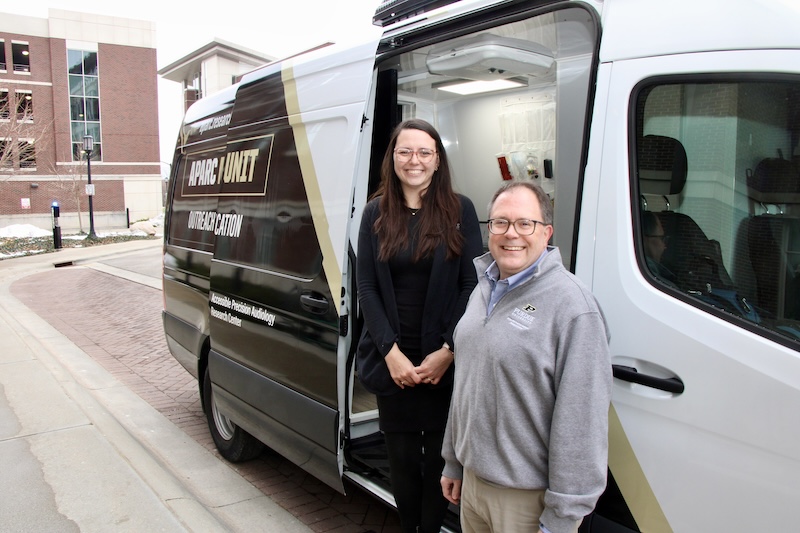
Alex Hustedt-Mai, left and research audiologist for the Purdue University Department of Speech, Language, and Hearing Sciences (SLHS), and Michael Heinz, head of SLHS, stand outside of the program’s new Accessible Precision Audiology Research Center (APARC) van, which serves populations that live far away from an audiologist. It can help obtain data in such crowded areas like outside of Purdue’s Mackey Arena.(Tim Brouk)
Written by: Tim Brouk, tbrouk@purdue.edu
The Purdue University Department of Speech, Language, and Hearing Sciences (SLHS) will now be able to take its audiology research and clinical tests to rural areas and other populations that live far from an audiologist.
The Accessible Precision Audiology Research Center (APARC) van was launched in the fall and has already logged a few hundred miles from visits to health fairs and even research outside of Mackey Arena. The new Mercedes-Benz Sprinter van was outfitted with a noise-attenuating sound booth and all the tools and technology required for full, comprehensive hearing evaluations for individuals ranging from kids to older adults. The APARC van is an extension of SLHS in West Lafayette as well as the APARC brick-and-mortar location in Indianapolis.
“We’re able to run everything we can run in our West Lafayette location and our Indianapolis location,” explained Alex Hustedt-Mai, SLHS research audiologist. “We’re able to run full audiograms with speech-in-noise testing as well as objective measures.”
“We’re trying to develop community-engaged research,” Heinz said. “Compared to here on the West Lafayette campus, we do a lot of testing, but it’s a very limited demographic sample. With APARC and the van, we are able to see a much broader range of people.”
The APARC van was recently able to park near Mackey Arena — a 20-minute walk from SLHS’ home base in Lyles-Porter Hall — to sign-up participants for a study on the historic basketball venue’s notorious noise levels. Led by APARC’s graduate student Isabella Huddleston, the ongoing study is measuring Boilermaker fans’ hearing before tipoff and after the often raucous games. Being able to post up in such a setting — a prime parking spot near one of the most cherished basketball venues in the country — opens many possibilities for the research program. Without the van, obtaining post-game measures so soon after the final whistle would be much more difficult.
Specs
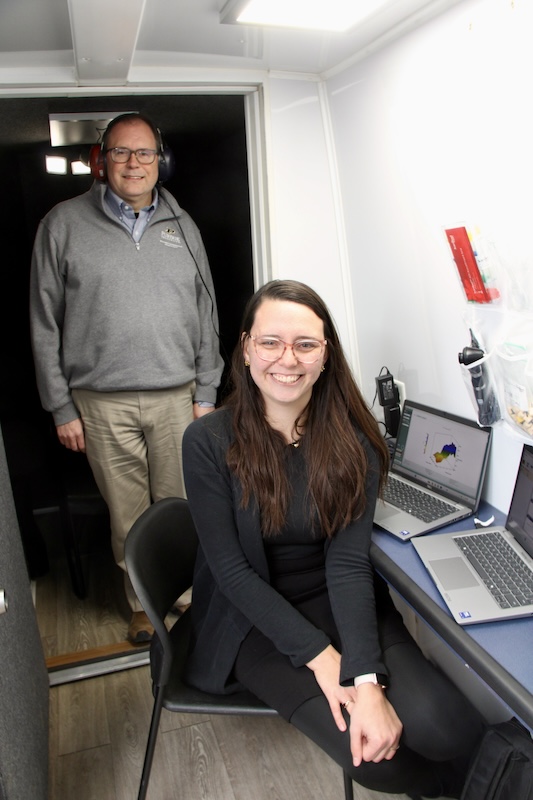
Inside the APARC van, a reseacher sits at a station in front of laptops displaying hearing test data while a patient sits in a soundproof booth during testing.(Tim Brouk)
Along with the soundproof booth, the APARC van is loaded with laptop computers and diagnostic equipment found in most clinical hearing settings — from otoscopes to traditional lab supplies. The sound booth, while intimate, is big enough to fit two people, and it is wheelchair accessible.
“We are flipping the audiology model on its head — instead of people coming to the clinic to get tested, we are bringing the clinic to them,” Heinz said.
Rural roots
Heinz, Hustedt-Mai and their team of students expect to log thousands of miles on the APARC van in 2026. The van was purchased to bring Purdue’s audiology program — ranked No. 5 in the nation, according to U.S. News & World Report — to rural populations all over Indiana. Some of those assignments will be with Purdue Extension Health and Human Sciences.
The rural visits can be part of a health fair or even an event where rural equipment is being used. Farm workers, for example, are often around tractors, combines and grain augers that can emit noise to more than 100 decibels. Prolonged exposure to noises louder than 85 decibels can lead to permanent hearing loss.
“We’re going to a pesticide training session where we will be doing five-minute hearing screenings for farmers and their families,” Heinz noted.
The van can also visit urban neighborhoods in Indianapolis that are far away from an audiology clinic. Rural or urban, the van will give students experience with populations that often don’t walk into Lyles-Porter Hall labs and clinics.
Hustedt-Mai has been on a few APARC van trips so far, and she believes the van is a natural extension of her program’s mission to provide top-notch hearing assessments for Indiana populations in need.
“You get to interact with a wider variety of people from different communities,” Hustedt-Mai said. “It’s really expanded the amount of people we get to work with and help.”
Discover more from News | College of Health and Human Sciences
Subscribe to get the latest posts sent to your email.