Talking back: Purdue researchers explore new implicit learning methodology in aphasia therapy
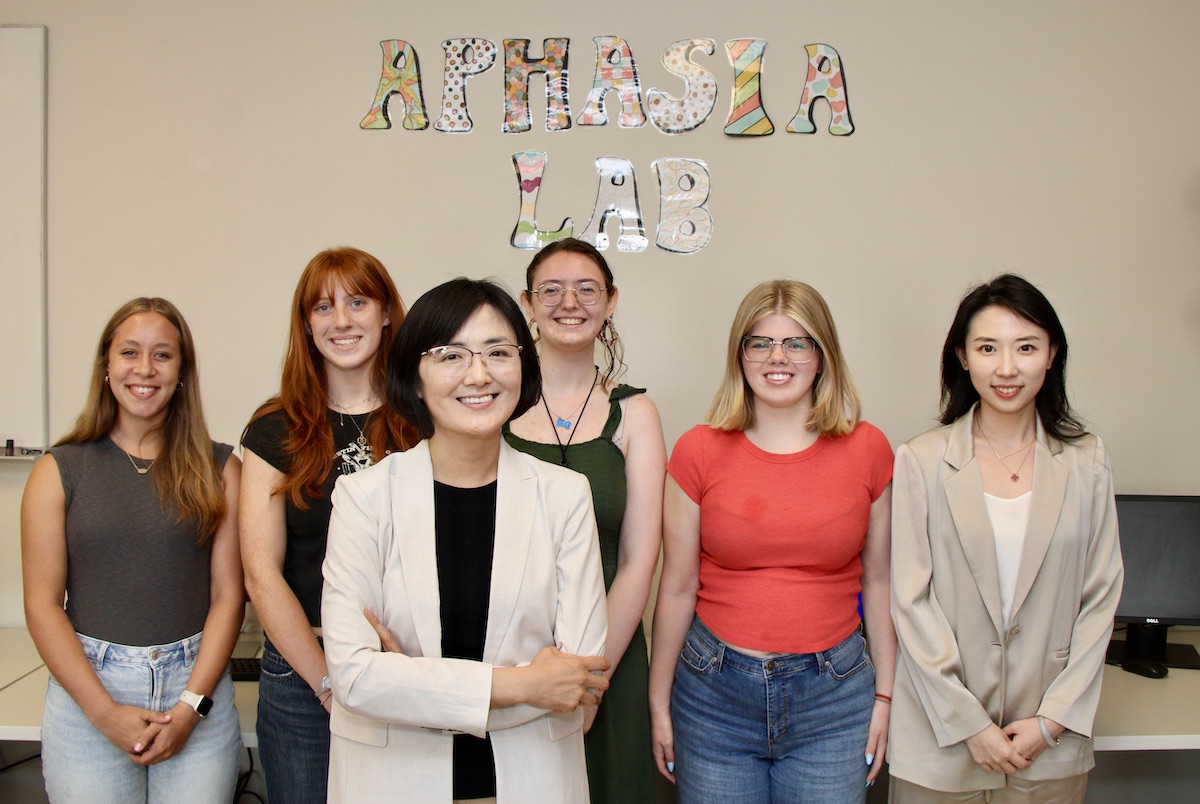
Jiyeon Lee, foreground and associate professor in the Purdue University Department of Speech, Language, and Hearing Sciences, has dedicated years of research in helping aphasia patients get their voices back. Lee is assisted by several student researchers.(Tim Brouk)
Written by: Tim Brouk, tbrouk@purdue.edu
Aphasia affects the speech, language processing and reading skills of about 2 million people in the United States, according to the American Stroke Association. The communication disorder occurs most often after a stroke and sometimes a head injury.
However, many people with aphasia can make significant gains with implicit learning during speech and reading therapies.
Improvements to aphasia recovery methodologies are being explored in Purdue University associate professor Jiyeon Lee’s Aphasia Recovery Lab. Lee, a researcher in the Department of Speech, Language, and Hearing Sciences (SLHS), collaborated with her PhD student Peng Zhang on the new study, “Improving Content Informativeness in Aphasia.” The work is part of Lee’s ongoing National Institutes of Health-funded project exploring aphasia patients’ speech patterns and word selections.
“(Aphasia patients) lose ability to use language to communicate their ideas in the way that they want to communicate,” Lee explained. “In most cases, it doesn’t affect their thinking ability or who they are personality-wise. So, it’s not some kind of psychiatric disorder or thinking disorder. It’s more about ability to use language efficiently.”
Preparing for publication, the study saw Zhang engage with 42 adults across the United States over Zoom for three two-hour sessions each. The first session was intake and assessment. The next sessions were one-on-one with participants reading sentences. Participants ranged in age from 33-82. Of the 42 recruited for the study, 20 were “controls” and 22 were diagnosed with aphasia of varying severities. Zhang met with each participant over a span of three months, noting improvements along the way.
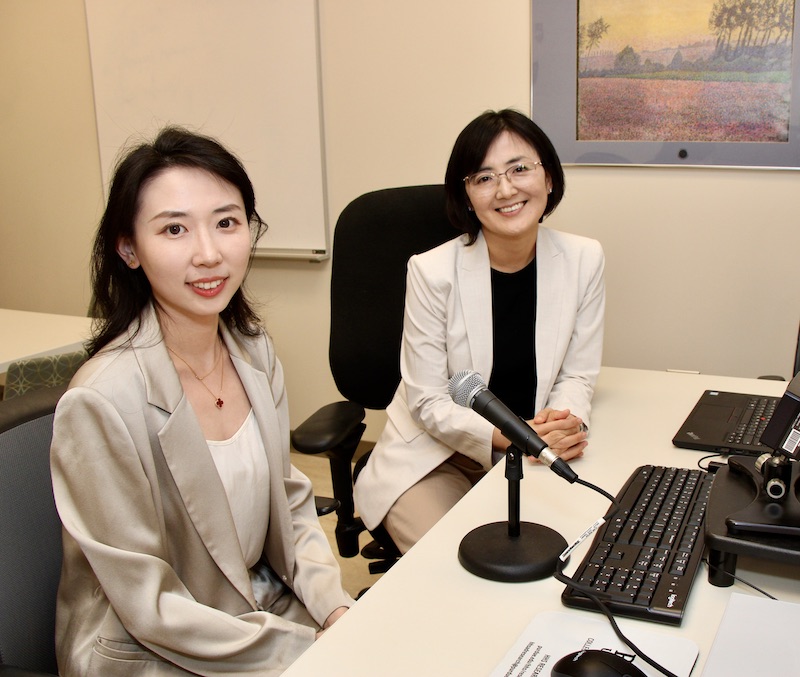
PhD student Peng Zhang, left, and Lee explored implicit learning methods by priming research project participants with aphasia with challenging exercises in reading and communicating sentences heavy with adjuncts. The participants showed marked improvement later in Zoom sessions.(Tim Brouk)
Zhang made sure to pay attention to adjunct phrases — elements in speech that speakers use to describe when, where and how events happened — during the sessions.
In session
One common difficulty for aphasia patients is “finding words,” according to Lee. They see the pen; they know the object is a pen, but they can’t verbalize what the writing utensil is called. It’s like a “tip of the tongue” moment that never comes. Another problem for aphasia patients is relearning to string together sentences. One-word responses may come, but putting together long sentences with adjuncts is difficult.
Lee said few aphasia therapies tackle sentence difficulty. While patients recovering from a stroke can “get by” with one-word utterances, Lee found aphasia patients feel frustration at not being able to converse like they used to. This current work aims to get them back into the conversation and eliminate feeling socially isolated.
During the sessions, Zhang would use illustrations that went with adjunct-laden sentences for participants to read. These sentences might be beyond their abilities at that moment, but it’s all part of Lee’s implicit learning approach. The sessions “prime” patients with aphasia for later success.
“We have found over the years that implicit learning is effective for changing their grammatical knowledge to the point that they can use it independently,” Lee said. “After being exposed to those sentence structures implicitly, they kind of pick up those language rules and then they can apply those rules to their own speech.”
During sessions, Zhang led participants through exercises and experiments on an online data collection platform called Gorilla. The participants would see pictures and sentences in front of them simultaneously. The software also measured eye-tracking, which informs aphasia patients’ attention to the sentence when speech fails them.
“You can still look into what’s going on in their mind using their eye movements,” Lee stated.
Zhang found her participants with aphasia showing improvement during their last Zoom sessions. They were using adjuncts in spontaneous speech.
“It was pretty noticeable, which was beyond my imagination in the beginning because two sessions are pretty short. I didn’t predict that they would have really incredible improvement in terms of the adjuncts,” Zhang recalled. “They were not knowing they were doing this for adjunct phrases. We were just doing it implicitly, and they were exposed to it. So, I think the real learning ability from the people with aphasia is actually beyond my expectation, which is also encouraging because we have a lot of room to provide more trainings with different kinds of content elements in the future.”
Undergrad researchers in the mix
Zhang quantified her successful sessions by counting the number of adjuncts as well as the density of adjuncts — essentially the complexity of their sentences. The number of adjuncts was divided by the number of utterances — usually in the form of singular words. By session three, most participants with aphasia were producing more utterances and quality adjuncts.
The researchers spent many hours crunching the data from all 42 sessions and transcribing every utterance. Several SLHS undergraduates in Lee’s lab coded every adjunct from the video sessions and some sat in on the Zoom sessions.
“It was just really cool to be able to see the joy that they had when they were improving,” said sophomore Abby Bolton. “I kept telling them, ‘You’re doing a great job.’”
Senior Leah Cave said the severity of the participants’ aphasia varied. Some just had trouble “finding the word” on a few occasions while others would get most of the words wrong or they would mistakenly reorder the sentence structure.
“But then over time, like by the end of their sessions, they would be much closer, if not generally across the board correct. And you could see that,” Cave added. “I could also see it in their face; they were happier speaking. … I could see they were feeling more confident.”
What’s next
As Zhang and Lee submit the study for publication, the researchers concluded their learning model will help patients with aphasia improve their ability to use grammatical and meaningful speech, beyond single words, in their recovery. The patient must tackle the language and not get discouraged, even if the utterances are short and incorrect at first.
“Research shows that recovery is still continuous. So, practice is really the key,” Lee said. “They may start with simple words, but then eventually, we’re talking connected speech. So, we want to make the materials that they are practicing on become more personalized and more complex so that it really reflects what’s going on in actual life.”
Lee has teamed with her other PhD student, Sally Min, for another series of virtual meetings — support group sessions for aphasia patients and caregivers who speak Korean. Lee said aphasia treatments and resources are difficult to find for non-English speakers. With Lee and Min being Korean/English bilingual speakers, they hope to give Korean families with aphasia patients an outlet to understand the condition and work to improve their speech in a supportive community context. They initially planned to provide the group meetings to Korean patients who reside in the United States, but the virtual meetings removed geographic boundaries.
“We have patients from Canada, Australia, Korea and, of course, the States joining the meetings,” Lee said. “We want to build a community of support for these patients, families and Korean/English bilingual clinicians.”
Discover more from News | College of Health and Human Sciences
Subscribe to get the latest posts sent to your email.