Purdue nutrition science graduate student links environment and diet with colorectal cancer risk in susceptible communities
Written By: Rebecca Hoffa, rhoffa@purdue.edu
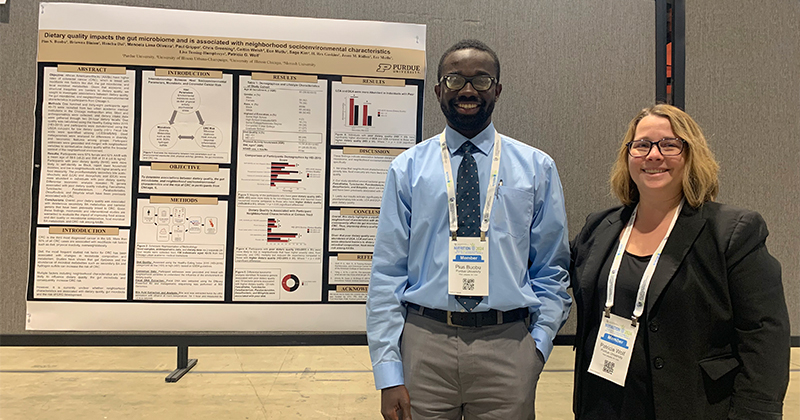
Pius Sarfo Buobu (left) stands with his mentor, Patricia Wolf (right), at the Black in Cancer Conference in Bethesda, Maryland.(Photo provided)
Protein, fiber and vitamins — there is a lot to consider when building a balanced diet. When factors such as socioeconomic status and access to nutritious foods come into play, diet choices become even more complicated.
In his work understanding diet and colorectal cancer risk, Pius Sarfo Buobu, a PhD student in the Purdue University Department of Nutrition Science, hopes to understand the role socioenvironmental factors and psychosocial vulnerabilities play in the development of colorectal cancer.
“The reason why I chose this topic is that chronic stress and poor diet quality are potential contributors to the development of colorectal cancer, yet the mechanisms linking these factors to the gut microbiome are not fully elucidated. Also, we have abundant research that indicates African Americans are disproportionately exposed to structural barriers which encompasses the social, economic and political systems that tend to systematically marginalize certain populations,” Buobu said. “These structures may contribute to chronic stress. Through increased exposure to poverty, neighborhood violence, limited access to nutritious foods and lower quality of care, all of these factors may increase people’s stress levels. Such stressors can activate maladaptive neuroendocrine or systemic responses or inflammation pathways, which are all implicated in cancer development.”
Buobu has recently taken his research to the Chicago metropolitan area for his dissertation work, where preliminary findings have pointed to the interaction of diet quality within disadvantaged neighborhood contexts and the gut microbiome pathways that may be linked to colorectal cancer.
“Our research group previously found that urban African American and Black individuals harbor higher levels of bacteria capable of utilizing sulfur-containing amino acids — taurine and cysteine — in the colon compared to non-Hispanic white individuals, with race being the strongest predictor,” Buobu said. “Also, we have recently discovered in our ongoing analysis that participants with elevated hair cortisol levels, which is a marker of stress, were more likely to self-identify as African American or Black, live in neighborhoods that were food insecure, have higher colorectal cancer mortality rates, and have higher rates of poverty and homicide in addition to significant variations in microbial taxonomy and more abundant primary and taurine-conjugated bile acids than the low hair cortisol group. This suggests a potential link between structural violence, psychosocial stress and microbial metabolism of bile acid.
“Given that diet is one of the key modulators of the gut microbiome, our ongoing clinical trial seeks to investigate whether we can use the Mediterranean diet in ways that can potentially modulate the gut microbiome to attenuate psychosocial stressors and associated markers that may be driving colorectal cancer risk among vulnerable populations, particularly African Americans.”
In looking at the “built environment,” such as the infrastructure of grocery stores and neighborhood poverty and safety, Buobu hopes his work will inform a systems-level approach toward cancer disparities.
“Studies have demonstrated that diet-related behaviors account for about 25% of the global cancer burden, which is very significant,” Buobu said. “Research has also shown that people who live in disadvantaged neighborhoods have about 22% higher cancer mortality. This got me interested in doing such research because the end goal is that we may be able to produce findings that can drive some sort of policy changes, because these are things we can change. They’re not molecular or genetic factors that we cannot do anything about. These are modifiable.”
Under the mentorship of Patricia Wolf, assistant professor of nutrition science in the College of Health and Human Sciences, Buobu has been involved in a variety of community-based projects in order to tailor the research outcomes to actionable solutions.
“Pius is a pleasure to mentor and continuously demonstrates an unwavering desire to conquer tough challenges,” Wolf said. “He entered our lab with a strong clinical background but has since developed bench and bioinformatic skills to allow him to conduct microbiome research. He currently manages four projects investigating socioenvironmental contributors to colorectal cancer disparities. Recently, he helped develop an independent hypothesis to examine the utility of a Mediterranean dietary intervention to improve bile acid composition in Black women experiencing psychosocial stress, which was funded by the Women’s Global Health Institute. Pius is clearly on a trajectory toward leading independent studies that will hopefully improve outcomes in communities disproportionately impacted by cancer.”
For Buobu, the Department of Nutrition Science offers the perfect home for his work because of its support, in mentorship, opportunities for collaboration and funding.
“It’s one of the most prestigious programs in the country and globally,” Buobu said. “Having seen several of the professors sit on the committee that puts together the Dietary Guidelines for Americans, that means you have wonderful professors who are authorities in their field, which opens a lot of doors and opportunities.”
Buobu will be presenting his work at the American Association for Cancer Research Conference on the Science of Cancer Health Disparities in September in Baltimore, Maryland, courtesy of a travel grant he received at Purdue’s fourth annual Health Equity Summit.
“It is exciting because I look forward to representing my lab and presenting my work,” Buobu said. “I’m excited to engage with like-minded researchers who will be giving me feedback on my work that I can use to improve and make connections.”
As Buobu enters the third year of his PhD program and begins work on his dissertation, he noted he has seen his research develop significantly as he has moved through the program.
“I remember Dr. Wolf telling me that growth in academia seems not to be linear, and in most instances, it is slow,” Buobu said. “I have seen that personally in my own growth trajectory. But I joined the lab with limited bench work experience or lab experience. Since I joined the lab, I’ve been able to learn techniques and skills that are important in progressing my research.”
Discover more from News | College of Health and Human Sciences
Subscribe to get the latest posts sent to your email.